The 2024 amendments to the Housing Law significantly expanded foreign ownership rights. Here's what you can now buy, for how long, and the restrictions that remain.
In this article6
The Law on Housing 2023 (No. 27/2023/QH15) is a new law that replaced the 2014 Housing Law, and Law 43/2024/QH15 brought its start date forward to 1 August 2024. The core foreign ownership rules, including the 30% apartment cap, the 250-house cap and the 50-year term, were carried over from the 2014 law.
What Foreigners Can Buy
Foreign individuals and organisations may purchase apartments in residential projects (condominiums) and detached houses in approved residential projects. The key restrictions: foreign buyers combined can own no more than 30% of the apartments in one apartment building (30% of each block where blocks share a podium), and no more than 250 detached houses in an area with a population equivalent to one ward, which Decree 95/2024/ND-CP sets at 10,000 people regardless of administrative level.
Ownership Duration
A foreign individual can own a home for up to 50 years from the date the Certificate is issued, and the term can be extended only once, for no more than 50 years. Vietnamese nationals hold land use rights for much longer periods. This asymmetry remains the most significant practical difference between foreign and domestic ownership. A foreign organisation's term cannot exceed the term of its investment certificate, and a foreigner married to a Vietnamese citizen living in Vietnam owns on the same terms as a citizen.
The Buying Process
Using a real estate trading floor is encouraged but not compulsory. Where the seller is a real estate business such as a developer, the Sale and Purchase Agreement is notarised only if the parties ask, while a sale between individuals must be notarised or certified. Payment must go through a credit institution or foreign bank branch operating in Vietnam, not in cash.
Using Your Home as Collateral
Foreign owners have the same rights as Vietnamese citizens to sell, give, mortgage and bequeath their homes, within the foreign ownership rules, so a foreign-owned apartment can be used as collateral for a bank loan in Vietnam. This is not a 2024 change: foreign owners already had the right to mortgage under the 2014 Housing Law, and the 2023 law carried it over.
What's Changed in 2025 and 2026
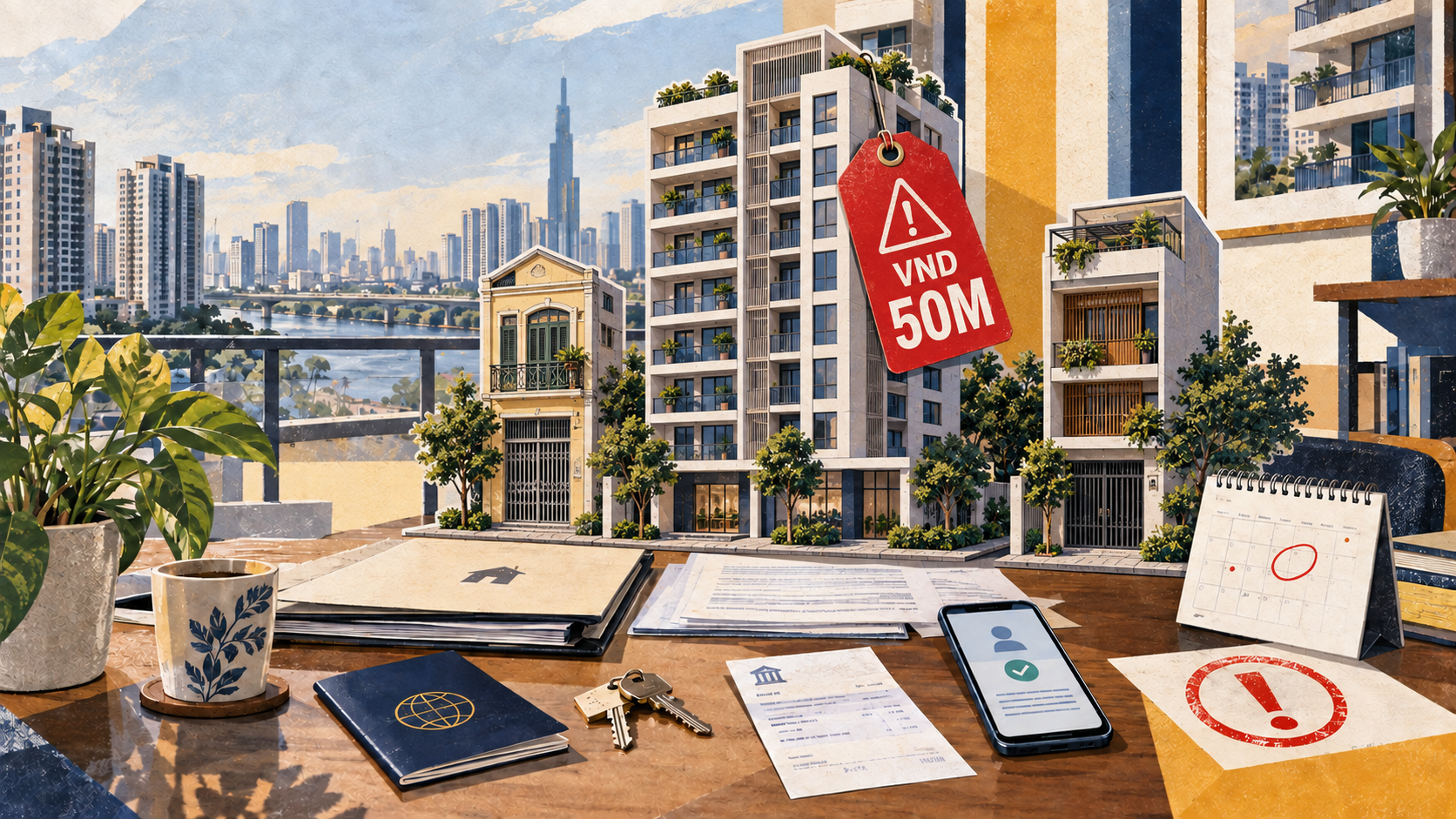
Decree 339/2026/ND-CP, in force since 26 August 2026, sets fines for foreign individual owners. Failing to notify the commune-level housing authority in writing before leasing a home, or when the lease ends, carries a fine of VND 20 million to 30 million, and paying for a home outside bank channels carries a fine of VND 30 million to 50 million. See our guide to Decree 339 housing fines.
Following the 2025 local government restructuring, the leasing notice now goes to the commune-level housing authority.
Decree 54/2026/ND-CP, in force since 9 February 2026, amended Decree 95/2024/ND-CP, including its rules on national defence areas where foreigners cannot own homes.
Frequently asked questions


Easytiger Match
Find the right professional
- Tell us what you need
- We shortlist professional(s) and introduce them to you