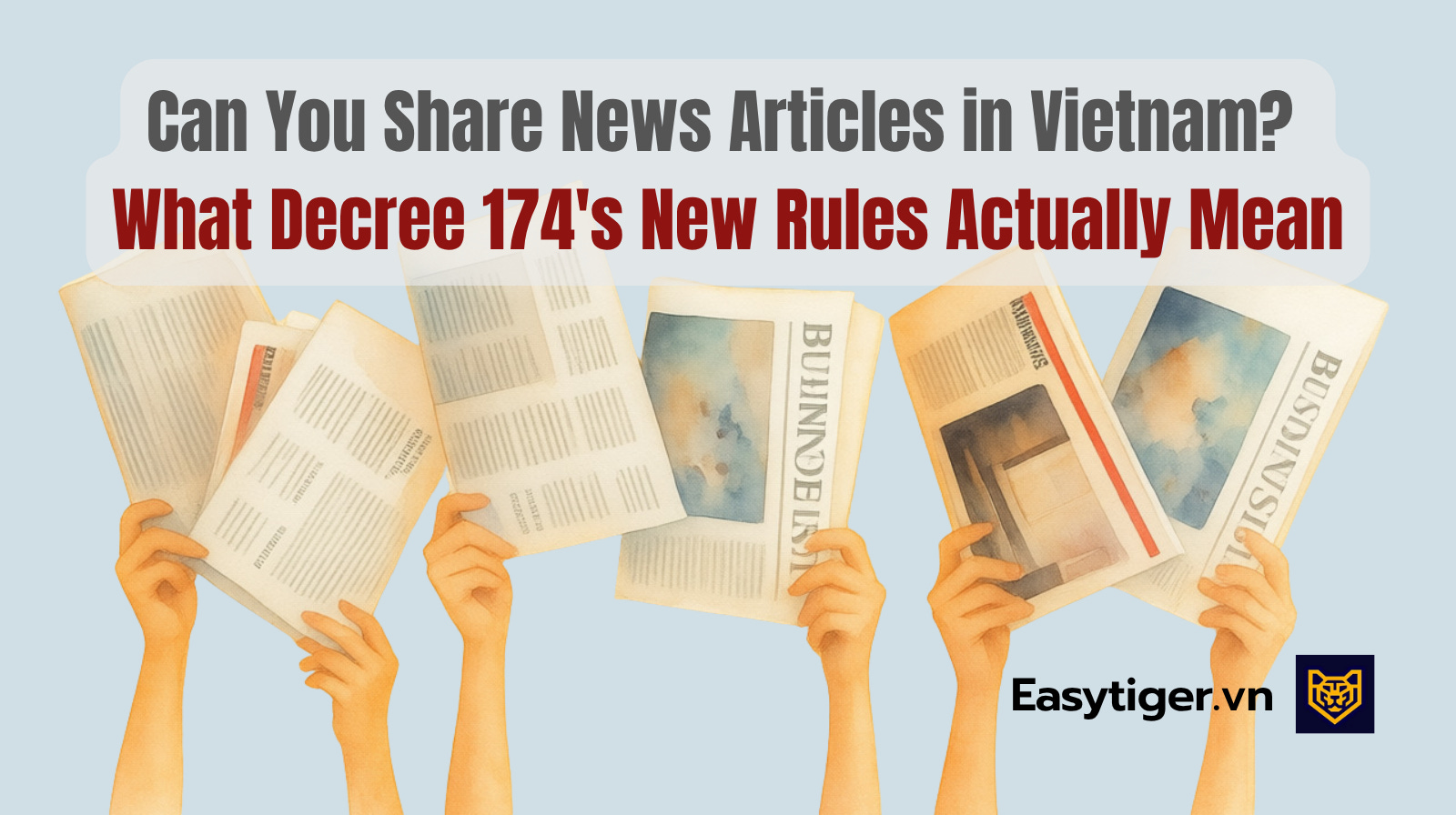
Vietnam's Decree 174/2026/NĐ-CP introduces fines of up to VND 30 million for unauthorized sharing of press works on social media. Here is what the law actually targets, and what you can do freely. (This article was originally published on 26 June 2026 on our Substack)
In this article9
Vietnam’s government issued Decree 174/2026/NĐ-CP on May 15, 2026, and it came into full effect on July 1, 2026. The decree is a broad administrative penalty framework that covers telecommunications, electronic transactions, and information technology. Most of it is technical and affects industry operators. But Article 95, the section dealing with social media responsibilities, has touched something far more personal: the way ordinary people, businesses, and content creators share information online.
The Decree and the Context Behind It
The backdrop is a problem that has been building for years. Numerous social media pages are effectively feeding on journalism content, writing sensationalized headlines and generating significant advertising revenue from republishing articles, while the journalists who produced that work bear the professional risks and costs. This phenomenon, known in Vietnamese as “báo hóa mạng xã hội” or the “press-ification” of social media, has been a persistent regulatory headache. The trend of social media channels behaving like news outlets has declined on aggregator websites but is now appearing in new forms through Fanpages, TikTok channels, and YouTube accounts with large followings.
What Does the Law Actually Prohibit?
Article 95 of Decree 174 covers a broad range of social media violations, not just content sharing. The VND 20 to 30 million fine tier applies to several types of conduct, including spreading false information, sharing content that promotes social vices, posting obscene or violent material, advertising prohibited goods, and sharing maps of Vietnam that misrepresent national sovereignty. These amounts are the fines for organizations; under Article 4 of the decree, an individual who commits the same violation is fined half, so VND 10 to 15 million.
The provision relevant to content creators and businesses is clause 1(d), which covers the unauthorized provision or sharing on social media of press works, literary works, artistic works, or publications, in any of the following situations:
- Without the consent of the intellectual property rights holder
- When the work has not yet been authorized for circulation
- When the work is subject to an existing circulation ban or confiscation order
It also explicitly prohibits using social media to produce content in the form of press reportage, investigations, or press interviews, such as investigation-style videos or mock press interviews.
Beyond the financial penalty, anyone found in violation can also be ordered to remove the content immediately. And for the more serious violations in the higher fine tier, entire accounts, community pages, groups, or content channels can be ordered locked.
The Admin Problem: Responsibility Goes Beyond the Person Who Posted
Here is where things get genuinely uncomfortable for anyone who manages a social media community in Vietnam.
The decree does not only penalize the person who uploaded the infringing content. It explicitly makes account owners, community page owners, content channel operators, and group administrators responsible for what happens on their platforms. Specifically, if a competent authority flags content in your group or on your page and orders you to remove it, your failure to act is itself a violation, carrying the same VND 20 to 30 million penalty range.
Think about what that means in practice. You run a business networking group on Facebook with three thousand members. Someone posts a full-length news article inside the group. A government body identifies it as infringing and sends a removal request. At that point, the legal obligation to remove it is yours, whatever liability the member faces for posting it. You cannot step back and say you were not aware, or that the group is too large to monitor. The responsibility is formal, written into the regulation, and it sits with whoever holds the admin role.
For expat business owners, marketers managing company pages, or anyone running any kind of community group in Vietnam, this is the provision that deserves the most attention.
So What Exactly Is a Press Work?
Before you can know whether what you are sharing puts you at risk, you need to understand what Vietnamese law means by a “press work”. Under the Press Law 2025, which took effect on the same date as Decree 174, a press work is defined as the smallest independent unit within a press product: a complete, self-contained piece of content expressed through written text, audio, or images.
In plain terms, a finished news article is a press work. So is a broadcast news segment, a produced news video, a photojournalism essay, and an investigative report. These are original creative outputs that belong to the media organization that produced them, and they are protected under Vietnam’s intellectual property law.
What does not fall inside this definition is just as important. The underlying news facts, the bare information that an event happened, that a policy was passed, that a company was fined, are not owned by anyone. You cannot copyright a fact. What is protected is the specific creative expression that sits around that fact: the writing, the editorial decisions, the structure, the production. This is the same logic that underpins copyright law in most countries, and it is the line that separates a news fact from a press work under Vietnamese law.
The Line Between “Sharing a Link” and “Copying Content”
This is where the confusion started, and where the government itself has had to step in and clarify.
The Director of the Authority of Broadcasting and Electronic Information made a public statement confirming what legal experts had already argued: simply sharing the URL link of a news article on social media is not a copyright violation. A link is a pointer. It sends the reader to the original publication. It is not the work itself, and sharing it does not reproduce the work.
Legal experts and lawyers consulted on the issue agree that Decree 174 is a tool for handling the unauthorized posting and exploitation of press works in the online environment, not a prohibition on the public sharing of credible information.
The distinction, in practical terms:
Not a violation:
- Posting the URL of an article on your Facebook timeline, in a group, or via Zalo
- Sharing using the official share button of a news platform
- Summarizing or commenting on publicly available news facts in your own words, without reproducing the creative expression of the original article
- Quoting a brief excerpt from an article for commentary, with the author and source named and without distorting the author’s meaning, within the reasonable-quotation exception of the Law on Intellectual Property
Potentially a violation:
- Copying and pasting partial or the full text of a news article into your own post or page
- Sharing a URL together with a substantial portion of the article’s content without permission
- Reposting videos or broadcast segments from a media outlet without authorization
- Running a Fanpage or social media channel that systematically republishes journalism content to attract advertising revenue
- Creating a website or aggregator that mirrors news content without a licensing agreement
- Producing video or audio content that reads aloud or recreates a news article verbatim without permission
- Sharing or linking to content that has been officially banned from circulation
- Reworking (”xào nấu”) journalism content by taking the core ideas, structure, or exclusive details from an article and rewriting them in different words without authorization. This is especially true when the original contains exclusive interviews, expert analysis, or other distinctive journalistic work that reflects the journalist’s original effort. Regulators have clarified that reworking general, publicly available news facts may be less problematic, but reworking content built on exclusive reporting is considered a copyright violation.
Lawyers have emphasized that what the law is targeting is the exploitation of journalism products to profit from others’ labor and investment costs. It should not be read to mean that a person who simply presses the share button on a news article is at risk of a fine.
The Higher Fine Bracket: When It Gets More Serious
Article 95 carries a second penalty tier that goes above the press work provisions, reaching from VND 30 million to VND 50 million for organizations (VND 15 to 25 million for individuals). This tier applies to behaviors of a different gravity:
- Sharing content that distorts Vietnamese history or denies national revolutionary achievements
- Revealing state secrets or private personal information without authorization
- Spreading false information that causes genuine public panic, economic damage, or disruption to the functioning of government institutions
These are behaviors that sit just below the threshold of criminal liability, which is why the fines are heavier. For expats and foreign businesses, this tier is less likely to arise in everyday social media activity, but it is worth keeping in the back of your mind. Content that touches on sensitive political, historical, or national security topics carries a meaningfully different risk level in Vietnam than in many other countries. If you are ever unsure whether something falls into this territory, the safest decision is simply not to share it.
What This Means If You Run a Business or Content Channel in Vietnam
For expats and foreign businesses with any kind of social media presence in Vietnam, the practical takeaways are straightforward.
If your company Fanpage reposts full news articles about your industry to keep followers informed, that practice carries legal risk now that the decree is in force. Linking to the original article, or writing a brief summary in your own words with a link, is the safer and legally sound approach.
If you run a content channel, a community group, or a TikTok account that regularly features news content, you are now formally responsible for what gets published. The decree explicitly extends liability to group administrators and page owners who fail to remove flagged content when instructed.
If your business model involves aggregating or redistributing news content in any form, you need to review those arrangements against the new framework, ideally with legal counsel.
For individual users, the everyday behavior of sharing article links, commenting on news, or forwarding articles via messaging apps remains entirely unaffected. The regulation is not designed to chill ordinary information sharing among people online.
The Bigger Shift: Intellectual Property Is Being Taken Seriously
Decree 174 did not arrive alone. It came alongside the Press Law 2025, which introduced explicit provisions requiring any organization or individual using press works from a Vietnamese media outlet to have an agreement with that outlet in line with intellectual property law. The two documents are designed to work together: one establishes the rights, the other enforces them.
This pairing signals something worth paying attention to for anyone running a business with a digital presence in Vietnam. The government is not simply adding rules for the sake of it. It is building an intellectual property enforcement framework that has real teeth, and it is doing so at a moment when the media industry is actively pushing for it. Journalism in Vietnam, like journalism everywhere, is under economic pressure from platforms and channels that distribute its output without contributing to its production. These regulations are the formal response to that pressure.
The message from Decree 174 is not that sharing information is dangerous. It is that taking someone else’s work and profiting from it without permission now has a price tag attached.
For guidance tailored to your specific situation, find a verified specialist at Easytiger.vn.
This article is for informational purposes only and does not constitute legal advice. Vietnam's regulatory environment moves quickly, and the details around Decree 174/2026/NĐ-CP and the Press Law 2025 may be updated or further clarified by authorities after publication. All information here is based on sources available as of June 2026. If you run a content channel, manage a social media community, or operate a business with a digital presence in Vietnam and need guidance specific to your situation, consult a qualified legal professional.
Frequently asked questions


Easytiger Match
Find the right professional
- Tell us what you need
- We shortlist professional(s) and introduce them to you