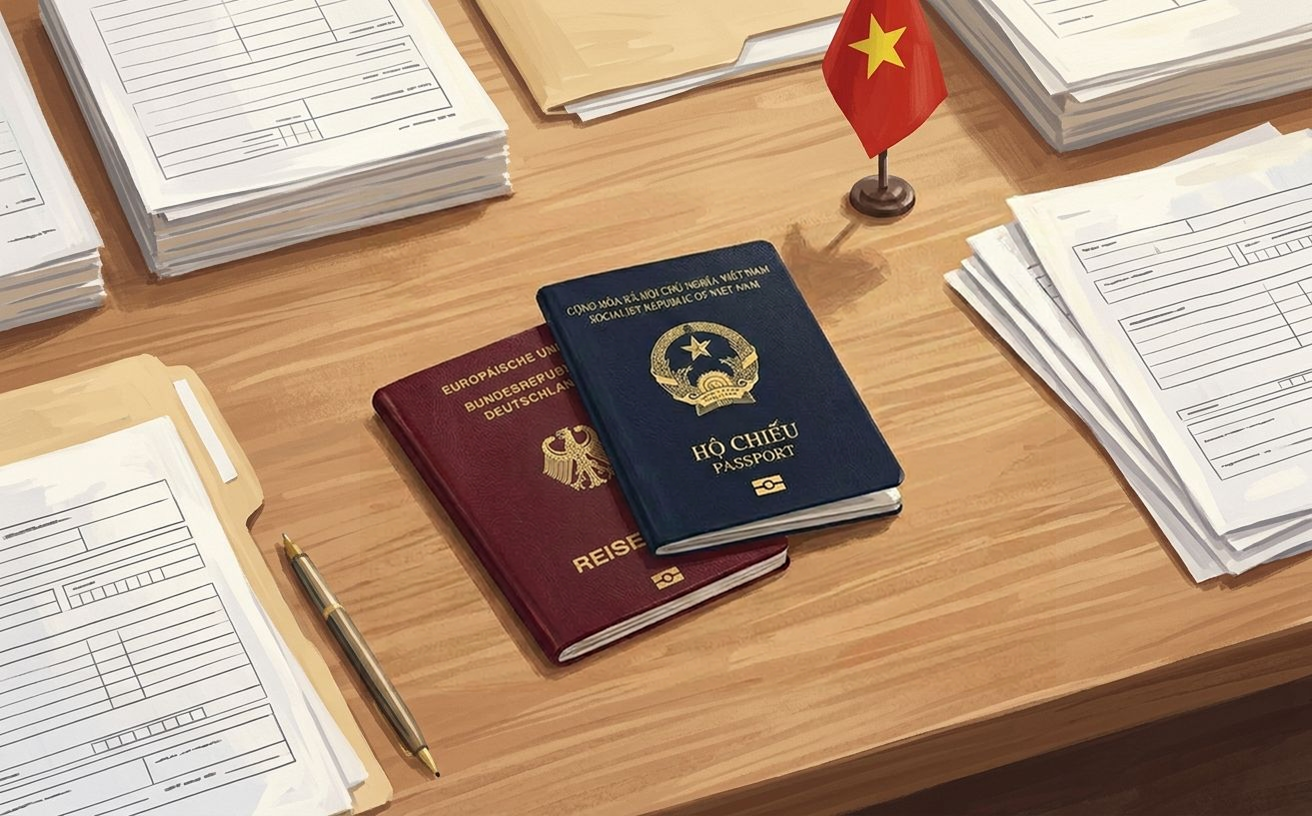
A foreign national can apply to become a Vietnamese citizen. The standard route asks for five years living in Vietnam on a permanent residence card, enough Vietnamese to integrate into the community, and the means to support yourself. The hard part is the card: Vietnamese law gives it to four groups only, and working or investing in Vietnam does not, on its own, put you in any of them.
In practice your route depends on your family. If you are married to a Vietnamese citizen or have a Vietnamese child, you skip the five years, the language requirement and the income requirement, but you still need the permanent residence card. If you have a Vietnamese parent, or Vietnamese grandparents on one side, you need no residence at all and can apply from abroad. Both groups can also ask to keep their current nationality.
These rules come from the Law on Vietnamese Nationality as amended by Law 79/2025/QH15, and from Decree 191/2025/ND-CP. Both have been in force since 1 July 2025, so guides written before then describe the earlier rules.
The standard conditions
Article 19 of the Law on Vietnamese Nationality sets six conditions that every applicant starts from:
| Condition | What it means |
|---|
| Full legal capacity | An adult able to act for themselves under Vietnamese law. Children applying with a parent, or who have a Vietnamese parent, are excepted. |
| Obey the law and respect Vietnamese culture | Comply with the Constitution and the law, and respect Vietnamese culture, traditions and customs |
| Enough Vietnamese to integrate | Listening, speaking, reading and writing suited to where you live and work |
| A current permanent resident | You hold a permanent residence card (thẻ thường trú) |
| Five years of permanent residence | Counted up to the date you apply |
| Able to support yourself | Shown by assets, a legal income, or a guarantee from an organization or individual in Vietnam |
Two more rules apply to everyone. You take a Vietnamese name, which you choose and which is written into the decision granting citizenship. And citizenship is refused if granting it would harm Vietnam's national interests.
The five years run from the date your permanent residence card was issued (Decree 191/2025, Article 11). Years on a temporary residence card do not count, however long you have lived here.
Which conditions you can skip
Article 19 exempts several groups from some or all of the conditions:
| If you | You skip | You still need |
|---|
| Are married to a Vietnamese citizen | Language, five years, income | A current permanent residence card |
| Have a Vietnamese child | Language, five years, income | A current permanent residence card |
| Have a Vietnamese father or mother | Residence, five years, language, income | No residence; you can apply from abroad |
| Have Vietnamese grandparents: both on your father's side, or both on your mother's | Residence, five years, language, income | No residence; you can apply from abroad |
| Are a child applying with a parent | Residence, five years, language, income | No residence |
| Have made special contributions to Vietnam, or are "beneficial to the State" | Residence, five years, language, income | Proof of the contribution or benefit, explained below |
Whoever is exempt from a condition is also exempt from the documents that prove it (Article 20(2)).
Married to a Vietnamese citizen
A foreign husband or wife skips the language test, the five years and the income test. What they cannot skip is holding a permanent residence card on the day they apply. The card is the real hurdle, and it takes time:
- Live in Vietnam on temporary residence for at least three continuous years.
- Apply to the immigration department for permanent residence, sponsored by your Vietnamese spouse, who must be a permanent resident of Vietnam. You also need a legal place to live and a stable income. The Minister of Public Security decides within four months, which can be extended by two.
- Once you hold the card, apply for citizenship. There is no further waiting period.
You can also ask to keep your current nationality, which is covered below. For working in Vietnam in the meantime, see Work Permit Exemption in Vietnam for Foreign Spouses of Vietnamese Citizens.
A Vietnamese parent or grandparents
If your father or mother is a Vietnamese citizen, you skip every residence, language and income condition. The same applies if both of your paternal grandparents, or both of your maternal grandparents, are Vietnamese citizens. The grandparent route is new since July 2025, and one grandparent is not enough.
Because you need no residence, you can apply from abroad, at the Vietnamese embassy or consulate where you live. You prove the family link with birth certificates or other documents, unless the authority can find it in Vietnam's civil status or population databases (Decree 191/2025, Article 13(2)).
This is a different procedure from regaining Vietnamese nationality. Someone who held Vietnamese nationality and lost it applies to return to it under Article 23 of the law, not to naturalize.
Investors, professionals and experts with no Vietnamese family
The standard route does not work for most of this group. It needs five years on a permanent residence card, and the card is open to four groups only (see the next section). Being an investor, a company director or an employee does not put you in any of them, however long you have lived in Vietnam. The nearest is the group for scientists and experts, which needs a minister to propose you.
The route open to them is being "beneficial to the State" (Article 19(3)(c)), which skips residence, language and income. Decree 191/2025, Article 12, defines two kinds:
- Outstanding talent in science, technology, innovation, digital transformation, economics, law, culture, society, the arts, sport, healthcare, education or another field, certified by a ministry-level agency or shown by international awards, orders or medals, with grounds to believe the person will contribute to that field in Vietnam over the long term.
- Entrepreneurs and investors doing business or investing in Vietnam, whose long-term contribution to Vietnam's development has been certified by a ministry-level agency.
Neither kind has a published threshold, such as a minimum investment, and the decree does not set out how to obtain the ministry's certification. Expect these cases to be decided one by one.
A separate exemption covers people who have made special contributions to building and defending Vietnam. They must hold a Vietnamese order, medal or other state honour, or have the contribution certified by a competent Vietnamese authority.
First, the permanent residence card
Anyone on the standard route, and any foreign spouse or parent of a Vietnamese citizen, needs a permanent residence card before applying. Article 39 of the Law on Entry, Exit, Transit and Residence of Foreigners in Vietnam (47/2014/QH13) gives it to four groups:
- Foreign nationals awarded a Vietnamese order or state honour for contributions to building and defending Vietnam.
- Scientists and experts living in Vietnam on temporary residence, proposed by the minister responsible for their field.
- Foreign nationals sponsored by a Vietnamese parent, spouse or child who is a permanent resident of Vietnam, after three continuous years of temporary residence.
- Stateless people who have lived in Vietnam continuously since 2000 or earlier.
All four also need a legal place to live and a stable income (Article 40). The application goes to the immigration department, and the Minister of Public Security decides within four months, extendable by two (Article 41). These articles have not been amended since 2014.
For how permanent residence fits beside short-term stay and temporary residence, see Staying in Vietnam? Short-Term Stay, Temporary Residence, and Permanent Residence. For the temporary residence card itself, see Vietnam Temporary Residence Card (TRC) Types.
Keeping your current nationality
The general rule is that you give up your current nationality. Applicants in the family, special-contribution and "beneficial" groups can ask to keep it, and the President decides (Article 19(6)). Two conditions apply: the other country's law must allow it, and you must not use that nationality to harm the rights of others or Vietnam's security, national interests or public order.
You file a document from the other country's authorities confirming you may keep its nationality. If that country issues no such document, you sign a statement saying so and that keeping it is lawful there. You also sign a commitment not to misuse it (Decree 191/2025, Article 13(3)). If you keep your nationality, your Vietnamese name can be a combination of a Vietnamese and a foreign name.
If you have to give up your nationality, the Ministry of Justice writes to tell you once your file has been checked. You then have nine months to produce the other country's document releasing you, or the file is refused (Decree 191/2025, Article 14(2)).
Inside Vietnam, a dual national is treated only as Vietnamese in dealings with Vietnamese authorities, unless a treaty says otherwise (Article 5(4)). Elected and appointed office, the cipher service and the armed forces are open only to people whose sole nationality is Vietnamese, and civil servants must also hold only Vietnamese nationality unless their employment benefits the State (Article 5(5) and (6)).
Proving your Vietnamese
Unless you are exempt, you prove your Vietnamese with a copy of one of these:
- A diploma from study in Vietnamese in Vietnam: a doctorate, master's or bachelor's degree, a college or vocational diploma, or an upper or lower secondary school certificate
- A Vietnamese-language certificate on the Ministry of Education and Training's competence framework for foreigners, issued by a Vietnamese institution
Without either, the provincial Department of Justice tests your listening, speaking, reading and writing in an interview, together with a representative of the Department of Education and Training (Decree 191/2025, Article 13(1)). No pass mark is published. The standard is Vietnamese suited to your own living and working environment.
Documents
Article 20 of the law and Article 13 of Decree 191/2025 list the file:
- The application form
- A copy of your birth certificate, passport or equivalent document
- A personal history statement
- A criminal record certificate from the authorities of each foreign country where you lived, for the time you lived there, issued no more than 90 days before you file
- Proof of your Vietnamese
- A copy of your permanent residence card, except for the parent, grandparent, special-contribution and "beneficial" groups
- Proof that you can support yourself: papers showing you own property, a letter from your employer stating your salary or income, a guarantee from an organization or individual in Vietnam, or a confirmation from the commune People's Committee of your housing, work and income
- For a family exemption: your marriage certificate, or birth certificates showing the family link
- To keep your nationality: the other country's document or your statement, and your commitment
The file is made in three sets. Decree 191/2025, Article 2, covers consular legalization and Vietnamese translation of foreign documents, so ask the Department of Justice which of yours need either before you file.
Where the information on a document is already held in a government database that the authority can use, you give the details instead of the paper, and the authority looks them up. It asks for the document only if it cannot find the information or the record is incomplete (Decree 191/2025, Article 5(3), as amended by Decree 18/2026/ND-CP from 15 January 2026).
How to apply in Vietnam
- File in person at the Department of Justice of the province where you live. Nobody can file for you (Decree 191/2025, Article 5(1)).
- Within five working days, the Department of Justice asks the provincial police to verify your identity. The police have 30 days, and the department checks your documents in the meantime.
- The chair of the provincial People's Committee reviews the file and sends a recommendation to the Ministry of Justice.
- The Ministry of Justice checks the file within 20 days. If you have to give up your current nationality, this is when it tells you.
- The Minister of Justice reports to the Prime Minister, who submits the file to the President, and the President decides.
- The decision is handed to you at a ceremony organized by the provincial Department of Justice.
If you live abroad, the Vietnamese embassy or consulate checks the file within 20 days and sends it to the Ministry of Justice, and the Ministry of Public Security verifies your identity within 45 days, or 60 in complex cases (Decree 191/2025, Article 15).
The fee is VND 3,000,000 for an application in Vietnam. At an embassy or consulate it is US$250 under Circular 163/2026/TT-BTC, in force since 1 November 2026. People with special contributions to Vietnam are exempt.
The time limits in the law add up to a few months, but they leave out the time it takes to give up another nationality, and no figures are published for how long cases take in practice.
No appeal, and citizenship can be withdrawn
A decision on nationality, including a refusal, cannot be challenged by administrative complaint or in court (Article 5(8)).
A naturalization can be cancelled if you made false declarations or used forged documents to obtain it, or if you use a foreign nationality you were allowed to keep to harm the rights of others or Vietnam's security and national interests (Article 33). Cancellation for one spouse does not change the other spouse's nationality.
What changed on 1 July 2025
| Before 1 July 2025 | Since 1 July 2025 |
|---|
| Living in Vietnam | Every applicant had to be a permanent resident | Applicants with a Vietnamese parent or grandparents, and the special-contribution and "beneficial" groups, need no residence and can apply from abroad |
| Grandparents | Not a route | Both grandparents on one side Vietnamese: no residence, language or income conditions |
| Keeping your nationality | Only for spouses, parents and children of Vietnamese citizens and the special-contribution and "beneficial" groups, in special cases, with the President's permission | The family, special-contribution and "beneficial" groups can keep it if the other country allows, with the President's permission |
| Name | A Vietnamese name | A Vietnamese name, or a combined name if you keep your nationality |
The language, five-year and income conditions are not new: they were already in the 2008 law. Nor is the rule that the five years run from the permanent residence card, which was already in Decree 16/2020/ND-CP, the decree that Decree 191/2025 replaced.
If you are married to a Vietnamese citizen and own property together, see also Can a Foreign Spouse Inherit Property in Vietnam?
Sources
- Law on Vietnamese Nationality 24/2008/QH12, Articles 19 and 20 as first enacted
- Law 79/2025/QH15 amending the Law on Vietnamese Nationality, Articles 5, 19, 20, 21, 23 and 33
- Decree 191/2025/ND-CP, Articles 5 and 11 to 16
- Law on Entry, Exit, Transit and Residence of Foreigners in Vietnam 47/2014/QH13, Articles 39 to 41
- Circular 163/2026/TT-BTC, fees at Vietnamese missions abroad
- Decree 18/2026/ND-CP, Article 15, amending Article 5(3) of Decree 191/2025