From individual traders to joint stock companies, here is everything you need to know before you open your doors in Vietnam. (This article was originally published on 15 May 2026 on our Substack)
Trong bài viết này9
Think of a typical business in Vietnam on its natural growth path: it usually begins with an individual doing things informally, then formalises as a household business, and eventually scales into a registered enterprise. Where you enter that arc and which legal form you choose shapes everything that follows. Understanding where each structure begins and ends is the first practical step for anyone planning to do business here.
If you are an expat, a foreign entrepreneur, or a business trying to establish a presence here, this guide is a practical breakdown of every type of company structure available in Vietnam in 2026, who can use each one, and how to decide which fits your situation.
Why Your Business Structure Choice Matters More Than You Think
The right structure depends on several factors: the scale of your operations, whether your sector has conditional licensing requirements, the size of your charter capital, and whether there is any foreign element in your ownership. Before covering the types that require a formal business licence, it helps to first understand the forms of economic activity that operate outside that system. Vietnam recognises a range of informal and semi-formal business activities, and knowing where those boundaries sit helps you understand how the full structure of commercial activity actually works.
When You Do Not Need to Register a Business in Vietnam (Not Applicable to Foreign Investors)
Not every person who earns money from a business activity in Vietnam is required to register for a business licence. Understanding this spectrum is useful context before examining the formal company structures.
1. Individual Commercial Activity (Cá Nhân Kinh Doanh)
Under Decree 39/2007/ND-CP, an individual commercial operator (cá nhân kinh doanh) is someone who independently and regularly carries out commercial activities for profit without being legally required to register as a business. These individuals are not considered merchants under the Law on Commerce. This category covers people operating informally without a fixed address or employed staff, from street food sellers and travelling vendors to seasonal traders, lottery ticket agents, and micro-scale online sellers.
That said, operating without a business licence does not mean operating outside the tax system. Under Decree 141/2026/ND-CP, individual commercial operators and household businesses with annual revenue above 1 billion VND must declare and pay both VAT and personal income tax. Below that threshold, no tax obligation arises on either count. The distinction matters: registration and taxation are two separate obligations, and whether or not you need a business licence, your revenue may still attract tax responsibility.
2. Agricultural Households and Other Exempt Categories
Separate from Individual Commercial Activity framework, Vietnamese law carves out a specific group of activities that are exempt from both business registration and personal income tax. Under Article 82 of Decree 168/2025/ND-CP, households and individuals directly engaged in cultivating crops, raising livestock, aquaculture, fishing, forestry, or producing salt do not need to register a household business. Under the Personal Income Tax Law 2025, income from these activities is also exempt from personal income tax, provided the output has not been processed beyond basic preparation.
This exemption reflects the government’s long-standing commitment to supporting food security, protecting rural livelihoods, and reducing poverty. An individual earning income from growing fruit trees, raising chickens, or farming fish in a pond, for example, owes no PIT on that income and faces no registration requirement, regardless of scale, income level, or informality.
Article 82 also covers people selling goods on the move, those running seasonal or short-term commercial activity, and low-income service providers, with income thresholds set by each province. The rule that overrides all exemptions is this: once an activity falls within a conditional business line, formal registration is compulsory regardless of scale, income level, or informality. Sectors requiring a professional licence, or any sector-specific permit also fall outside the exemptions. All informal categories are available only to Vietnamese residents.
Household Business (Hộ Kinh Doanh): Vietnam’s Most Common Semi-Formal Business Form (Not Applicable to Foreign Investors)
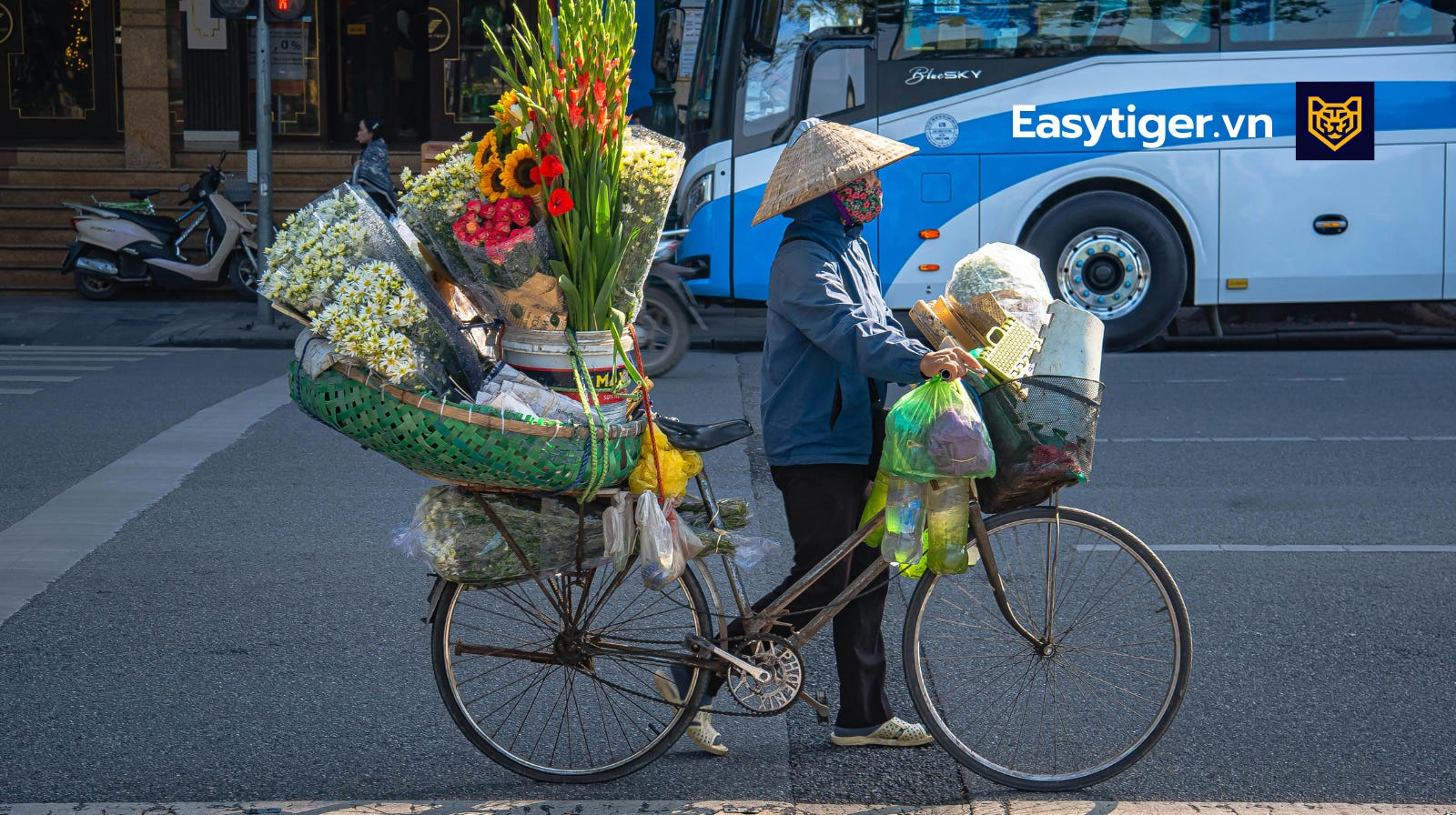
A household business sits one level above the fully informal categories. It is registered with the commune-level business registration authority, has a fixed business location, and operates under the name of a registered individual or family.
Household businesses are the most widespread form of organised economic activity in Vietnam. According to Resolution 68-NQ/TW of 4 May 2025, Vietnam’s private sector has more than 940,000 enterprises and more than 5 million household businesses, and the private sector as a whole contributes about 50% of GDP, over 30% of state budget revenue and about 82% of total employment. Household businesses are the backbone of the country’s micro-economy: local coffee shops, family restaurants, neighbourhood grocery stores, small tailors, traditional market stalls, pharmacies, and repair shops.
Running a household business is simpler than running a company. Registration takes around 3 working days at the commune level. Under Decree 141/2026/ND-CP, household businesses with annual revenue below 1 billion VND are exempt from both VAT and personal income tax. The owner trades under their own name and is personally responsible for everything the business does.
That personal responsibility, however, is unlimited. There is no legal separation between owner and business, and the owner’s entire personal assets are at risk. A household business may operate from several business locations anywhere in the country, provided it notifies the tax and market-management authorities, but each individual can only register one household business. Employing more than 10 workers under social insurance-covered contracts starts to trigger obligations that are more naturally managed inside a formal company structure.
There is also a practical ceiling when dealing with corporate clients: household businesses can only issue direct VAT invoices, not VAT-deductible ones. Direct exporting or importing is not available, and access to meaningful bank financing is considerably more limited. From January 2026, the lump-sum tax method has been abolished. All household businesses now declare taxes based on actual revenue, invoices, and supporting documents.
Foreigners cannot establish a household business in Vietnam. This structure is strictly available to Vietnamese citizens with full civil legal capacity. Vietnamese citizens are also prohibited from registering a household business if they are simultaneously a sole proprietor or a general partner in a partnership company without consent from existing general partners.
The Five Main Business Types in Vietnam That Require Legal Registration
Vietnam’s Law on Enterprises 2020, amended in 2025 and effective from July 2025, defines five corporate forms that carry full legal entity status or operate as registered enterprises.
1. Sole Proprietorship (Doanh Nghiệp Tư Nhân)
A sole proprietorship is an enterprise owned by a single Vietnamese individual who bears unlimited personal liability for all business activities and obligations. The owner commits a declared capital amount to the business, though there is no statutory minimum.
Unlike a household business, a sole proprietorship is classified as an enterprise under the Law on Enterprises and must complete full enterprise registration with the provincial-level business registration authority. However, it does not have legal entity status, meaning owner and business are legally the same person. The owner cannot simultaneously hold a household business or be a general partner in a partnership company. A sole proprietorship cannot issue shares and cannot contribute its capital as a member in another company.
In practice, this structure has declined sharply in popularity. Most individuals who want sole ownership of a business now opt for a one-member LLC instead, as it provides limited liability protection while remaining straightforward to manage. Common use cases where a sole proprietorship still appears include small professional service providers who prefer a simpler legal form and do not require the liability protection of an LLC. Foreigners cannot establish a sole proprietorship in Vietnam.
2. Partnership Company (Công Ty Hợp Danh)
A partnership company must include at least two general partners who are individuals, and may additionally have limited partners who can be either individuals or organisations. General partners bear unlimited, joint, and several liability for all business obligations. Limited partners are liable only to the extent of their committed capital contribution.
Partnership companies cannot issue shares of any kind. Decision-making authority rests with the general partners, with major decisions requiring either a majority vote or unanimous consent depending on the matter under consideration. The company has legal entity status.
This structure remains rare in practice in Vietnam. Its most common appearances are in regulated professional services where sector-specific law mandates a partnership structure, such as certain auditing firms or legal practices. The unlimited liability of general partners and the inability to issue shares make it unattractive for most business contexts.
The law does not limit foreigners to the role of limited partner: general partners must be individuals, and Investment Law 143/2025/QH15 expressly covers partnerships in which a majority of the general partners are foreign individuals. Even so, this structure is almost never recommended as a primary entry vehicle for foreign investors. It offers none of the capital-raising flexibility of a JSC and none of the liability protection of an LLC.
3. One-Member LLC (Công Ty TNHH Một Thành Viên)
A one-member LLC is owned by a single individual or a single organisation. The owner’s liability is limited strictly to the amount of charter capital they have committed to the company. Personal assets beyond that capital are protected. The company has full legal entity status.
Unlike a sole proprietorship or household business, the one-member LLC creates a legal separation between owner and company. The company can own assets, enter contracts, and sue or be sued in its own name. It cannot issue shares to the public, but it can issue bonds under applicable law. Governance is relatively straightforward: the owner exercises all member rights through either a Members’ Council or as the sole member.
The company must always have at least one legal representative residing in Vietnam. The law does not require that person to be a Vietnamese national, so a foreign owner can hold the role, but a foreigner acting as legal representative must still comply with work permit and immigration rules.
This structure suits solo founders, consultants, boutique design studios, single-operator F&B outlets, digital agencies, IT service providers, and any business where one owner wants full control with personal liability protection. A foreign investor who wants 100% ownership of a small or medium business will most frequently use this structure, registering it as a 100% Foreign-Owned Enterprise (FOE).
Advantages include clean, simple governance, full owner control, and limited liability. The main limitation is that it cannot issue equity to bring in additional investors, which caps its capital-raising options unless restructured.
4. Multi-Member LLC (Công Ty TNHH Hai Thành Viên Trở Lên)
A multi-member LLC has between two and fifty members, which can be any combination of individuals and organisations, Vietnamese or foreign. Each member’s liability is limited to their capital contribution. Like the one-member LLC, this structure has full legal entity status and cannot issue shares to the public, but it can issue bonds.
Governance is through a Members’ Council, led by a chairperson. The company must appoint a legal representative. A Board of Supervisors is mandatory only if the company is a state-owned enterprise or a subsidiary of one; for other multi-member LLCs it is optional. Capital ownership is proportional to each member’s contributed capital, and profit distribution follows the same proportion unless the charter specifies otherwise.
This is the most popular structure for joint ventures between Vietnamese and foreign investors, or for two or more foreign parties investing together in Vietnam. It offers the flexibility of agreed capital ratios, limited liability for all parties, and relatively lean governance compared to a joint stock company. Tech companies, trading businesses, professional services firms, F&B concepts operated with a local partner commonly choose this form.
The main practical limitation of a multi-member LLC is the cap at fifty members, which means it cannot accommodate a broad shareholder base. Companies that anticipate needing institutional investors or public fundraising should consider a joint stock company instead.
5. Joint Stock Company (Công Ty Cổ Phần)
A joint stock company, or JSC, is the most scalable and the most complex business structure available in Vietnam. It requires a minimum of three shareholders, with no upper limit. Capital is divided into equal shares, and this is the only corporate form in Vietnam legally permitted to issue shares to the public and, ultimately, to list on a stock exchange.
Governance is formal and layered, and a JSC can choose between two management models. Under the first, the company has a General Meeting of Shareholders, a Board of Directors, a Board of Supervisors and a Director or General Director; the Board of Supervisors can be left out only if the company has fewer than 11 shareholders and organisations own less than 50% of its shares. Under the second, there is no Board of Supervisors, but at least 20% of the Board of Directors must be independent members and an audit committee must operate under the Board. This governance structure carries meaningfully more administrative weight than either form of LLC.
The JSC can issue multiple classes of shares, including ordinary shares, preference shares, and redeemable shares, giving it significant flexibility in structuring investor rights. It can also issue convertible bonds, providing a bridge for early-stage fundraising before full equity conversion.
Foreign investors can own shares in a JSC, and in most sectors can own up to 100% of the equity. This structure is the natural choice for medium to large enterprises planning to raise external capital, bring in institutional investors, pursue mergers and acquisitions, or eventually go public. Banks, insurance companies, real estate developers, large manufacturing operations, and listed technology companies typically operate as JSCs.
For foreign investors at SME scale, the JSC can also be used but adds governance overhead that most early-stage operators do not need. The one-member LLC or multi-member LLC tends to be a more efficient starting point, with the option to restructure later if the business grows to a scale where public equity becomes relevant.
Which Structures Can Foreigners Actually Use?
A 100% Foreign-Owned Enterprise in the form of a one-member LLC is the most common path for solo foreign investors entering Vietnam. It offers full control, limited liability, legal entity status, and a relatively clean registration process for most sectors. A multi-member LLC is the preferred structure for joint ventures, whether between a foreign investor and a Vietnamese partner or between two or more foreign investors. A JSC is the tool for larger operations, companies with institutional investors, or businesses planning to raise capital from the public. A Representative Office is available to foreign companies that want a market presence without generating revenue or signing commercial contracts. A Branch Office allows a foreign company to operate in Vietnam under its own name, though with sector-specific restrictions.
In sectors where Vietnamese law requires local participation in ownership, a joint venture structure (multi-member LLC or JSC with a qualifying Vietnamese partner) is the standard market entry method.
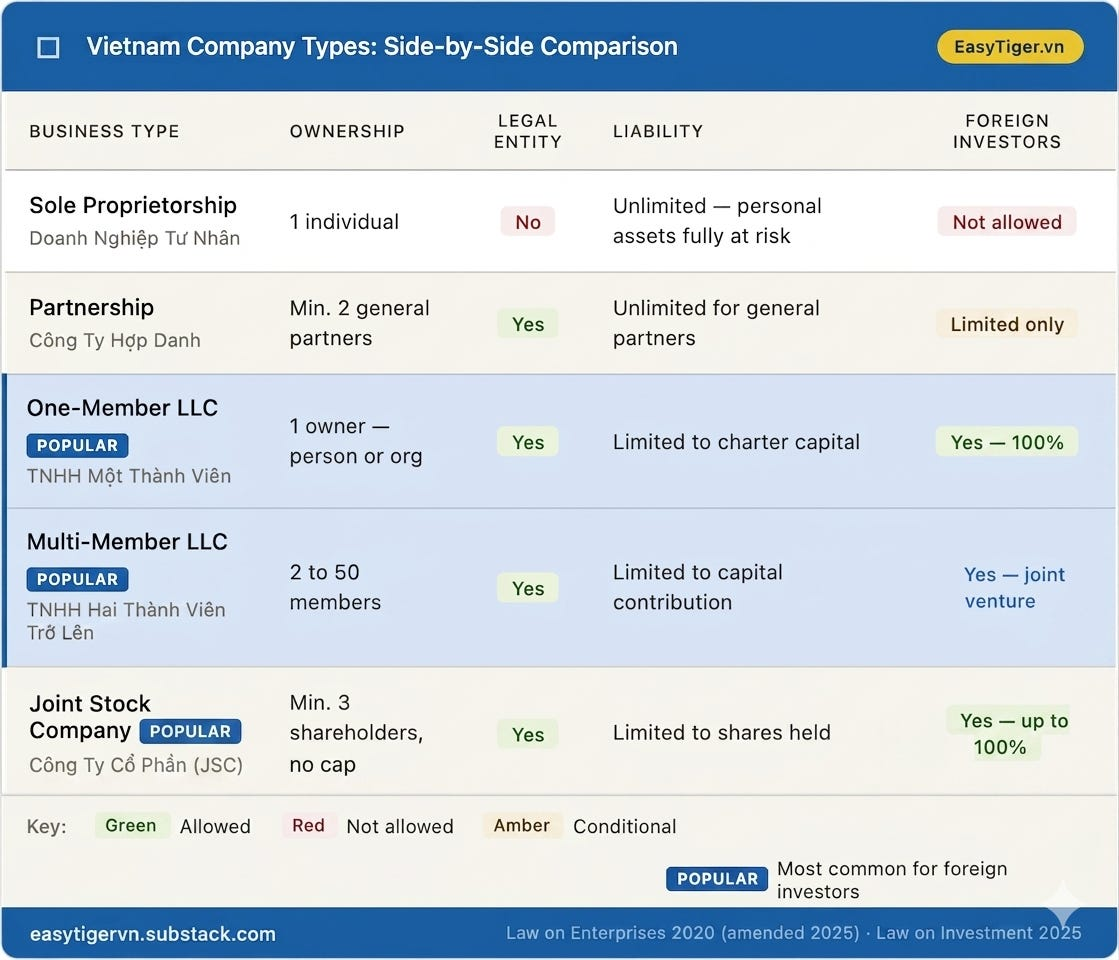
Correction to the table above: foreign investors are not limited to being limited partners in a partnership. General partners must be individuals, and foreign individuals can be general partners too.
Looking at how foreign investors actually operate in Vietnam in practice: large multinational corporations tend to focus on manufacturing, electronics, energy, real estate, and logistics, typically through JSCs or multi-member LLC joint ventures with significant capital commitments. SMEs and individual foreign investors are predominantly active in technology, design, F&B, consulting, trading, education, and professional services, most commonly through one-member or multi-member LLCs.
Business Sectors Open to Foreign Investment
Vietnam uses a Negative List approach to foreign investment access. Any sector not explicitly designated as prohibited or conditional is, by default, open to 100% foreign ownership. The starting point is openness, not restriction.
Prohibited sectors are narrow and firm: narcotics, human organ trading, certain types of fireworks, specific wildlife and natural products, debt collection services, and a small number of other categories. These are non-negotiable.
Conditional sectors require foreign investors to meet additional criteria before operating, and sometimes cap the percentage of foreign ownership allowed. Common examples include certain retail distribution activities, advertising, tourism services, some transport and logistics operations, publishing, press, and broadcasting. In these sectors, a joint venture with a Vietnamese partner holding a minimum required stake is typically the mandated structure.
Vietnam is actively prioritising and incentivising FDI in high-technology manufacturing, semiconductor design, green energy, digital infrastructure, artificial intelligence and software development, biotechnology, healthcare, and education. Resolution 57-NQ/TW of December 2024 signals the government’s ambition to make technology and digital transformation a national development pillar, which creates tangible structural advantages for foreign investors entering those sectors.
For the majority of standard business activities, including most technology services, consulting, design, F&B, trading, and professional services, foreign investors can enter Vietnam with 100% ownership and face no sector-specific ownership restrictions.
The Registration Process: How It Actually Works
Theoretically, you can DIY the paperwork, but in practice, especially if there is a foreign element in your ownership, partnering with a reputable formation service is the more efficient path. They understand the specific sequencing of the bureaucracy, often anticipating hurdles before you even encounter them.
The process starts with confirming your business structure and checking the Negative List for your sector. You’ll then prepare notarised dossiers to secure your Enterprise Registration Certificate (ERC) and Investment Registration Certificate (IRC), and bank setup. Since 1 March 2026, under Investment Law 143/2025/QH15, a foreign investor may register the company before obtaining an IRC, although an IRC is still needed for the investment project itself. For standard service or trading companies, expect one to one and a half months; regulated sectors typically run two to four months. Government filing fees are around USD 100 to 200; professional formation agency fees range from USD 1,000 to 5,000.
The Bottom Line
Vietnam’s business landscape is broader and more layered than most people expect. Informal individual trading, household businesses, and registered enterprises all coexist within a clear legal framework, each serving a different stage and scale of economic activity.
Under Resolution 68-NQ/TW of May 2025 and the supporting tax and registration reforms that followed, the government is actively encouraging household businesses to upgrade to formal enterprises. Conversion is not mandatory under current law for most household businesses, but from a practical business development standpoint, the question for growing household businesses is increasingly not whether to convert, but when.
For foreign investors, the path is clearer still. The one-member LLC and multi-member LLC cover the vast majority of entry scenarios, from solo founders to joint ventures to professional service firms. The JSC is the tool for those thinking at a greater scale or planning to raise capital over time.
Once you have picked a structure, our guide on how to open a business in Vietnam takes you through registration, the investment certificate, charter capital and the first filings.
If you are trying to navigate this and want to connect with a verified company formation specialist or legal adviser in Vietnam, that is exactly what Easytiger was built for.
The information in this article is for general reference only and does not constitute formal legal or tax advice. Vietnam’s regulatory framework, including tax thresholds, registration requirements, and licensing conditions, is subject to ongoing change. All figures and rules referenced reflect information available as of May 2026. For guidance specific to your business, sector, or ownership structure, consult a qualified legal or tax professional in Vietnam.
Câu hỏi thường gặp


Easytiger Match
Tìm chuyên gia phù hợp
- Cho chúng tôi biết nhu cầu của bạn
- Chúng tôi chọn lọc (các) chuyên gia và giới thiệu cho bạn