
Making sense of the 2026 BHXH reforms: A straightforward guide for expats and businesses building a future in Vietnam. (This article was originally published on 01 Apr 2026 on our substack and modified on 28 Jul 2026)
Trong bài viết này6
You signed a contract, you started working, and then someone mentions BHXH. Or maybe your company sends you a payslip with deductions you did not expect. Or you are leaving Vietnam and someone at the office says you can claim back your social insurance contributions, but nobody knows how.
If any of that sounds familiar, this guide is for you. Vietnam’s social insurance system has gone through major reforms as of July 1, 2025, and there is more at stake here than a line item on your payslip. Done right, it is actually money you can get back, and a safety net you are building while you work.
What Is Social Insurance in Vietnam, and Who Manages It?
Social insurance in Vietnam, locally known as Bảo Hiểm Xã Hội or BHXH, is a mandatory government-managed system where both employers and employees contribute a percentage of salary into a national fund. That fund then pays out when life takes an unexpected turn: illness, maternity leave, workplace accidents, retirement, or the death of a breadwinner.
The system is managed by Vietnam Social Security (VSS), which operates under the Ministry of Home Affairs since a governmental restructuring in 2025. VSS oversees contribution collection, benefit processing, and nationwide distribution.
There are three components under the mandatory social insurance umbrella:
- Social Insurance (SI / BHXH): covers sickness, maternity, occupational accidents, retirement, and survivorship benefits. Applies to Vietnamese and foreign employees on contracts of 12 months or more.
- Health Insurance (HI / BHYT): covers medical examinations and inpatient/outpatient treatment. Applies to contracts of 3 months or more.
- Unemployment Insurance (UI / BHTN): provides income support during job loss, plus job placement support. Applies to Vietnamese employees only, on contracts of 3 months or more. Foreign employees are not required to contribute to this fund.
Where can you check your records?
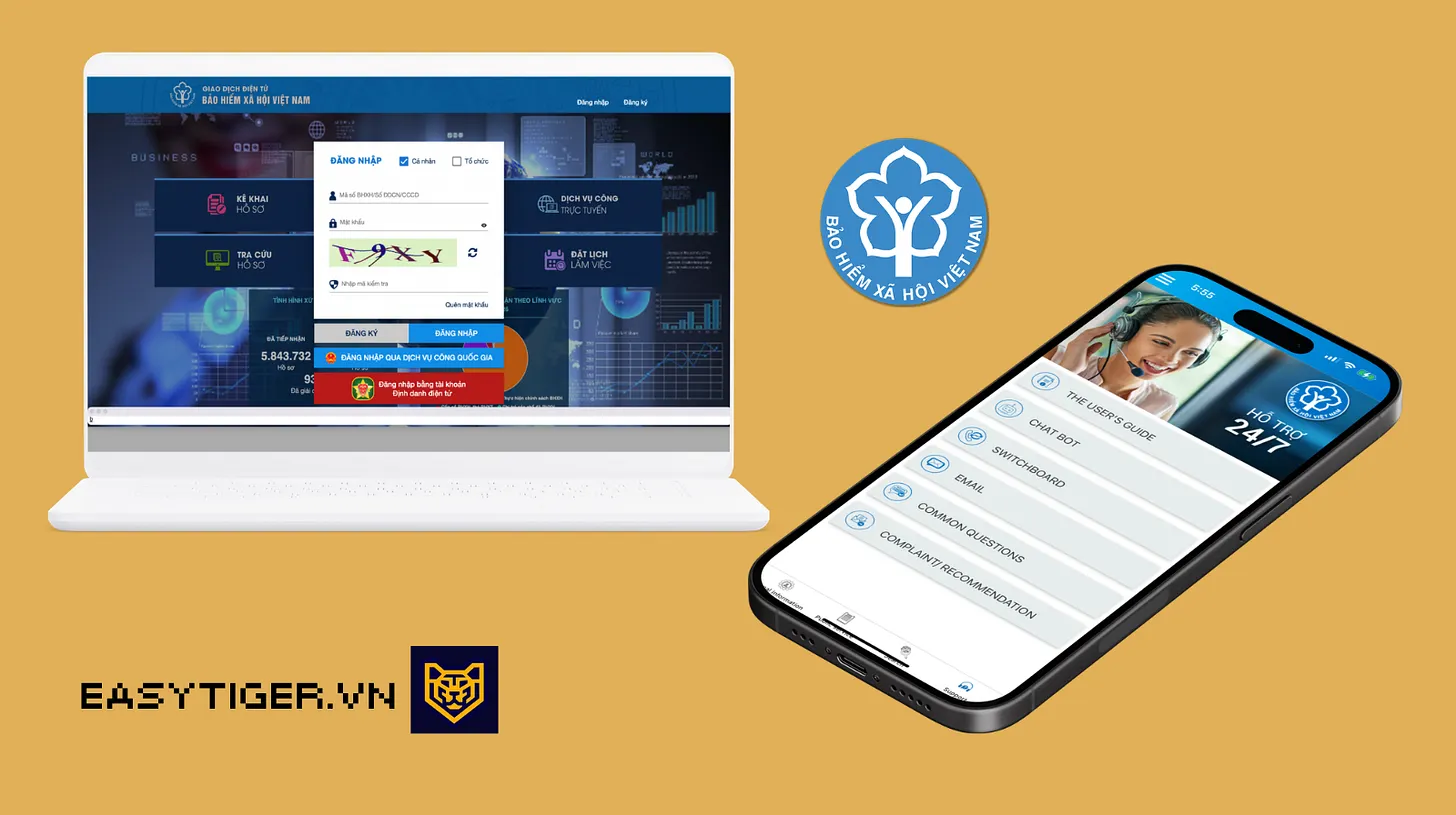
The VssID app (available on iOS and Android) is the official Vietnam Social Security mobile app. It lets you look up contribution history, access your digital health insurance card (BHYT), and track your accumulated months. Since 2023, it can be accessed through your VNeID electronic identity account, so there is no separate login to manage. You can also look things up via the web portal at vss.gov.vn using your citizen ID or passport number. As of August 2025, VSS has unified social insurance codes with citizen ID numbers, making records easier to trace.
Why Does This Actually Matter? The Part Most People Skip
For many expats and foreign workers, BHXH feels like just another deduction. But that framing misses the point entirely.
First, the practical reality: your social insurance contributions, including both your share and your employer’s share, are recoverable. When you leave Vietnam or your contract ends, you are entitled to withdraw the full accumulated amount as a lump sum. For someone on a mid-range salary working in Vietnam for two to three years, that can translate to tens of millions of dong paid back to you when you leave, money that was quietly building while you worked.
Second, if you stay long enough, you are building toward real retirement benefits. Foreign workers who reach 15 years of social insurance contributions in Vietnam are eligible for a monthly pension, calculated at 45% of average monthly salary, increasing by 2% for every additional year. For anyone considering a long-term future here, that is not a trivial benefit.
Third, the system covers you while you are here. Vietnamese public hospitals operate on the health insurance system. With an active BHYT card (health insurance card), you can access inpatient and outpatient care at public facilities with 80 to 100% coverage depending on conditions. For the sick leave benefit, if you are certified ill by a licensed medical provider, you can receive 75 to 100% of your monthly salary during leave. Maternity benefits are also substantial, with female employees entitled to 6 months of paid maternity leave calculated at 100% of their average insured salary, and male employees now entitled to 5 to 14 days of paternity leave under the 2025 reforms.
To be straightforward about it: public hospitals in Vietnam are not always the most comfortable experience, and not everyone will choose to use them. But having that health insurance card (BHYT) still means you have access to covered care when you genuinely need it, and that is a lot better than facing a hospital bill with no coverage at all.
In short: social insurance is not just a compliance box to tick. It is a financial tool that rewards participation.
How Much Do You Pay? Contribution Rates Explained
How are these numbers actually figured out? It all starts with something called the insured salary, which is the figure that the contribution percentages are applied to, and it does not always match what you see on your payslip.
By law, the insured salary includes the base salary stated in your labor contract, plus any fixed, regular allowances or supplements with specific amounts written into that contract. However, variable welfare perks that are listed separately as benefits rather than salary components (such as meal, phone, or transport allowances provided outside the contract structure) do not count toward the contribution base. Because of these exclusions, the insured salary is usually just the base salary component of your contract.
In the real world, companies often establish a benchmark for social insurance contributions. While some firms contribute based on your full gross salary, many choose to set a specific benchmark, such as 80% of your gross salary, or stick closer to the legal minimums.
There are strict guardrails on this:
The floor: You cannot contribute on an insured salary lower than the applicable regional minimum wage for employees.
Regional minimum wages — effective January 1, 2026
| Region | Monthly minimum | Key areas |
|---|---|---|
| Region 1 | 5,310,000 VND ~USD 204 | Urban Hanoi, Ho Chi Minh City, Hai Phong, Da Nang and key industrial hubs |
| Region 2 | 4,730,000 VND ~USD 182 | Peri-urban Hanoi and HCMC, most of Binh Duong, Dong Nai, Can Tho |
| Region 3 | 4,140,000 VND ~USD 159 | Provincial cities and industrial towns; parts of Hai Duong, Khanh Hoa, Long An |
| Region 4 | 3,700,000 VND ~USD 142 | Remaining rural provinces and districts |
Per Decree 293/2025/ND-CP. These figures are the floor for social insurance contribution bases. A company cannot set an insured salary below the rate for its operating region.
The ceiling: There is a cap of 20 times the government reference level. As of 1/7/2026, the government reference level is VND 2,530,000/month, putting the maximum insured salary cap at VND 50,600,000/month. Anything earned above that ceiling is not subject to additional social insurance contributions.
Contribution Breakdown
For Vietnamese employees and their employers:
| Contribution type | Employee | Employer |
|---|---|---|
| Social Insurance (BHXH) | 8% | 17.50% |
| Health Insurance (BHYT) | 1.50% | 3% |
| Unemployment Insurance (BHTN) | 1% | 1% |
| Total | 10.50% | 21.50% |
Unemployment insurance applies to Vietnamese employees on contracts of 3 months or more. Contributions are based on the insured salary, floored at the applicable regional minimum wage and capped at VND 50,600,000/month.
For foreign employees and their employers:
Foreign employees contribute to SI and HI but are excluded from unemployment insurance.
| Contribution type | Employee | Employer |
|---|---|---|
| Social Insurance (BHXH) | 8% | 17.50% |
| Health Insurance (BHYT) | 1.50% | 3% |
| Work accident & occupational disease fund | 0% | 0.50% |
| Total | 9.50% | 20.50% |
Foreign employees are excluded from unemployment insurance, making the combined rate 30% versus 32% for Vietnamese employees. Applies to foreign workers on fixed-term contracts of 12 months or more with a valid work permit or practicing certificate. Source: Social Insurance Law 2024 and Decree 158/2025/ND-CP.
A Real Example: What It Looks Like in Practice
Imagine a local employee with a contracted gross salary of VND 25,000,000 per month. Depending on the company’s internal payroll strategy, the actual insured salary used for contributions can vary significantly.
Example 1: The legal floor (regional minimum wage)
Some companies choose to set the insured salary at the absolute minimum permitted by law to minimize monthly costs. For a business based in a Region 1 urban area such as Ho Chi Minh City or Hanoi, the 2026 minimum wage is VND 5,310,000.
- Employee pays (10.5%): VND 557,550
- Employer pays (21.5%): VND 1,141,650
- Total monthly social insurance contribution: VND 1,699,200
Example 2: The 80% salary benchmark
Other companies take a more balanced approach, setting the contribution benchmark at 80% of the gross salary. In this case, the insured salary becomes VND 20,000,000.
- Employee pays (10.5%): VND 2,100,000
- Employer pays (21.5%): VND 4,300,000
- Total monthly social insurance contribution: VND 6,400,000
From a business perspective, the employer-side contribution represents a significant portion of the total cost of each hire, well beyond the base salary listed in the contract.
Who Is Required to Participate, and When?
Employers must register employees within 30 days of their start date. Under the Social Insurance Law 2024, the SI book must be issued within 5 working days of a complete application. Late payment carries a daily interest charge of 0.03% on the outstanding amount, and deliberate evasion can result in administrative prosecution.
For foreign employees specifically, mandatory social insurance participation applies when all three conditions are met:
- The employee holds a valid work permit, practicing certificate, or practicing license issued in Vietnam.
- The labor contract is for a fixed term of 12 months or more.
- The employee has not yet reached retirement age at the time of signing (currently 62 for men, rising gradually, and 60 for women).
Foreigners are not required to join if they are:
- Intra-company transferees (managers, directors, experts, or technical workers assigned from a foreign parent company, where the foreign company has employed them for at least 12 consecutive months beforehand).
- At or beyond retirement age at the time of contract signing.
- Covered under a bilateral social insurance treaty with Vietnam. The Vietnam-South Korea SI agreement is in effect as of January 1, 2024.
Something many business owners miss: unpaid company executives are still required to contribute.
Before July 1, 2025, only managers with a labor contract and an actual salary were required to participate in social insurance. The Social Insurance Law 2024 changed that. Now, even if you hold a management title and draw no salary from the company, the obligation still applies to you.
Specifically, the new rules cover directors, general directors, board members, members of the supervisory board, capital representatives, and other elected management roles across all company types and structures, not just single-member LLCs. The law refers to these individuals as enterprise managers without a salary (người quản lý doanh nghiệp không hưởng tiền lương), and they are now a named category of mandatory social insurance participant under Article 2 of the Social Insurance Law 2024. If your name appears on the company registration documents in a management capacity, and you have not yet reached retirement age, you are in.
For unpaid executives, the entire social insurance contribution falls on the individual rather than being split with the company. The total rate is 25% of the chosen contribution salary (3% into the sickness and maternity fund, 22% into the retirement and survivorship fund), plus 4.5% for health insurance, bringing the combined total to 29.5%. The contribution salary is self-selected within a range from VND 2,530,000/month at the minimum up to VND 50,600,000/month at the maximum (as of 1/7/2026). To put that in concrete terms: someone choosing the minimum reference level would pay roughly VND 746,350/month, while someone contributing on a higher self-declared salary would pay proportionally more. Payment can be made monthly, quarterly, or every six months.
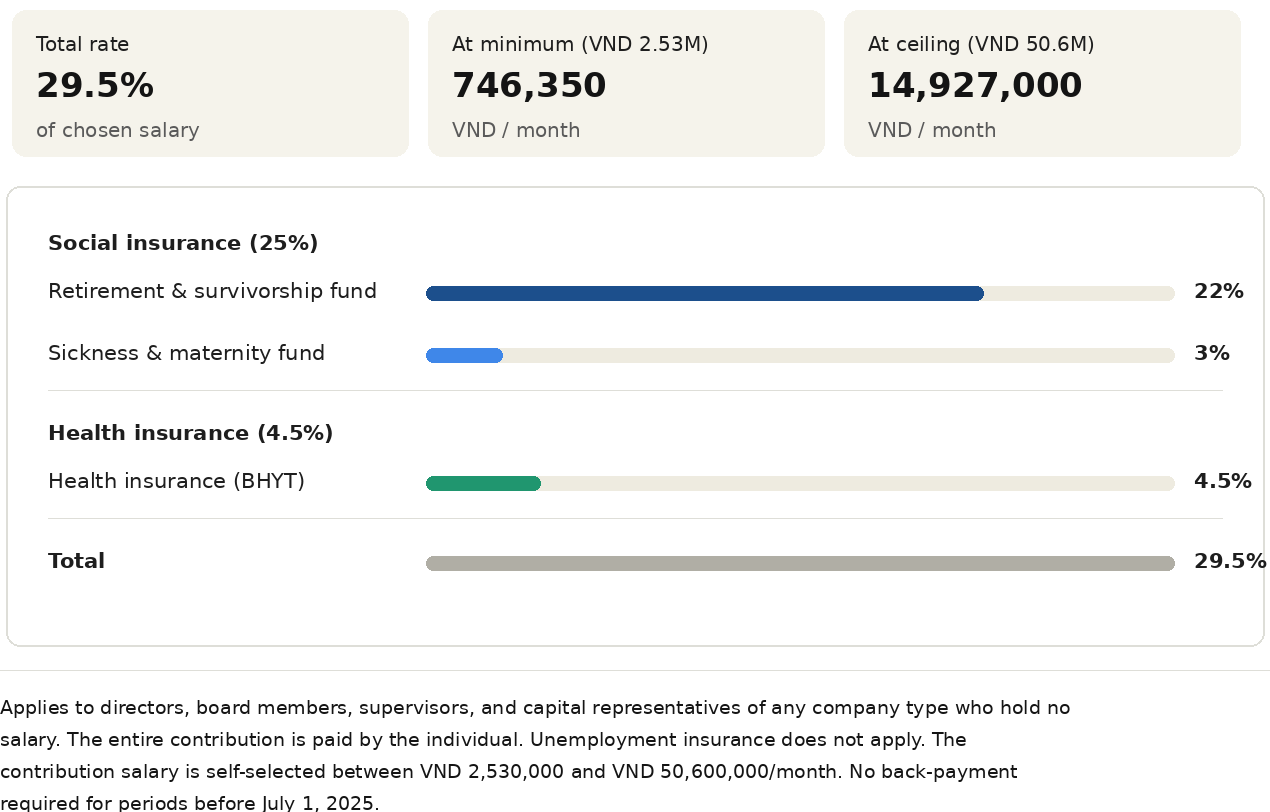
There is no back-payment required for periods before July 1, 2025, but the obligation applies from that date forward. If a director holds positions at multiple companies, social insurance is only required at the first company where they manage or administer. Unemployment insurance does not apply to this group.
Withdrawing Social Insurance: What Locals and Foreigners Can Each Do
This section is where the rules diverge most, and where the 2025 reform changes things significantly.
For Vietnamese employees:
The lump-sum withdrawal option has tightened considerably under the Social Insurance Law 2024. Employees who began contributing before July 1, 2025 still have access to some one-time withdrawal conditions, though with more restrictions than before. For those who join the system after July 1, 2025, a lump-sum payout is only available in specific circumstances: reaching retirement age without meeting the 15-year threshold, being diagnosed with a serious qualifying illness (cancer, paralysis, decompensated cirrhosis, severe tuberculosis, HIV/AIDS), or having a working capacity loss of 81% or more. The previously popular option to withdraw after simply being unemployed for 12 months no longer applies for new participants.
On the positive side, the minimum social insurance contribution period to qualify for a monthly retirement pension has been reduced from 20 years to 15 years from July 1, 2025, making long-term pension access significantly more achievable.
For foreign employees:
The rules are more straightforward and considerably more flexible. Foreign workers can apply for a one-time lump-sum withdrawal when any of the following apply:
- The labor contract ends, or the work permit/license expires without renewal.
- The employee permanently leaves Vietnam.
- Retirement age is reached but fewer than 15 years of contributions have been made.
- A qualifying serious illness is diagnosed.
How the payout is calculated:
Claimed amount = 2 x average monthly insured salary x number of years contributing to SI. For contributions under one year, the amount equals total paid contributions, capped at two months of average insured salary.
Example: If a foreign employee has an average monthly insured salary of VND 20,000,000 and contributes for 3 years, the calculation is: 2 x VND 20,000,000 x 3 = VND 120,000,000 (approximately USD 4,800).
To claim, submit Form 14-HSB to your social insurance office at least 30 days before your contract expires. Processing takes within 10 working days.
One thing to be aware of: if you claim your lump sum and then return to work in Vietnam shortly afterward, the Social Insurance authority may demand repayment of the withdrawn amount, and administrative penalties can apply. This is confirmed under both Decree 143/2018 and the current Social Insurance Law 2024 framework. Plan your timing carefully if there is any chance you will return.
What You Should Keep in Mind
Social insurance is one of those things that is easy to ignore until something goes wrong. Here is what is worth staying on top of:
Register on time. The 30-day window from an employee’s start date is strict. Employers who miss it face back-payment obligations plus daily interest penalties.
Know your contribution base. Make sure you understand the difference between base salary and separately listed welfare benefits. The line between the two matters when negotiating salary packages, setting up payroll, or simply verifying that what you are being told on paper matches what is actually being contributed on your behalf.
Foreigners are not exempt by default. If a foreign employee has a contract of 12 months or more and holds a valid work permit, they are in. Review each contract individually, especially for roles that were onboarded informally.
When you leave a job, collect your documentation before you go. Whether switching employers or leaving the country, always request your social insurance contribution record and book confirmation from HR before your last day. This document is your proof of how many months you have contributed, and it directly affects both your withdrawal amount and any future unemployment insurance claims. For Vietnamese employees, this record is a required document when filing for unemployment benefits at the employment center.
Use the digital tools. The VssID app and VNeID integration mean you can verify your own social insurance contribution history without depending on HR. This matters especially when onboarding with a new employer, as gaps or errors in past contributions are your responsibility to catch.
Bilateral treaties may apply. Vietnam has a bilateral social insurance agreement with South Korea (effective January 1, 2024). Other agreements may be in progress. If your employees are nationals of a country with an active treaty, they may qualify for exemption or credit, so it is worth checking before onboarding.
This article is for informational purposes only and does not constitute legal, HR, or tax advice. Social insurance regulations in Vietnam are subject to change. Contribution rates, eligibility rules, and withdrawal conditions referenced in this article are based on the Social Insurance Law 2024 and related decrees effective as of the date of publication. For guidance specific to your business or personal situation, consult a qualified specialist.
Cần tư vấn chuyên môn?
Kết nối với các chuyên gia pháp lý, thuế và kinh doanh đã xác minh tại Việt Nam.
Tìm chuyên gia