A grounded take on why expats, entrepreneurs, and professionals are betting on Vietnam — from people who actually live and build here. (This article was originally published on 06 March 2026 on our substack)
In this article5
Look around the world right now. Geopolitical tensions, economic volatility, unpredictable policy shifts. If you’re thinking about where to plant your next flag, professionally or personally, it’s worth asking a question most people overlook: Why not Vietnam?
We’re the team behind Easytiger, built by UXBOX in Ho Chi Minh City. As cross-cultural founders who’ve navigated Vietnam’s systems from both the outside and the inside, we’ve watched this country evolve at a pace that still catches us off guard, in the best way. This isn’t a tourism brochure. It’s an honest take on what makes Vietnam genuinely compelling right now, and what you should know before you come.
1. Market Growth & Business Potential
Vietnam’s economy isn’t just growing. It’s accelerating. After a post-COVID normalization year in 2023, the country has come back strongly: 7.09% in 2024, then 8.02% in 2025, the second-highest full-year rate since 2011 (behind only 2022), according to Vietnam’s National Statistics Office (formerly the General Statistics Office). That upward trend isn’t accidental. The government has formally committed to 10% annual growth through 2026–2030, with the explicit goal of reaching upper-middle-income status by 2030 and a GDP per capita of $8,500, about 70% above the 2025 level of roughly $5,026.
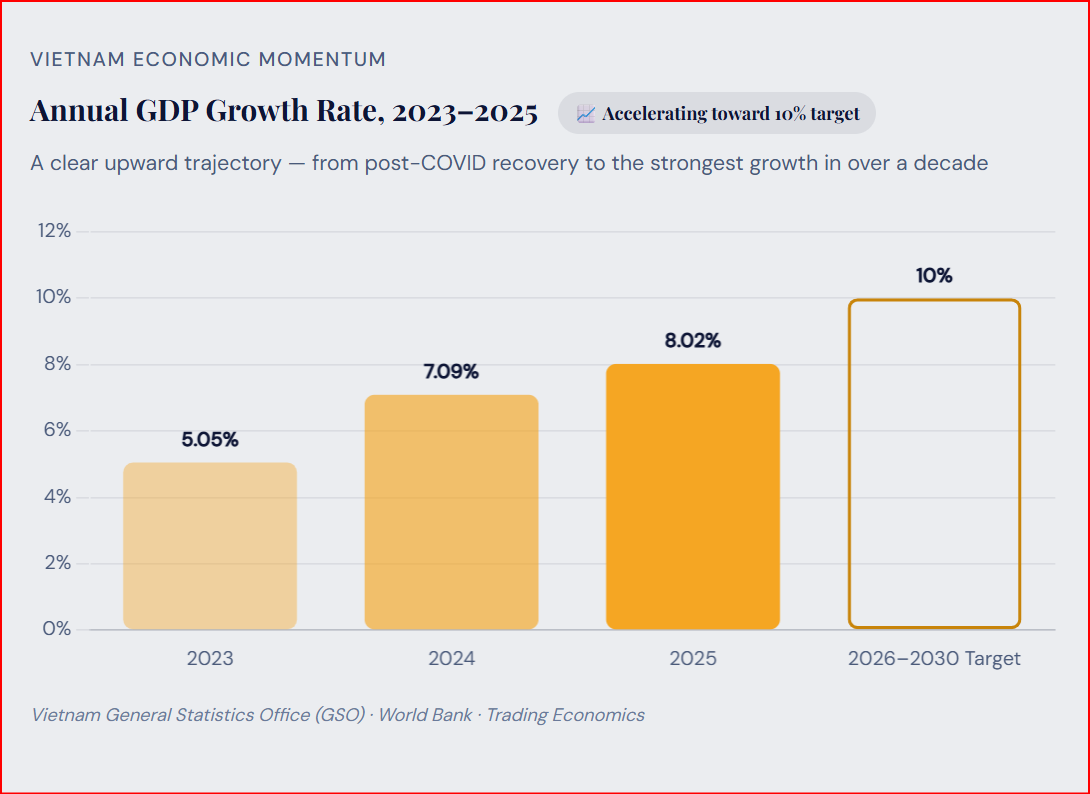
Note: 8.02% growth in 2025 was the second-highest rate since 2011, behind 2022, rather than the strongest in over a decade. The General Statistics Office cited in the chart is now the National Statistics Office under the Ministry of Finance.
What drives this resilience isn’t just manufacturing or exports, as the old narrative suggests. The government has placed science, technology, innovation, and digital transformation at the center of its growth strategy. Politburo Resolution No. 57-NQ/TW, issued in December 2024, sets a confirmed target for the digital economy to reach at least 30% of GDP by 2030, and 50% by 2045. Today it already stands at 14.02% of GDP (roughly $72 billion USD), according to Vietnam’s National Statistics Office, and its value added grew about 11.8% in real terms in 2025, faster than the broader economy. Priority sectors include AI, IoT, fintech, e-commerce, semiconductor manufacturing, and software development, with telecom leaders like Viettel alone investing approximately $1.2 billion in 5G infrastructure nationwide.
What this means in practical terms: foreign direct investment reached approximately $36 billion in 2023, according to the U.S. International Trade Administration, and the flow hasn’t slowed. More global companies are setting up regional hubs, and more opportunities are forming for people who want to build something meaningful here. The market is opening up, not chaotically, but with clear government direction and hard-earned momentum behind it. Vietnam isn’t just welcoming visitors. It’s actively looking for people with expertise, capital, and ideas to help shape this next chapter. If you want a market with room to grow, Vietnam is hard to ignore.
2. Living Environment
Let’s be upfront: Vietnam isn’t for everyone, and we’d rather be honest about that than oversell it. The traffic in Ho Chi Minh City is relentless. Air quality in Hanoi has real issues. Bureaucracy can move at its own pace. If you need silence, perfectly efficient systems, and full predictability in everyday life, you may find certain aspects of Vietnam frustrating.
But here’s what we’ve noticed, and we’ve seen it happen with dozens of people who came here not quite sure what to expect. Vietnam has a way of shifting your focus. The rawness that might feel overwhelming at first becomes part of what makes it feel alive. The noise, the motorbikes weaving through intersections, the street food carts that appear at 11pm, this is a city that doesn’t pretend. For people who connect with that energy, the minor inconveniences stop feeling like problems. They become texture. You find yourself more present, more resourceful, and often more connected to the people around you than you’ve felt in years. The country rewards those who lean into it.
3. Cost of Living
One of Vietnam’s most practical advantages is how far your money goes. In the major cities, Ho Chi Minh City, Hanoi, and Da Nang, there’s a genuine range. A comfortable, quality life on a modest budget is achievable from around $1,000–$1,500/month, covering a decent apartment, good food, transport, and some leisure. If you want more, a nicer place, regular dining out, an active social life, and regional travel, you’re looking at $2,000–$5,000/month. In most Western cities, that same spend would be considered a tight budget, not a comfortable one.
Rural areas and smaller provinces are even more affordable, though it’s worth being realistic: access to high-speed internet, international-standard healthcare, and convenient transport can be inconsistent outside the urban centers. For most expats and remote workers, the sweet spot is one of the big three cities, where infrastructure has improved dramatically and the quality-to-cost ratio is genuinely excellent. Vietnam lets you live well without burning your runway, which matters a lot if you’re here to build something.
4. Social Connections & Culture
Vietnamese people are, in our experience, genuinely warm. Coworkers tend to be sharp, eager to learn, and collaborative. Neighbors are friendly in a way that feels natural rather than performative. You’ll often find yourself invited to share a meal or a drink before you’ve properly exchanged names. There’s a generosity of spirit here that’s hard to quantify but easy to feel.
That said, cultural differences are real and worth respecting. Communication styles can be indirect at times, face-saving is important in professional settings, and language remains a genuine barrier outside of business or expat communities in major cities. But these aren’t walls. They’re layers. With patience and a willingness to meet people where they are, you’ll find that meaningful connections form faster here than in many places. Vietnam rewards curiosity and humility. Come with an open mind and genuine respect for the culture, and you’ll be welcomed for it.
Sources:
Vietnam National Statistics Office (formerly the General Statistics Office) · World Bank East Asia & Pacific Outlook 2025 · Trading Economics · Politburo Resolution No. 57-NQ/TW, Dec 2024 · Vietnam Investment Review · VietnamPlus / Ministry of Science & Technology · U.S. International Trade Administration, Vietnam Country Commercial Guide
Frequently asked questions


Easytiger Match
Find the right professional
- Tell us what you need
- We shortlist professional(s) and introduce them to you