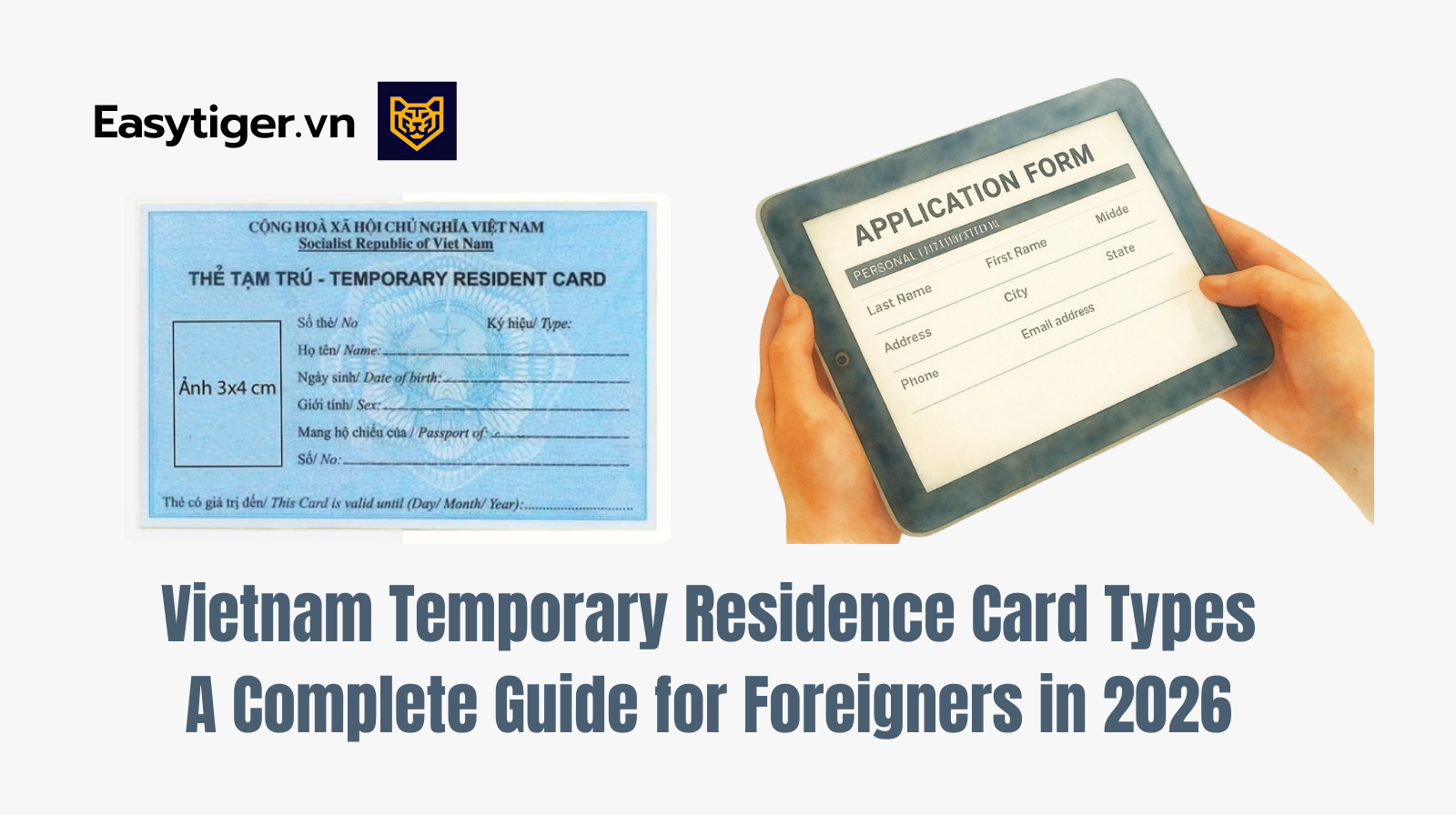
Look closely at any Temporary Residence Card in Vietnam and you will find a small string of letters printed near the photo. DT2. LD1. TT. NN2. Almost nobody explains what these mean when the card lands in your hands, and most people who hold one for years never find out.
That little code is not decoration. It is the legal category your entire residence in Vietnam is built on, and it determines how long your card lasts, what you are allowed to do while holding it, and whether your spouse or children can join you here. Misunderstanding your category, or ending up in the wrong one, tends to create complications later rather than immediately, often surfacing during a renewal application or a change in employment.
With that in mind, here is the full picture: the categories that exist, who qualifies for each one, and what the process actually looks like once you are the one filing the paperwork.
First, What a TRC Actually Replaces
A Temporary Residence Card, thẻ tạm trú in Vietnamese, is issued by Vietnam’s Immigration Management Department, or in a handful of diplomatic cases, an office under the Ministry of Foreign Affairs. Once you hold one, it functions as a full substitute for your visa. You can enter and leave Vietnam as many times as you like during the card’s validity without applying for a new visa each time, and you are not stuck in the cycle of visa runs or extension applications that short-term visa holders deal with.
This sits in the middle tier of Vietnam’s residence structure, above short-term stay (lưu trú) and below permanent residence (thường trú). We broke down how all three fit together in more detail in an earlier piece. Think of the TRC as the long-term lease compared to a visa’s month-to-month arrangement. It is still tied to a specific purpose and still expires, but it buys you years of stability instead of weeks.
So, How Many Types of TRC Actually Exist?
This is where most explanations online get sloppy, because the honest answer depends on how you count. Vietnamese immigration law recognizes sixteen distinct TRC categories, each tied to a specific visa symbol, grouped under four duration tiers by Article 38 of the amended Law on Entry, Exit, Transit, and Residence of Foreigners (Law No. 47/2014/QH13, as amended by Laws No. 51/2019/QH14, 23/2023/QH15, and 118/2025/QH15). Some guides round this down by lumping categories together under a purpose label like “labor” or “investment,” which is fine for a quick summary but leaves out real distinctions that matter once you are the one filing the paperwork.
Here is the actual breakdown, by purpose:
The institutional and diplomatic group. NG3 covers members of diplomatic missions, consulates, and UN or intergovernmental organization offices in Vietnam, along with their spouse, children under 18, and accompanying domestic staff. LV1 is for foreigners working with central Party bodies, the National Assembly, the Government, the Fatherland Front, the courts, the State Audit Office, ministries, or provincial People’s Councils and Committees. LV2 covers those working with socio-political organizations or the Vietnam Chamber of Commerce and Industry. A less commonly discussed category, LS, applies to foreign lawyers licensed to practice at a law firm based in Vietnam.
The investor group. This is where a single letter hides three very different realities. DT1, DT2, and DT3 are all investor categories, and which one you qualify for depends mainly on your capital contribution, though DT1 and DT2 can also be granted for investment in sectors or locations the Government gives incentives to or encourages. Below a certain capital threshold, and outside those sectors, you are not eligible for a TRC at all, only a short-term visa. We will map this out properly in a moment.
The labor group. LD1 covers foreigners confirmed as exempt from needing a work permit. LD2 covers those working under a valid work permit. This is the most common category among the expat professionals and business owners we talk to regularly.
The family group. TT is issued to the spouse or child under 18 of someone holding an LV1, LV2, LS, DT1 through DT3, NN1, NN2, DH, PV1, LD1, or LD2 card, or to the parent, spouse, or child of a Vietnamese citizen.
The academic and professional groups. DH covers students, trainees, and interns at a Vietnamese school or training institution. NN1 and NN2 cover heads of representative offices, whether for international organizations and foreign NGOs (NN1) or foreign traders, branches, and economic or cultural organizations (NN2). PV1 covers foreign correspondents and journalists on long-term assignment in Vietnam.
The preferential group. Since 1 July 2026, Law No. 118/2025/QH15 has added two more categories. UD1 (UĐ1) covers high-quality digital technology workers and other preferential cases, and UD2 (UĐ2) covers their spouses and children under 18. Both can be issued cards valid for up to 10 years.
Add it up and that is sixteen categories: NG3, LV1, LV2, LS, DT1, DT2, DT3, DH, NN1, NN2, TT, PV1, LD1, LD2, UD1, and UD2.
One detail that trips up a lot of investors specifically: if your capital contribution falls under VND 3 billion, you do not qualify for a TRC on the strength of your capital alone. You are typically limited to a DT4 visa, capped at 12 months, and there is no version of that visa that upgrades into a card. The exceptions are investments in sectors or locations eligible for investment incentives, which can qualify for DT1, and in sectors where the Government encourages investment, which can qualify for DT2. Otherwise, the usual path forward is increasing your registered capital contribution.
Which of These Can You Actually Renew?
All sixteen. There is no category on this list that is a one-time-only card. What changes from category to category is simply what you need to show to prove the underlying basis for your stay is still valid. An LD2 holder renews by presenting a work permit that is still active or has been extended. A DT1 through DT3 holder renews by confirming the investment or business registration is unchanged and the capital is still in place. A TT holder renews by reconfirming the marriage or family relationship still stands.
What does not happen is a simple extension stamp on your existing card. Vietnam’s immigration system reissues the entire physical card with a new expiry date each time, so budget for the same document-gathering effort as your first application, just usually with less back-and-forth since the file already exists on record.
There is no hard legal deadline dictating exactly how many days before expiry you must file, but the consistent advice from immigration lawyers and agencies we have spoken with is 5 to 15 working days before your card expires. That window gives you room to fix any missing paperwork without risking even a single day of overstay, which carries financial penalties regardless of how minor the delay is.
The Conditions You Need to Meet Before Anyone Grants You a Card
Every category shares a baseline set of requirements, on top of whatever is specific to your purpose of stay.
Your passport needs at least 13 months of remaining validity at the time you apply. This matters beyond just having a valid document, because your card’s duration is capped at your passport’s remaining validity minus 30 days. A five-year TRC does you no good if your passport expires in eighteen months. You will simply be issued a shorter card.
You need a properly registered temporary residence confirmation from your local ward or commune police, either filed in person or through the online declaration system, before your TRC application can move forward.
You need to be entering or already residing in Vietnam under a visa category that actually matches the TRC you are applying for. Immigration will not process a TRC application for a purpose that does not match your current visa symbol. If your situation has changed since you entered Vietnam, for example you came in on a business visa and later got married to a Vietnamese citizen, you need to formally convert your visa category first before applying for the corresponding TRC.
And critically, you cannot be under criminal investigation, named in an unresolved civil, economic, or labor dispute, obligated to serve a criminal sentence, obligated to fulfill a civil or economic judgment, or behind on an administrative penalty or tax debt. That last point catches more people than you would expect, particularly foreign legal representatives of Vietnamese companies. If your company has an outstanding tax liability, immigration authorities can suspend your exit and refuse your TRC application entirely until the tax office issues a formal release, a rule tied to Decree 252/2026/ND-CP on tax administration.
Building the Application, and Where It Actually Goes
The paperwork differs meaningfully depending on your category, so here is what each common path actually requires.
If you are applying under a labor category (LD1 or LD2), your sponsoring company needs to submit a notarized copy of its business registration certificate, its seal registration, and your work permit or work permit exemption confirmation, which needs at least 12 months of remaining validity at the time of filing. You will also need the standard immigration forms, NA6 and NA8, along with two passport-style photos.
If you are applying as an investor (DT1 through DT3), you need your investment registration certificate or business registration certificate clearly showing your capital contribution, plus documentation proving the capital was actually transferred, such as bank records. Immigration will also want to see that the company is genuinely operating, not simply registered on paper.
If you are applying under the family category (TT) through marriage to a Vietnamese citizen, you need your marriage certificate, either registered in Vietnam or consularly legalized and translated if registered abroad, plus your spouse’s Vietnamese identification documents.
If you are applying as the dependent of another TRC holder, you need a legalized and translated document proving the family relationship, whether that is a marriage certificate or a birth certificate, along with your sponsor’s own passport and TRC.
Your sponsor files the application with the immigration authority covering where the sponsoring organization has its head office, or where the sponsoring individual lives. That means the Immigration Management Department under the Ministry of Public Security or the relevant provincial immigration office, while NG3 cards go through the Ministry of Foreign Affairs. In practice, that means 333 to 337 Nguyen Trai Street in Ho Chi Minh City, or 44 Tran Phu Street in Ba Dinh, Hanoi, depending on your sponsor’s base. Some companies with a registered digital identification account can now initiate submission through the National Public Service Portal, though original documents typically still need a follow-up in-person visit.
Government fees under Circular 28/2026/TT-BTC are 145 USD for cards valid up to 2 years, 155 USD for cards valid more than 2 and up to 5 years, and 165 USD for cards valid more than 5 and up to 10 years. The legal processing time is 5 working days from receipt of a complete file, though we would plan for closer to two weeks in practice, since first submissions frequently come back with a request for one more document.
When Does Getting a TRC Actually Make Sense?
If you are in Vietnam for a few months, a standard visa or extension is simpler and cheaper, and pursuing a TRC is probably overkill. The math flips once you are looking at a year or more under a stable purpose, whether that is a job, an investment, a marriage, or a course of study. At that point, the TRC removes an entire cycle of repeat visa applications for the length of the card, which adds up in both money and hassle.
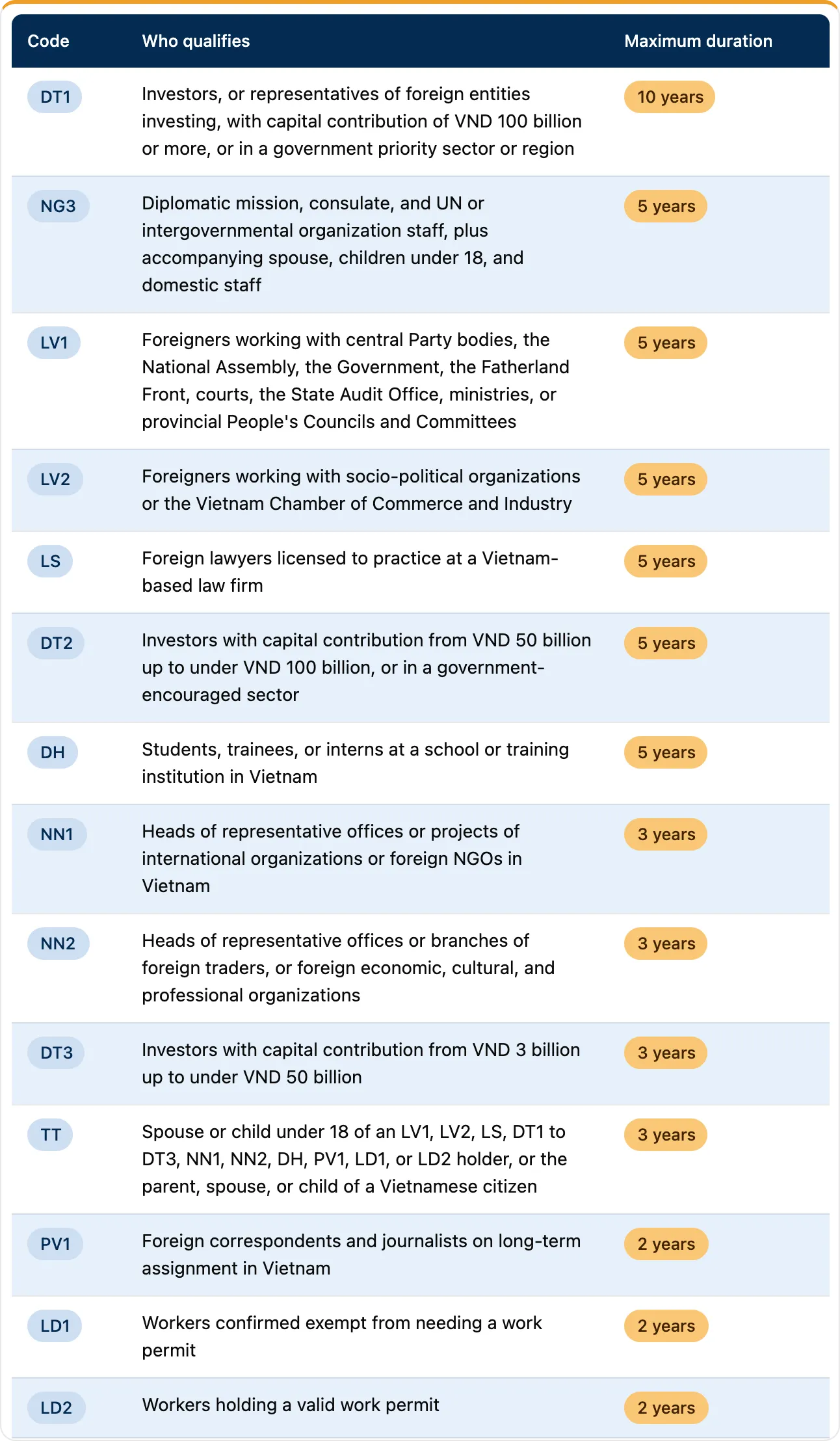
Here is the full category breakdown in one place, to help you place yourself.
TRC Category Full Breakdown
Reminder for the investor rows: capital contribution under VND 3 billion means a DT4 visa only, capped at 12 months, unless the investment is in a sector or location that qualifies for DT1 or DT2 on incentive or encouraged-investment grounds.
What You Actually Gain by Holding One
Beyond skipping repeat visa applications, a TRC changes daily life in a few concrete ways.
You enter and exit Vietnam visa-free for the entire validity of your card, just by showing it at the border, without the timing pressure that comes with standard visas.
It smooths the path toward owning an apartment in Vietnam under the foreign ownership provisions, and it makes company registration or getting married here considerably easier, since your legal residence status is already documented and on file.
You can sponsor parents, grandparents, a spouse, or children to visit more easily. And if you hold a TRC under LV1, LV2, LS, DT1 through DT3, NN1, NN2, DH, PV1, LD1, or LD2, your spouse and children under 18 can live with you in Vietnam under a TT card of their own, as long as your sponsoring employer or organization consents.
For anyone building something here rather than just passing through, that adds up to fewer interruptions and a lot less time spent managing paperwork instead of the actual reason you came.
Where People Actually Get Tripped Up
A handful of things are worth knowing before you walk into an immigration office.
Using your card for something other than what it was issued for is a real violation, not a technicality. Entering under an investor category and later taking a salaried job at a different, unrelated company without a proper work permit can get your TRC revoked outright. If your circumstances genuinely change, the correct move is converting your visa category first, then applying fresh, not continuing to use the old card.
Overstaying carries real financial consequences starting from day one. Under Decree 282/2025/ND-CP, penalties scale with how long you have overstayed, starting at VND 500,000 to 2,000,000 for an overstay of under 16 days and rising steeply from there, with deportation and a re-entry ban possible for longer violations. Sponsoring companies that allow this to happen face double the individual penalty.
Your passport quietly caps everything else. If it is close to expiring, your TRC gets shortened to match, sometimes well under the maximum your category technically allows. Check your passport’s expiry date before applying for anything longer term.
And do not assume every category is denied for the same reasons. Tax debt tied to a company you legally represent, an unresolved civil dispute, or a pending criminal matter can each independently block an otherwise straightforward application, no matter how solid your underlying visa category is.
Sixteen categories is genuinely a lot to hold in your head, and you are not expected to memorize all of them. What actually matters is identifying the one category that fits your situation and building your file around that path specifically, rather than trying to absorb the whole system at once. If your case involves anything unusual, converting categories mid-stream, a mixed-status family, capital contributions near a threshold, working with someone who handles Vietnamese immigration paperwork daily will save you far more time than any amount of further reading, including this article.
If this cleared things up, pass it along to whoever you know is currently squinting at their own TRC trying to figure out what the letters mean.
And if you would rather have a specialist walk through your specific situation directly, Easytiger can put you in touch with the right person.
This article is for informational purposes only and does not constitute legal or immigration advice. Immigration regulations in Vietnam are subject to change. Consult a qualified specialist for guidance specific to your situation.
Frequently asked questions
Since 1 July 2026 there are 16 TRC categories. Article 36 of the Law on Entry, Exit, Transit, and Residence of Foreigners (Law No. 47/2014/QH13, as amended, most recently by Law No. 118/2025/QH15) covers NG3, LV1, LV2, LS, DT1, DT2, DT3, NN1, NN2, DH, PV1, LD1, LD2 and TT. The 2025 amendment added UD1, for high-quality digital technology workers and other preferential cases, and UD2 for their spouses and children under 18. Each card carries the same symbol as the visa it is based on.
It depends on the category. Under Article 38 of Law No. 47/2014/QH13 as amended, DT1, UD1 and UD2 cards last up to 10 years. NG3, LV1, LV2, LS, DT2 and DH cards last up to 5 years, NN1, NN2, DT3 and TT up to 3 years, and LD1, LD2 and PV1 up to 2 years. In every case the card must expire at least 30 days before your passport, so a passport close to expiry means a shorter card.
DT1 needs a capital contribution of VND 100 billion or more, DT2 needs VND 50 billion to under VND 100 billion, and DT3 needs VND 3 billion to under VND 50 billion. DT1 is also open to investment in sectors or locations that qualify for investment incentives, and DT2 to sectors where investment is encouraged, as decided by the Government. On capital alone, under VND 3 billion only leads to a DT4 visa of up to 1 year, which has no TRC. These rules are in Articles 8 and 9 of Law No. 47/2014/QH13 as amended.
Under Circular No. 28/2026/TT-BTC, in force since 1 April 2026, the government fee is 145 USD for a card valid up to 2 years. It is 155 USD for a card valid more than 2 and up to 5 years, and 165 USD for more than 5 and up to 10 years. The circular replaced Circular No. 25/2021/TT-BTC but kept these amounts. The fee is not refunded if the application is refused.
The legal processing time is 5 working days from receipt of a complete file. Under Article 37 of Law No. 47/2014/QH13 as amended, the sponsoring organization or individual files at the immigration authority where the organization has its head office or where the sponsoring individual lives. NG3 cards go through the Ministry of Foreign Affairs instead. The file includes the sponsor's request letter, a declaration form with a photo, the passport, and proof that the applicant fits an eligible category.
You need a new card. Under Article 38 of Law No. 47/2014/QH13 as amended, an expired TRC can be considered for a new card, not extended. That means a fresh application with current proof that the basis for your stay, such as the work permit, investment or family relationship, still applies. File before the old card expires, because staying past its expiry without permission is fined under Decree No. 282/2025/ND-CP.
Yes, in most categories. The spouse and children under 18 of an LV1, LV2, LS, DT1, DT2, DT3, NN1, NN2, DH, PV1, LD1 or LD2 holder qualify for a TT visa and card, and so do the parents, spouse and children of a Vietnamese citizen. Dependants of a UD1 holder get a UD2 card instead. Under Article 44 of Law No. 47/2014/QH13 as amended, a TRC holder can sponsor a spouse and children under 18 to live with them only if the holder's own sponsoring organization agrees.
Fines apply from the first day. Under Article 21 of Decree No. 282/2025/ND-CP, in force since 15 December 2025, staying past the expiry of a TRC or other permitted stay for less than 16 days is fined VND 500,000 to 2,000,000. The fine rises through several tiers to VND 30,000,000 to 40,000,000 for one year or more. Deportation can also be imposed, depending on how serious the violation is.
Share article
Easytiger Match
Find the right professional
1Tell us what you need
2We shortlist professional(s) and introduce them to you