
On July 1, 2026, the World Bank moved Vietnam into the upper middle income bracket years ahead of its own target. Here is what actually changed, and what the next two decades will demand.
In 1986, the average person in Vietnam earned about 95 US dollars a year. Not a month. A year.
The country was among the poorest on earth at the time, still rebuilding from decades of war, largely cut off from the global economy, and about to make a gamble few of its neighbors expected to pay off. That year, Vietnam’s leadership launched Đổi Mới, meaning Renewal, a sweeping decision to open a closed, centrally planned economy to markets, private enterprise, and foreign trade.
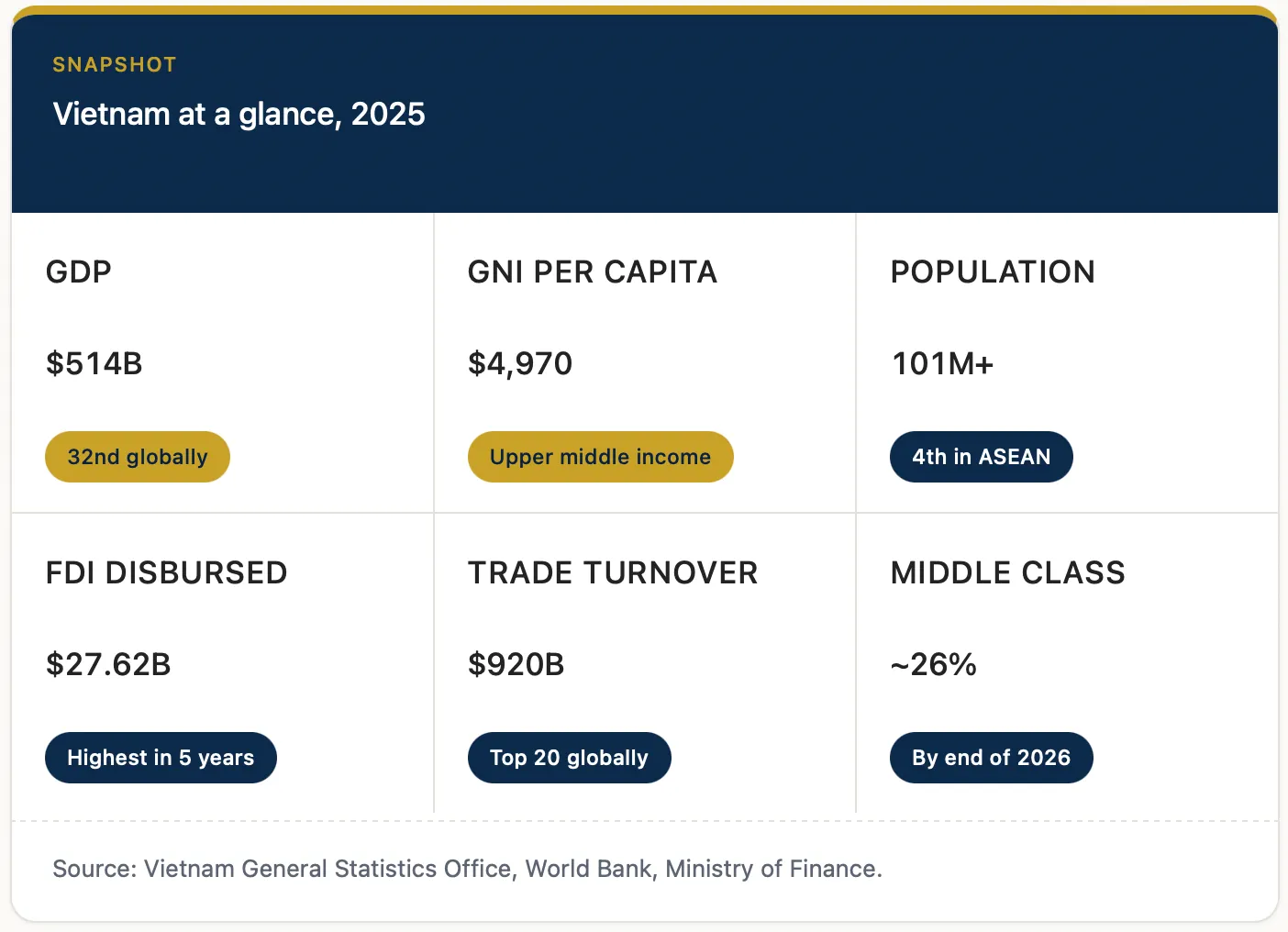
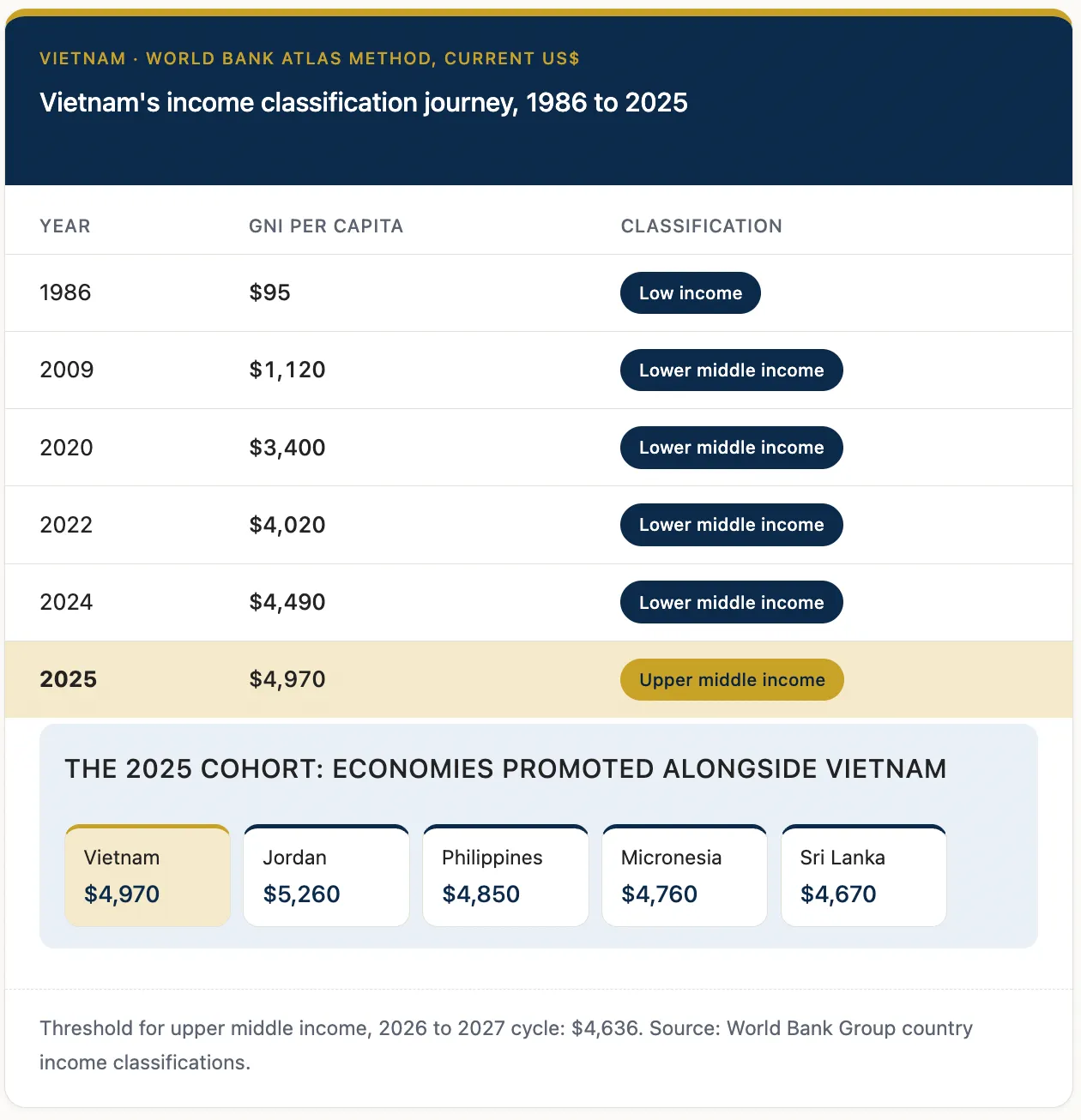
Almost forty years later, that gamble reached a new milestone. On July 1, 2026, the World Bank released its annual country income classifications, the report that sorts every economy on earth into one of four income tiers. Vietnam’s gross national income (GNI) per capita, the exact figure the Bank uses to do the sorting, had reached 4,970 US dollars in 2025. That number cleared the 4,636 dollar line drawn for upper middle income status, and Vietnam moved out of the lower middle income bracket it had occupied since 2009.
Run those two figures side by side, 95 dollars then and 4,970 dollars now, and Vietnam’s income per person today is more than fifty times higher than it was when Đổi Mới began. That is the kind of number that explains a lot of what those of us living and working here have been watching happen around us for years: the price of an apartment two streets over climbing faster than most salaries, entire new manufacturing parks rising outside Hanoi and Hai Phong where there was rice paddy a decade ago, and a growing number of the business owners we talk with who are no longer asking whether to set up in Vietnam, only how quickly they can get it done.
This is not the first milestone Vietnam has reached ahead of schedule this decade, and it will not be the last conversation we have about what comes after it. Here is what the reclassification actually means, how Vietnam got here faster than almost anyone in the region expected, what it does and does not change for the people building something inside this economy, and what the next twenty years are going to ask of the country.
So, what does "upper middle income" actually mean?
Once a year, the World Bank sorts the world’s economies into four income groups: low income, lower middle income, upper middle income, and high income. The sorting is not based on GDP, the number most people reach for first. It is based on gross national income (GNI) per capita, a slightly broader measure that starts with GDP and adjusts it for money moving in and out of the country. A Vietnamese engineer sending savings home from a project abroad adds to Vietnam’s GNI. A foreign manufacturer repatriating profits from a factory in Binh Duong subtracts from it, even though that same factory added to Vietnam’s GDP the moment it produced anything. The Bank converts the result into US dollars using what it calls the Atlas method, a formula that averages exchange rates over three years to smooth out currency swings, then divides by population.
For the classification cycle that took effect this month, the bands are set at 1,175 dollars or less for low income, 1,176 to 4,635 dollars for lower middle income, 4,636 to 14,375 dollars for upper middle income, and anything above that for high income. Vietnam’s GNI per capita climbed from 4,490 dollars in 2024 to 4,970 dollars in 2025, comfortably clearing the line.
The World Bank credited the jump to Vietnam’s export led growth model. Exports grew by more than 15 percent in both 2024 and 2025, while GDP expanded 7 percent and then 8 percent in those same two years, the strongest back to back performance the country has posted since 2011. Zoom out further and GNI per capita grew at an average of roughly 10 percent a year between 2021 and 2025, a pace the Bank itself described as one of the strongest sustained runs in the region.
None of this is just a label for a press release. The classification determines which countries can still access concessional loans and development assistance, and it is the benchmark that governments, credit agencies, and investors use to track how an economy is actually developing over time. It is also, quietly, one of the more concrete answers to a question we get asked constantly by people weighing whether to move a business or a life here: is Vietnam still an emerging frontier, or has it become something else. As of this month, the World Bank’s answer is official.
How big is Vietnam's economy right now?
GNI per capita tells you about income. It does not tell you about scale, and scale is the part that changes what is actually possible inside an economy: how many jobs it can support, how much capital it can absorb, how loud a voice it gets at the regional table.
By the General Statistics Office’s own count, Vietnam’s GDP reached approximately 514 billion US dollars in 2025, up from 476.3 billion in 2024 and about 48 percent higher than the 346.6 billion dollars recorded back in 2020. That places Vietnam as the 32nd largest economy in the world, five places higher than in 2020, and the fourth largest in ASEAN, having overtaken the Philippines in 2024. Only Indonesia, and depending on the year and the dataset, Singapore or Thailand, now sit ahead of it in the region.
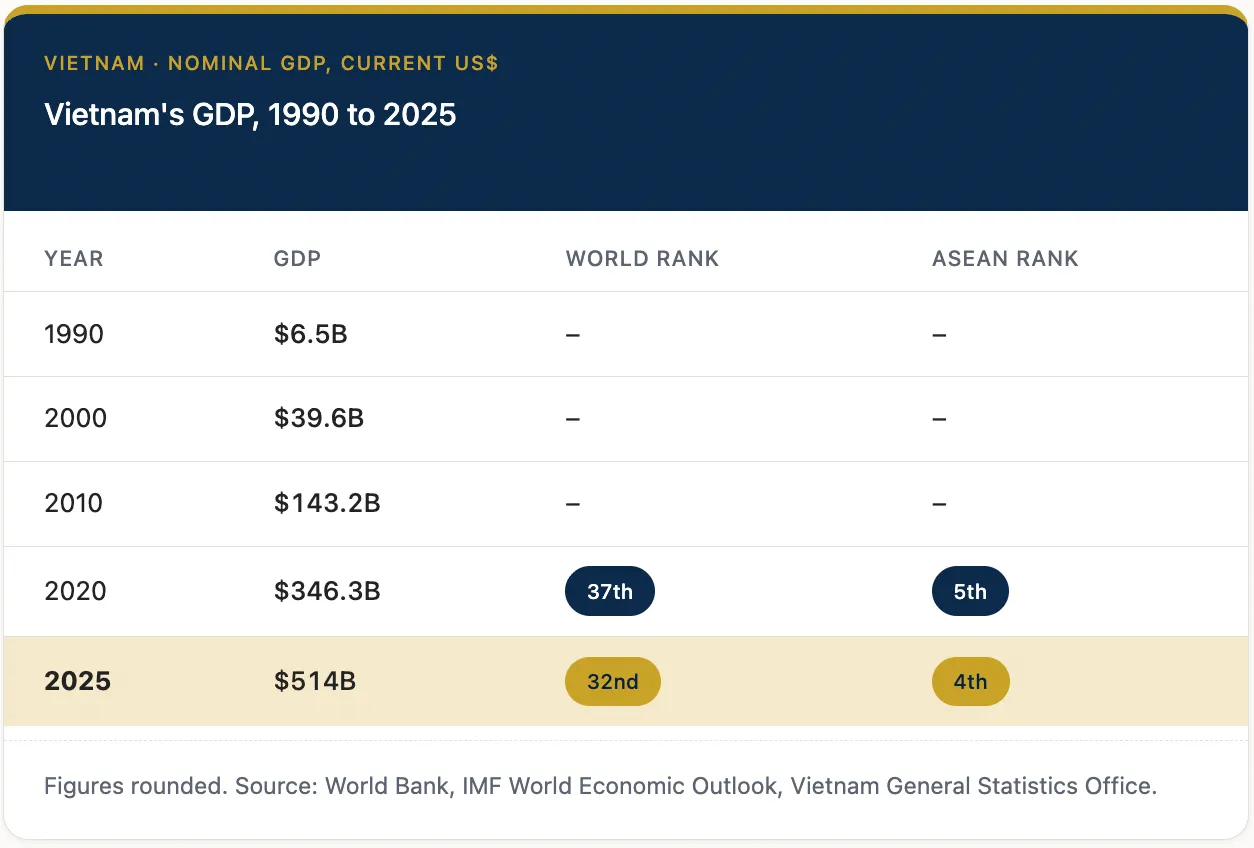
Put the last thirty five years side by side and the shape of the curve is genuinely unusual. Vietnam's economy was worth somewhere around 6.5 billion dollars in 1990, a few years into the Đổi Mới (Renewal) reforms that first opened the country to a market economy. By 2000 it had grown roughly sixfold to about 39.6 billion dollars. By 2010 it had grown almost fourfold again, to 143.2 billion. By 2020 it had more than doubled once more, to 346.3 billion. And in the five years since, it has grown by nearly half again, to 514 billion. Few economies compound at that pace for one decade, let alone four in a row.
Why Vietnam’s climb looks different from its neighbors
Scale explains what Vietnam’s economy can do today. Pace explains why the upper middle income label landed now rather than a decade from now, and the pace is really the standout part of this story.
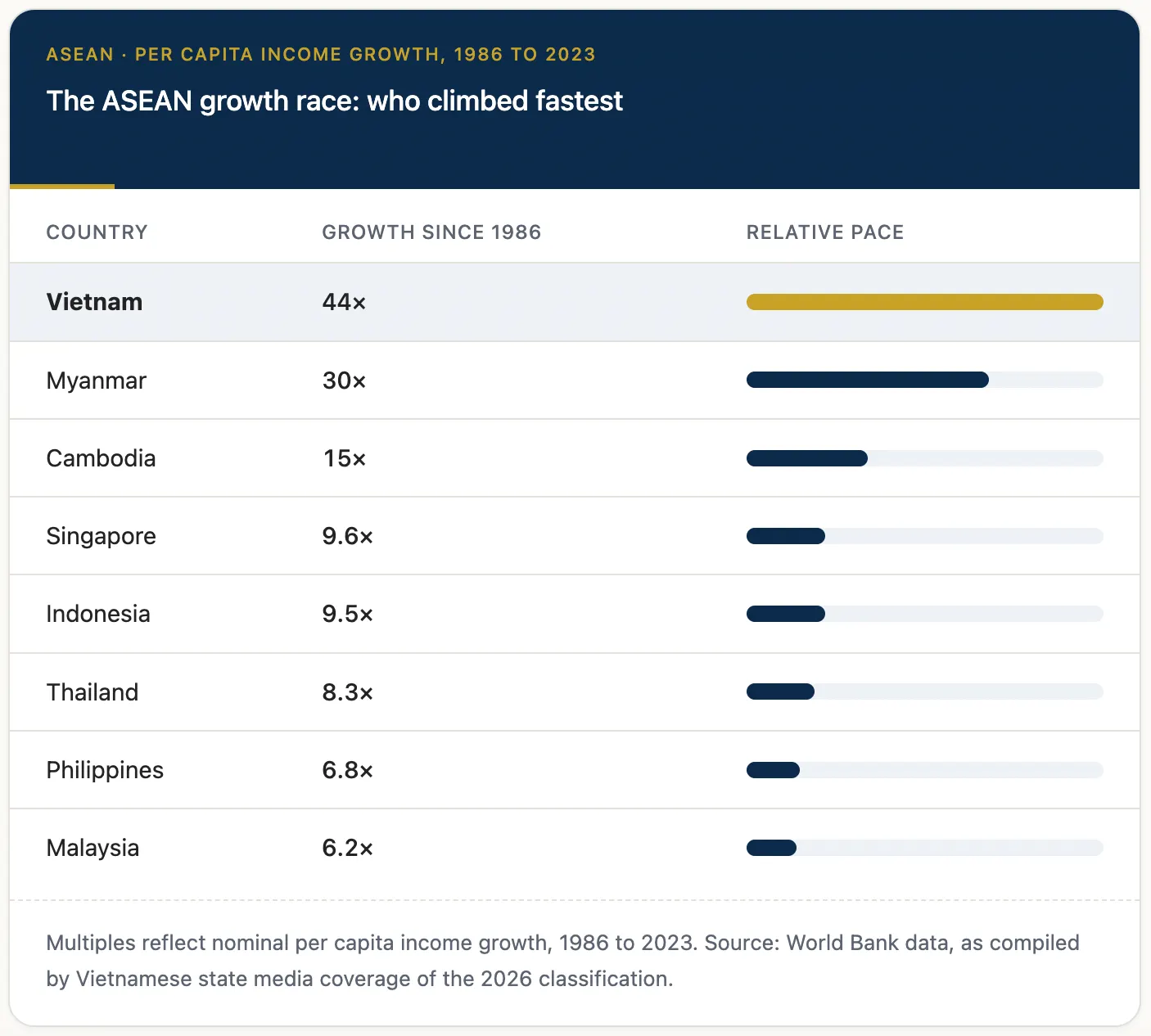
Look at per capita income growth across ASEAN between 1986, the year Đổi Mới began, and 2023, and Vietnam’s improvement is the largest in the bloc by a wide margin: a 44 fold increase, ahead of Myanmar’s 30 fold gain, Cambodia’s 15 fold gain, and the roughly sixfold to tenfold gains posted by Singapore, Indonesia, Thailand, the Philippines, and Malaysia over the same stretch.
The starting point makes the climb easier to picture. In 1986, Vietnam’s income per person sat at around 95 dollars a year, among the lowest anywhere on earth at the time. By 2009 that had climbed to roughly 1,120 dollars, enough to cross into lower middle income territory. From there it took about fifteen years to climb the next rung into upper middle income. For comparison, Thailand needed 22 years to make the same jump, and the Philippines needed 30. Vietnam has now made both of the moves the World Bank tracks, out of low income and out of the lower middle income bracket, faster than most of the region managed either one alone.
Vietnam was not the only one promoted this year
It is worth saying plainly that Vietnam did not do this alone, and the company it kept this cycle is genuinely instructive. Four other economies moved from lower middle income into upper middle income alongside Vietnam: Jordan, whose GNI per capita reached 5,260 dollars, the Philippines at 4,850 dollars, Micronesia at 4,760 dollars, and Sri Lanka at 4,670 dollars. A sixth country, Togo, moved up a different rung entirely, from low income into lower middle income, largely on the back of a population count that came in smaller than previously estimated once its 2022 census was finalized. Out of the 218 economies the World Bank assessed this year, these were the only six that moved up, and none moved down.
What makes Vietnam’s promotion stand out even within this group is how it got there. Jordan’s jump leaned heavily on a national accounts rebasing that found its economy was already about 10 percent larger than earlier estimates had captured. Sri Lanka’s was a recovery story, clawing back from the depths of its 2022 economic collapse. The Philippines earned its upgrade through broad based growth spread across nearly every sector rather than one standout industry. Vietnam is the only one of the five whose story is a straightforward export and manufacturing engine running at full power for several years running, with no statistical revision or crisis rebound doing any of the heavy lifting.
That distinction matters more than it sounds. The World Bank’s own 2024 World Development Report found that since 1990, only 34 middle income economies worldwide have gone on to reach high income status, and more than a third of those got there with help from European Union integration or newly discovered oil wealth, shortcuts that are not on the table for Vietnam. Whatever Vietnam does from here, it will have to do the hard way.
The tailwinds working in Vietnam’s favor
None of this happened by accident, and the same forces that produced this reclassification are still running underneath the economy right now.
The most visible one is the middle class. It made up roughly 13 percent of Vietnam’s population in 2023 and is projected to reach around 26 percent by the end of this year, doubling in under three years and adding more than 25 million new consumers, reportedly the fastest expansion anywhere in Southeast Asia. It comes with a caveat worth being honest about: World Bank research has found that close to 40 percent of people who enter Vietnam’s middle class slip back into a lower income bracket within just two years, a reminder that this new consumer class has more members than it has savings buffers.
Poverty, meanwhile, has kept falling. The share of the population living on less than 3.65 dollars a day, the World Bank’s line for extreme poverty in a lower middle income economy, dropped from 14 percent in 2010 to under 4 percent by 2023, down from close to 60 percent in the early 1990s.
Foreign direct investment has stayed remarkably resilient through all of this. Registered FDI reached 38.42 billion dollars in 2025, and disbursed capital, meaning money that actually arrived and got put to work, hit 27.62 billion dollars, up 9 percent on the year before and the highest disbursement figure in five years. Manufacturing alone pulled in over half of newly registered capital, with Singapore, China, Hong Kong, and Japan the largest sources.
And then there is simple demographic weight. With a population above 101 million, Vietnam is not just an export platform anymore. It is becoming a consumer market in its own right, one large enough that global brands are starting to plan around it rather than through it.
What this upgrade does not fix
An upper middle income label is not the same thing as an easier life, and it would be dishonest to write this piece without saying so.
The most immediate friction is cost of living, and housing leads that list. Apartment prices in Ho Chi Minh City rose by roughly a quarter year on year through the final quarter of 2025, with some segments climbing considerably faster, and Hanoi has seen similar pressure. By some estimates, a typical 70 square meter apartment in either city now costs a young professional something in the range of 20 to 25 years of income, a ratio that would be considered a crisis in most developed economies. For the expats and business owners we work with, this shows up as rising rents, harder salary negotiations, and a widening gap between headline growth numbers and what people actually feel in their monthly budget.
There is also a quieter shift in how the world finances Vietnam. Reclassification does not switch off concessional lending overnight (Vietnam still borrows through the same World Bank lending arm it always has), but the direction of travel is toward less cheap financing over time, not more, which puts more weight on Vietnam’s own capital markets and private investment to fund the next stage of growth. That is part of why officials have been talking openly about developing a genuine corporate bond market, so that businesses have a real alternative to bank loans when they want to expand, rather than leaning on bank credit for nearly everything the way the economy still does today.
Productivity is the harder problem underneath all of this. Vietnamese economists have pointed out that total factor productivity, essentially how much growth comes from working smarter rather than simply working more or investing more, needs to climb above 60 percent of overall growth for the economy to keep compounding at the pace it will need. Research and development spending remains comparatively low next to regional peers, and a large share of Vietnam’s exports still sit at the assembly and packaging end of global supply chains rather than the design or engineering end, where the real margins live.
Vietnam’s answer to that last problem is its semiconductor strategy, formalized in Decision 1018/QD-TTg in September 2024, which targets 25 billion dollars in industry revenue and 50,000 trained engineers by 2030, alongside the country’s first wafer fabrication plant, already approved and under construction. It is an ambitious bet on moving up the value chain rather than just adding more assembly lines, and it is still very early days.
Layered on top of all of this is a demographic clock now ticking the other way. The share of Vietnam’s population over 50 has grown from around 18 percent in 2010 to close to 28 percent today, and the window of young, low cost labor that powered the last four decades will not stay open indefinitely.
The next twenty years: can Vietnam reach high income by 2045?
We wrote in an earlier piece, Vietnam Is Calling, that the government had committed to reaching upper middle income status by 2030, alongside a target of 10 percent annual growth through the rest of the decade. Vietnam has now cleared that bar roughly four years ahead of its own schedule, which tells you something about how this government tends to set targets: they seem to function as floors, not ceilings.
The next one on the list is bigger. Vietnam has set its sights on becoming a high income country by 2045, timed to the 100th anniversary of the country’s founding. To get there, GDP per capita needs to clear somewhere around 13,000 to 14,000 dollars, close to the World Bank’s current line for high income status, which means nearly tripling today’s figure inside two decades. That works out to sustained per capita growth of roughly 6 percent a year, every year, for twenty straight years, a pace few economies anywhere have managed to hold for that long without a serious stumble along the way. The Government’s own longer range ambition, laid out in earlier congress resolutions, aims higher still: a GNI per capita around 18,000 dollars by 2045, well past the bare minimum needed to clear the threshold.
Whether Vietnam gets there will come down to a handful of things this piece has already touched on: raising the share of value that stays inside the country from FDI driven exports rather than exporting it back out as profit, lifting productivity’s share of growth rather than leaning on ever more capital and labor, developing capital markets deep enough to fund the next generation of Vietnamese companies, and building genuine capability in the kind of core technology that does not get outsourced. None of that happens on autopilot. Remember, only 34 economies worldwide have made this exact jump since 1990, most of them with help Vietnam will not have.
For those of us running businesses here, none of this is abstract. It shows up as the cost of the next apartment, the strength of the next hiring market, the value of the next contract with a foreign partner who is watching these same numbers. Vietnam just proved it can hit a milestone years ahead of its own schedule. The next two decades will decide whether that becomes the norm or the exception.
Have questions about what this shift means for your business, your investments, or your move to Vietnam?
Contact Easytiger.vn and we will help you think it through.
This article is for informational and educational purposes only and does not constitute financial, investment, or legal advice. Economic data and government targets are subject to revision. Consult a qualified professional for guidance specific to your situation.