What Law 134/2025/QH15 means for businesses, startups, and expats navigating Vietnam's fast-moving digital economy (This article was originally published on 19 March 2026 on our substack)
Trong bài viết này8
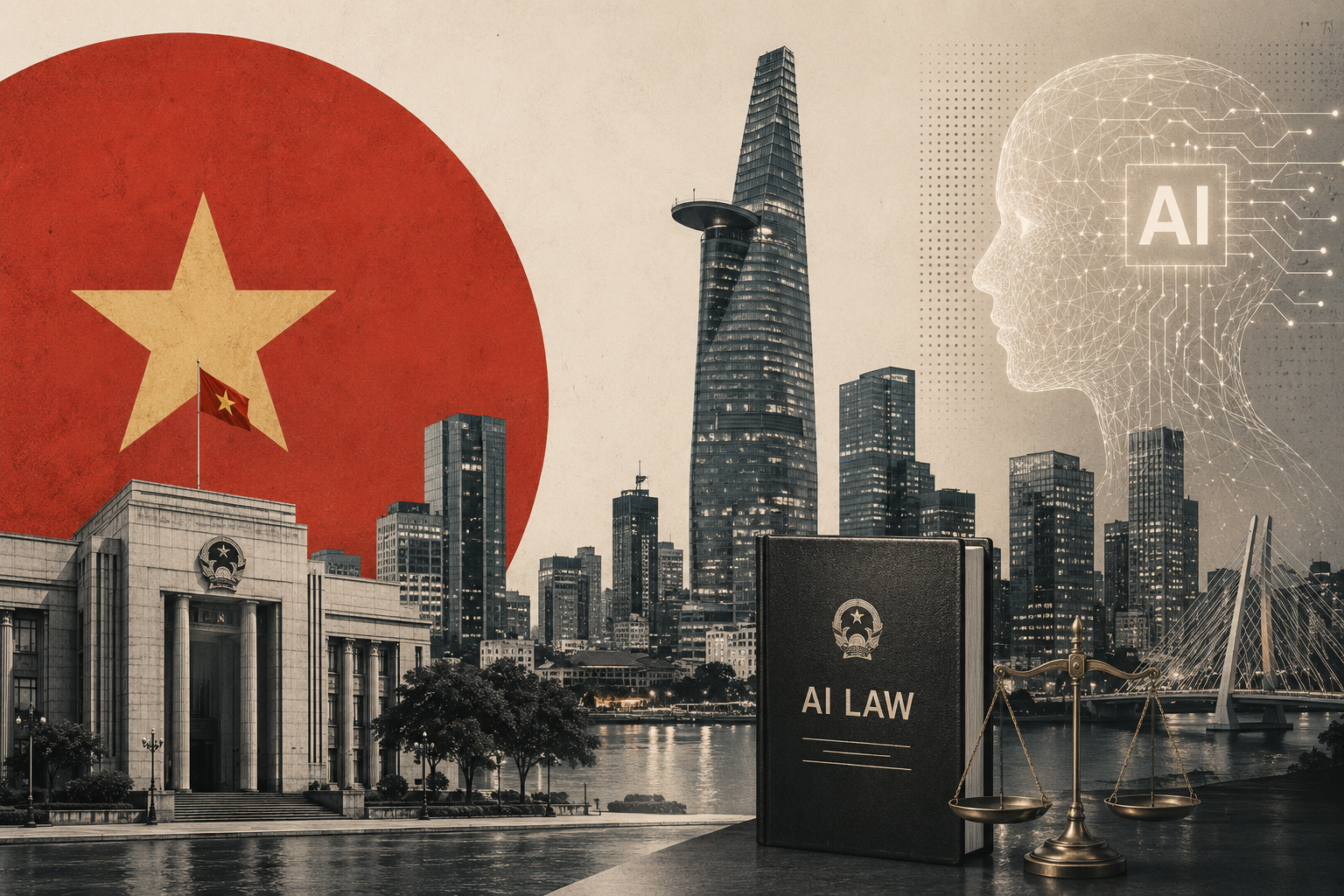
Vietnam moves fast. Anyone who has spent time doing business here knows it: the energy, the entrepreneurial hunger, the speed at which this country adapts. So it shouldn’t come as a surprise that on March 1, 2026, Vietnam became the first country in Southeast Asia to have a comprehensive, standalone legal framework for Artificial Intelligence. The National Assembly passed Law No. 134/2025/QH15 on December 10, 2025, and it came into force on March 1, 2026. While most of its neighbours are still in exploratory phases, Vietnam has already codified its rules, making it one of only a handful of countries globally to have done so.
For founders, tech companies, legal professionals, and expats setting up operations in Vietnam, this law changes the landscape. Here is what you need to know.
What the Law Actually Covers
The AI Law governs the research, development, provision, deployment, and use of AI systems in Vietnam. It applies to both Vietnamese and foreign entities participating in AI-related activities on Vietnamese soil. If your company uses, sells, or deploys an AI product here, this law applies to you.
The law was deliberately designed with a “regulate to develop” philosophy. Rather than regulating the technology itself, it focuses on outputs and behaviors: what AI systems do, how they affect people, and what risks they create for society. This approach mirrors international best practice and avoids stifling innovation at the infrastructure level. Vietnam has placed particular emphasis on national AI sovereignty alongside accountability, going further than many peer frameworks by pairing strict risk controls with active state investment in domestic AI capability.
Consisting of 35 articles across 8 chapters, the law covers rights and obligations for developers, providers, deployers, and users of AI systems, and establishes a state management framework led by the Ministry of Science and Technology.
Human-Centered by Design
One of the law’s foundational principles (Article 4) is that humans remain at the center. AI must serve people, not replace human authority and responsibility. In every significant decision, whether in healthcare, finance, education, or public administration, human oversight must be maintained.
This is not just philosophical language. Decision-makers remain legally responsible for AI-assisted outcomes. AI systems must be designed to allow human intervention and control at any point. Transparency, non-discrimination, and explainability are embedded as core obligations for anyone operating AI systems in Vietnam.
For product teams and businesses deploying AI-assisted services here, this means human-in-the-loop requirements need to be part of your system architecture from day one, not bolted on later.
What Is Strictly Prohibited
Article 7 lays out a clear list of banned behaviors. The law prohibits using AI systems that rely on fake or simulated people or real events to deliberately and systematically deceive or manipulate people in ways that seriously harm their rights, exploiting vulnerabilities of at-risk groups including children, the elderly, people with disabilities, and ethnic minorities, and creating or distributing deepfakes that could seriously harm national security or public order. Obstructing human oversight mechanisms is also explicitly banned.
Critically for IP-sensitive businesses: the law puts strong emphasis on intellectual property protection in the digital and AI environment. Collecting, processing, or using data to train AI systems in violation of data protection, personal data, cybersecurity, or IP laws is explicitly prohibited. This covers copyright, trademarks, patents, and industrial designs. AI-generated content that simulates real people, events, or voices must be clearly labeled so that it cannot be mistaken for authentic material.
For any company using third-party datasets, scraping content, or deploying generative AI tools commercially in Vietnam, this is non-negotiable compliance territory.
Risk Classification: High, Medium, Low
Chapter II introduces a three-tier risk classification system that determines how strictly your AI system is regulated.
High-risk systems are those capable of causing significant harm to human life, health, legitimate rights and interests, national or public interests, or national security. These require conformity assessment before deployment, periodic inspections, technical documentation and activity logs, and for foreign providers, a lawful point of contact in Vietnam (a commercial presence or authorized representative is mandatory where the system must be certified before use). For AI systems already in operation before March 1, 2026, the law gives an 18-month transition window in healthcare, education, and finance, giving providers and deployers until September 1, 2027 to achieve full compliance. All other sectors have a 12-month grace period, with compliance required by March 1, 2027. Decision No. 33/2026/QD-TTg applies the same deadlines to systems on the high-risk list that were already operating before August 15, 2026.
Medium-risk systems face transparency obligations. Providers must ensure users are clearly informed when they are engaging with AI, and audio/visual content created by AI must be machine-readable marked.
Low-risk systems face lighter oversight, with accountability triggered primarily when there are signs of violation or public harm.
Providers self-classify their systems before deployment. Medium and high-risk systems must notify the Ministry of Science and Technology through a national one-stop digital portal. The details the law left to implementing guidance, including risk classification criteria, labeling requirements, incident reporting, and conformity assessment procedures, have since been issued in Decree No. 142/2026/ND-CP, in force since May 1, 2026. The Prime Minister's list of high-risk AI systems followed in Decision No. 33/2026/QD-TTg, in force since August 15, 2026.
How Vietnam Government Actively Supports AI Growth
Perhaps the most underreported aspect of this law is how pro-development it actually is. The Vietnamese government is not just regulating AI; it is actively funding and scaffolding the ecosystem.
The law establishes the National AI Development Fund (Article 22), a non-budgetary state financial fund that will mobilize resources to support AI research, infrastructure, training, and enterprise development. The fund operates with flexible disbursement mechanisms not tied to the annual budget cycle, meaning it can move at the speed of technology rather than government procurement timelines.
Article 25 introduces the AI Voucher mechanism, which provides startups, SMEs, and creative tech enterprises with subsidized access to computing infrastructure, shared datasets, large Vietnamese-language models, testing environments, and technical advisory services. This directly reduces the cost of entry for early-stage companies.
A controlled regulatory sandbox (Article 21) allows companies to test sensitive or high-risk AI solutions in a supervised environment with reduced legal liability, a genuine incentive for companies that want to experiment before committing to full-scale deployment.
The law also mandates a National AI Strategy (Article 19), reviewed at minimum every three years. Vietnamese-language large language models and AI tools for ethnic minority languages are explicitly prioritized, a signal that Vietnam is thinking seriously about domestic AI sovereignty rather than simply adopting foreign models wholesale.
Ethics and Accountability: Built Into the Framework
Chapter V establishes a National AI Ethics Framework built on principles of safety, human dignity, fairness, transparency, non-discrimination, and social responsibility. The framework will inform technical standards, industry guidelines, and incentive policies across sectors.
For businesses, the practical outcome is this: AI ethics in Vietnam is becoming institutionalized. Government agencies operating high-risk AI systems, or AI with a significant impact on human rights, social fairness, or the public interest, must prepare impact assessment reports, which are published except for confidential content. AI systems cannot absorb responsibility for decisions affecting citizens; human decision-makers remain accountable throughout.
This alignment with international norms makes Vietnam’s framework legible and credible to foreign investors and multinational partners, which is precisely the point. The legislation is designed to let Vietnam integrate deeply with global technology standards while retaining sovereignty over how AI operates within its borders.
What This Means for Vietnam’s Growth
From our perspective at Easytiger, working at the intersection of legal services and technology in Vietnam, this law signals something important. Vietnam is no longer positioning itself purely as a manufacturing economy. It is positioning itself as an innovation economy with sovereign rules, a domestic AI ecosystem, and the regulatory credibility to attract serious tech investment.
Then-Prime Minister Pham Minh Chinh explicitly linked the law to national economic ambitions, describing AI as a pillar of sustainable development and central to Vietnam’s digital economy growth targets. The state will invest in a national AI computing center and a controlled open-data system, which are expected to reduce computing costs, remove market entry barriers, and foster a more competitive AI ecosystem.
For expats and foreign businesses, the practical implications are significant. There is now legal clarity on AI use that did not exist before. Compliance frameworks are becoming more predictable. And the government is actively investing in infrastructure and incentives that lower the barrier to entry for tech-forward businesses.
The risks are also real. Enforcement is coming. Companies that have been deploying AI tools in Vietnam without thinking about data handling, IP, transparency, or user rights are now on a clock. The 12-to-18 month transition period is generous, but it is not indefinite.
Vietnam is building something ambitious. The question for businesses, local and international alike, is whether you are ready to grow with it.
Source:
Law No. 134/2025/QH15 — Law on Artificial Intelligence, National Assembly of the Socialist Republic of Vietnam.
Câu hỏi thường gặp


Easytiger Match
Tìm chuyên gia phù hợp
- Cho chúng tôi biết nhu cầu của bạn
- Chúng tôi chọn lọc (các) chuyên gia và giới thiệu cho bạn