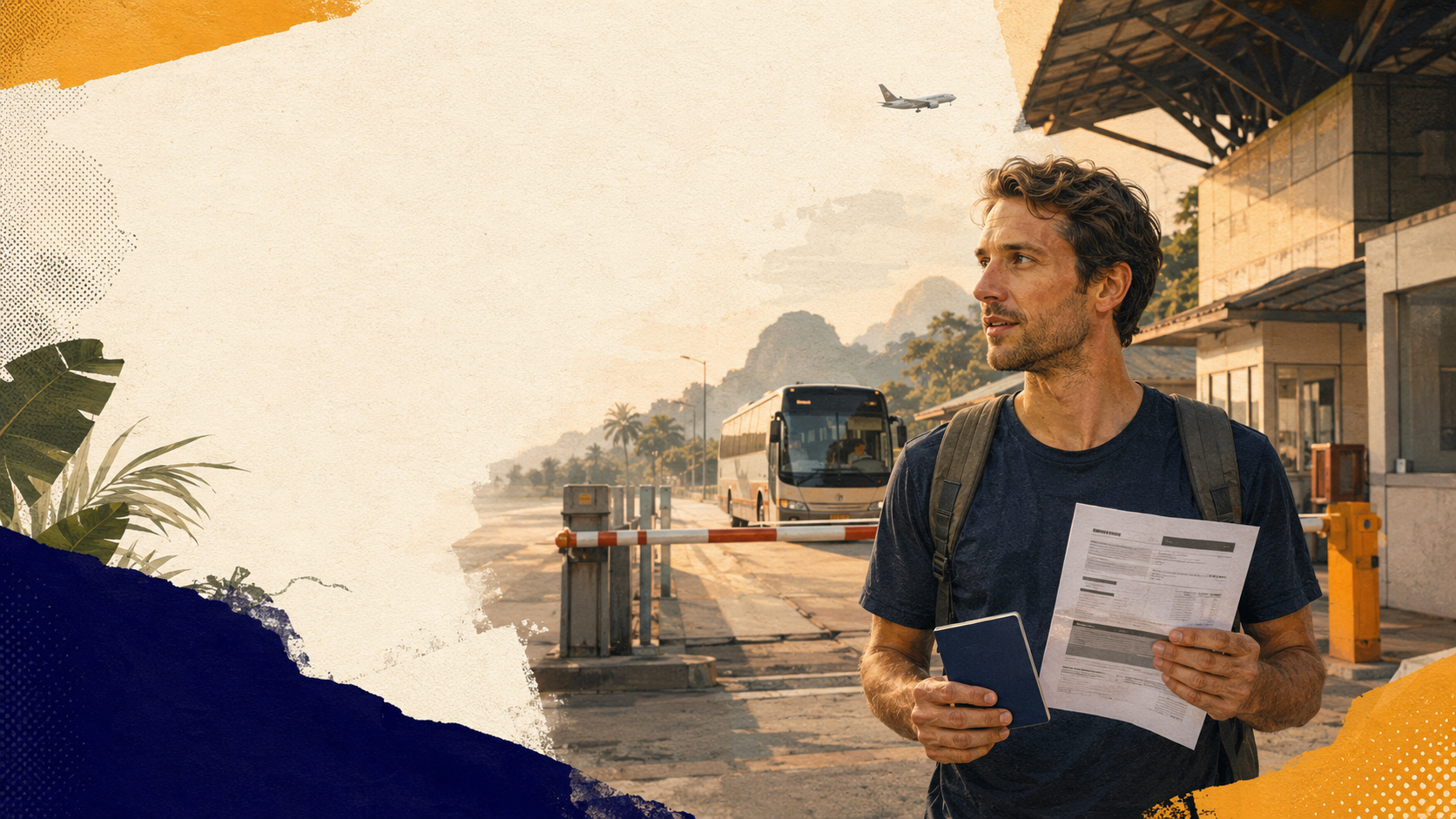
A practical guide for foreigners planning to leave and re-enter Vietnam by land or air, with updated e-visa checkpoints, overstay penalties, and the legal limits of repeated border runs.
Trong bài viết này14
Your Vietnam visa expires next week. You still have an apartment in Ho Chi Minh City, unfinished plans for the month, and no intention of leaving Vietnam for good. A friend tells you to take a bus to Cambodia, cross the border, turn around, and come back with a fresh visa.
It sounds simple. Sometimes it is. But leaving Vietnam does not automatically give you the right to return, not every border accepts an e-visa, and an existing multiple-entry visa does not start again each time you cross. A visa run can work in the right circumstances, but it can also leave you waiting abroad if one part of the plan is wrong.
What Is a Vietnam Visa Run?
“Visa run” is an informal travel term. It is not the name of a Vietnamese visa, an official extension procedure, or a legal status of its own.
In practice, a visa run means leaving Vietnam before your current permitted stay expires, entering another country legally, and later returning to Vietnam under a valid new basis. That new basis may be:
- A newly issued Vietnam e-visa
- A valid multiple-entry visa that has not expired
- A visa exemption available to your nationality
- A new visa issued through an eligible Vietnamese sponsor
The important point is that exit does not reset your current document. Leaving Vietnam does not extend an expired visa or restart the end date printed on an existing e-visa. If your multiple-entry e-visa expires in five days, a border trip does not give you another 90 days. You still have five days.
Vietnam’s e-visa can be valid for up to 90 days, for either single or multiple entry. Citizens of all countries and territories may apply, subject to the statutory entry conditions. The official Immigration Department portal also states that a self-applicant must be outside Vietnam when applying. The government fee is currently 25 USD for a single-entry e-visa and 50 USD for a multiple-entry e-visa, and the fee is not refunded if the application is refused. The official processing period is three working days after complete information and payment are received, although a sensible travel plan should leave additional time for corrections, weekends, public holidays, or delayed results. Applications should be made only through evisa.gov.vn or thithucdientu.gov.vn.
Who Can Realistically Use a Visa Run?
A visa run is most relevant to a lawful short-term visitor whose current stay is ending and who independently qualifies to enter Vietnam again. This may include a tourist finishing one e-visa period, a person exploring Vietnam before making a longer-term decision, or a visa-exempt traveler eligible for another entry. Citizens covered by Vietnam’s visa-exemption resolutions, which include the unilateral exemption and a tourism waiver for 12 European countries, may receive up to 45 days per entry. Bilateral and special exemptions can differ, so passport-specific rules still need to be checked.
It may also form part of a transition arranged by a legitimate Vietnamese sponsor, such as an employer coordinating a new visa that requires exit and re-entry.
A visa run is not a good solution if:
- Your current stay has already expired
- You expect a same-day return but do not already have another valid entry basis, such as a visa exemption or an unexpired visa
- You cannot legally enter the country on the other side of the border
- You are using repeated short-term entries to avoid obtaining the proper work, investment, study, or family status
- Your passport, visa details, travel purpose, and supporting documents do not match
- You are subject to an exit suspension, entry restriction, unpaid administrative decision, or another unresolved immigration issue
There is no official promise of unlimited back-to-back entries. Admission still depends on meeting Vietnam’s entry conditions, and repeated short stays may lead to questions about your real purpose.
One older rule still causes confusion. Until August 15, 2023, a visa-exempt visitor had to spend at least 30 days outside Vietnam before entering again. Law No. 23/2023/QH15 removed that condition, so the law no longer sets a minimum gap between visits, but the English pages of the official e-visa portal still mention the 30-day rule. Legally, a same-day return is possible with a valid entry basis, yet border officers still decide every admission and may ask about frequent back-to-back entries.
Two Common Types of Vietnam Visa Run
Visa Run by Land
An overland run means leaving through an international checkpoint bordering Cambodia, Laos, or China and returning through an approved checkpoint. It is usually cheaper, but even a convenient route normally takes a full day. It also creates a second visa question: can you enter the neighboring country at that exact checkpoint? Vietnam accepting your e-visa says nothing about whether the country on the other side will admit you.
Visa Run by Air
An air run means flying abroad and returning after your new entry basis becomes valid. It is usually more comfortable from a major city, but flights, baggage, transfers, accommodation, and a foreign visa can make it more expensive. A same-day trip is possible only if you already have a valid basis to return. Otherwise, allow enough time abroad for the new permission to be issued.
How Long Does It Take and What Does It Cost?
There is no official “visa-run fee.” The total is a combination of several separate costs.
| Cost or timing item | What to expect in 2026 |
|---|---|
| Vietnam single-entry e-visa | 25 USD government fee |
| Vietnam multiple-entry e-visa | 50 USD government fee |
| Official e-visa processing | 3 working days after a complete submission and payment |
| Safer application buffer | At least 7 to 10 working days before a fixed return date |
| Land travel itself | Usually 1 full day, sometimes 2 days depending on the route |
| Air trip | Commonly 1 to 3 days when return permission is already valid |
| Neighboring-country entry | Separate visa, e-visa, visa-on-arrival, or visa-exemption rules and fees |
| Transport or agency support | Variable, with land options generally cheaper than flights |
As a planning range, shared land services are often quoted at roughly 1.5 million VND to 4 million VND before the new Vietnam visa and foreign-country visa. Air trips may start around 3 million VND, then rise with baggage, hotels, and transfers. These are not government prices. Ask any agent to itemize every government fee, foreign visa, transport cost, and service charge.
These travel estimates do not include waiting abroad for a fresh self-filed e-visa. Because the official portal says the applicant must be outside Vietnam, that route may add at least the official three-working-day processing period, and sometimes longer.
Documents to Prepare for the Trip and Return
Requirements depend on your passport, destination, and return status, but prepare:
- Your original passport. For visa-exempt entry into Vietnam under these resolutions, at least six months of passport validity is required. Six months is also a practical minimum because airlines and neighboring countries may impose their own passport rules.
- A printed copy of your approved new Vietnam e-visa before you attempt to return, if applicable. Check your full name, passport number, date of birth, nationality, entry date, expiry date, and permitted entry checkpoint.
- Proof that you may enter the neighboring country, such as its visa, e-visa approval, or evidence that your passport is visa-exempt.
- Confirmed outbound transport and a return plan. Avoid locking yourself into a non-refundable return before a fresh e-visa is approved. Airlines or immigration officers may also ask for onward travel.
- Accommodation or contact details for the country you are entering, even for a planned same-day return.
- A copy of your current Vietnam visa, entry stamp, or temporary residence document.
- Backup digital and paper copies of your passport data page and visa approvals.
- Any cash, photograph, form, or insurance required by the neighboring country.
Older guides still mention COVID-19 tests or a stamping fee for a standard Vietnam e-visa. Those instructions are outdated. A standard e-visa is approved and paid online, then printed. Separate fees may apply to other visa processes.
The Visa Run Procedure, Step by Step
1. Confirm the date your lawful stay actually ends
Check the expiry date on your e-visa, sticker, entry stamp, temporary residence certificate, or residence card. Do not rely on a friend’s calculation.
2. Decide what legal basis you will use to return
Settle the route before booking. Your return basis may be a visa exemption, an unexpired multiple-entry permission, a new e-visa, or a sponsored visa. For a fresh self-filed e-visa, the official rule says the applicant must be outside Vietnam, so plan to apply and wait abroad. Do not reach a land border expecting to buy one on the spot.
3. Check both sides of the route
Confirm that Vietnam accepts your document at the selected checkpoint and that the neighboring country will admit your nationality at its corresponding checkpoint. Laos and China arrangements can differ sharply by border.
4. Leave Vietnam before expiry
Complete Vietnamese exit and legal entry into the neighboring country. Turning around between the two immigration posts is not enough.
5. Wait until your new Vietnam permission is valid
Do not return before the “valid from” date. If the application is still processing, remain abroad until approval or another lawful option is confirmed.
6. Re-enter and check the result immediately
Present your passport and valid entry document. Once admitted, check the stamp or electronic record before leaving the counter.
7. Have your accommodation declared again
After you return, your hotel, landlord, host, or accommodation provider must make the required temporary residence declaration. Re-entry creates a new arrival that must be reflected in the accommodation record.
Easytiger explains this distinction in more detail in our guide to short-term stay, temporary residence, and permanent residence in Vietnam.
How Many Vietnam E-Visa Checkpoints Are There in 2026?
This is one area where many visa-run articles are now out of date.
Resolution 127/NQ-CP originally designated 42 international checkpoints for e-visa travel. Resolution 389/NQ-CP added 41 more in December 2025. Vietnam now has 83 legally designated e-visa entry and exit checkpoints: 17 air checkpoints, 27 land checkpoints, and 39 seaports. The Vietnamese Government’s updated list confirms the new total.
The 17 listed air checkpoints are Nội Bài, Tân Sơn Nhất, Cam Ranh, Đà Nẵng, Cát Bi, Cần Thơ, Phú Quốc, Phú Bài, Vân Đồn, Thọ Xuân, Đồng Hới, Phù Cát, Liên Khương, Vinh, Chu Lai, Long Thành, and Gia Bình. As of August 2026, Long Thành and Gia Bình are legally listed but not yet available for normal commercial visa-run travel. Long Thành is scheduled for commercial operation from December 2026, while Gia Bình is expected later in 2026.
The 27 listed land checkpoints can be grouped by neighboring country:
- China: Móng Cái, Hữu Nghị, Lào Cai road checkpoint, Đồng Đăng railway checkpoint, Lào Cai railway checkpoint, Trà Lĩnh, and Thanh Thủy
- Laos: Tây Trang, Na Mèo, Nậm Cắn, Cầu Treo, Cha Lo, La Lay, Lao Bảo, Bờ Y, Lóng Sập, and Nam Giang
- Cambodia: Mộc Bài, Xa Mát, Tịnh Biên, Vĩnh Xương, Hà Tiên, Lệ Thanh, Bình Hiệp, Thường Phước, Dinh Bà, and Tân Nam
These are approved checkpoints, not 27 guaranteed visa-run services. Some have limited transport or foreign-side restrictions, so established routes are usually safer.
The Most Common Vietnam Visa Run Routes
1. Ho Chi Minh City to Cambodia: Mộc Bài and Bavet
- Vietnam checkpoint: Mộc Bài International Border Gate, Tây Ninh
- Cambodia checkpoint: Bavet, Svay Rieng
- Typically suitable for: People based in Ho Chi Minh City and southern Vietnam who want the most established overland option
Mộc Bài is the best-known land route from Ho Chi Minh City. The drive commonly takes around three hours each way, so treat it as an all-day trip.
Vietnam accepts e-visas here, and Cambodia’s official e-visa portal lists Bavet as an e-visa entry point. You must still confirm your own Cambodian eligibility. Transport is widely available, but re-entry is never automatic.
2. Da Nang to Laos: Lao Bảo and Dansavanh
- Vietnam checkpoint: Lao Bảo International Border Gate, Quảng Trị
- Laos checkpoint: Dansavanh, Savannakhet Province
- Typically suitable for: People based in Da Nang, Hoi An, Hue, and central Vietnam who prefer an overland route
Lao Bảo is the established central route. From Da Nang, it is roughly 245 kilometres and around five hours each way. A same-day trip is possible, but one or two days is more realistic.
Vietnam accepts e-visas here. Laos e-visas and visas on arrival are not accepted uniformly at every land checkpoint or for every nationality, so confirm Dansavanh directly through Lao immigration or a consular source.
Nam Giang, now within Da Nang after the 2025 reorganization, joined the e-visa list in late 2025. Its transport and foreign-side arrangements are less established for a quick turnaround, so Lao Bảo remains more familiar.
3. Hanoi to Laos: Cầu Treo and Nam Phao
- Vietnam checkpoint: Cầu Treo International Border Gate, Hà Tĩnh
- Laos checkpoint: Nam Phao, Bolikhamsai Province
- Typically suitable for: People in Hanoi or north-central Vietnam who can allow an overnight journey or two-day trip
Cầu Treo is an approved e-visa checkpoint, but it is not close to Hanoi. Road travel can take around eight hours or longer each way, and overnight buses are common.
Do not assume that Nam Phao accepts your Lao e-visa or visa on arrival simply because Cầu Treo accepts a Vietnam e-visa. Arrange the Lao entry basis in advance if uncertain. From central Hanoi, flying may be easier once total time is considered.
4. Hanoi to China: Hữu Nghị and Youyi Guan
- Vietnam checkpoint: Hữu Nghị International Border Gate, Lạng Sơn
- China checkpoint: Youyi Guan, Guangxi
- Typically suitable for: People based in Hanoi or northern Vietnam who already hold a valid Chinese visa or qualify for visa-free entry into China
Hữu Nghị is one of the closest major checkpoints to Hanoi and accepts Vietnamese e-visas. The difficulty is China. Many nationalities need a visa in advance, and transit policies are not a safe substitute for an ordinary turnaround. If you cannot prove China will admit you, do not use this route.
Lào Cai and Hekou are another option near Sapa. The same China-entry warning applies.
Other Useful Land Options
Hà Tiên can suit people in Phú Quốc, An Giang, or the Mekong Delta. Tịnh Biên and Vĩnh Xương are also approved, but Cambodia does not accept e-visas at every land gate. Móng Cái can work from Quảng Ninh for travelers already eligible to enter China.
Common Visa Run Routes by Air
For people in Ho Chi Minh City, Hanoi, or Da Nang, a short regional flight is often more comfortable than a distant land border. Common direct routes include:
- Ho Chi Minh City to Kuala Lumpur
- Ho Chi Minh City to Bangkok or Don Mueang
- Ho Chi Minh City to Singapore
- Hanoi to Bangkok or Don Mueang
- Hanoi to Kuala Lumpur or Singapore
- Da Nang to Bangkok or Kuala Lumpur
AirAsia and Vietjet currently publish direct services on several of these routes, but schedules and fares change frequently. Choose the destination based on your legal right to enter, not only the cheapest ticket displayed that morning.
An air run is safer as a short trip than as two flights with almost no buffer. Confirm that the airport you use is an approved e-visa checkpoint. Vietnam’s official FAQ says you need not exit through the same checkpoint used for entry, but both must be government-approved.
What Happens If Your Vietnam Visa Has Already Expired?
Once you have overstayed, this is no longer an ordinary visa-run problem. Contact the Immigration Department or your provincial immigration division. The authority may require an explanation, an administrative record, payment of the assessed fine, and arrangements for lawful exit.
Under Article 21 of Decree 282/2025/ND-CP, effective from 15 December 2025, the fines for using an expired temporary residence document or remaining beyond the authorized period are:
| Length of overstay | Individual fine |
|---|---|
| Under 16 days | 500,000 to 2,000,000 VND |
| 16 days to under 30 days | 5,000,000 to 10,000,000 VND |
| 30 days to under 60 days | 10,000,000 to 15,000,000 VND |
| 60 days to under 90 days | 15,000,000 to 20,000,000 VND |
| 90 days to under 180 days | 20,000,000 to 25,000,000 VND |
| 180 days to under 1 year | 25,000,000 to 30,000,000 VND |
| 1 year or more | 30,000,000 to 40,000,000 VND |
From 16 days upward, the decree also permits expulsion to be considered based on the case. Vietnam’s official police guidance warns that serious violations can affect future entry. Even a short overstay remains an offense.
A Visa Run Does Not Give You the Right to Work
A visa, a temporary stay period, and permission to work are different legal questions. Leaving Vietnam and returning with a new short-term visa does not create a work permit. Foreign employees working in Vietnam generally need a valid work permit or a formal exemption under the Labor Code and Decree 219/2025/ND-CP.
It also does not reset tax residency, erase payroll obligations, or change the legal purpose of your activities. A weekend outside Vietnam does not make months already spent living and working here disappear from immigration, labor, or tax records.
If you are employed locally, managing operations, or providing services in Vietnam, get advice on the correct visa, work authorization, and tax treatment. A border stamp cannot replace that analysis.
For a stable long-term situation, the better route may be a work or business visa, an investor status, a family visa, a sponsored conversion, or a Temporary Residence Card. Our Vietnam visa guide for foreigners in 2026 and complete TRC guide explain these options in more detail.
Common Vietnam Visa Run Mistakes
Most problems come from ordinary planning mistakes, not complicated legal puzzles:
- Assuming a multiple-entry e-visa restarts its 90-day validity after each entry
- Booking transport before the new Vietnam permission is approved and valid
- Choosing a Vietnam e-visa checkpoint without checking the paired foreign checkpoint
- Entering the wrong passport number, name order, date, or checkpoint on the e-visa application
- Arriving one day before the “valid from” date
- Believing an agent can guarantee admission
- Using an old guide that still lists only 42 e-visa checkpoints or includes COVID-era documents
- Forgetting the accommodation declaration after returning
- Treating repeated visa runs as a long-term work or residence strategy
A reputable visa service can review documents, organize transport, and explain the route. It cannot override an immigration officer, repair an invalid visa at the border, or guarantee re-entry.
The Bottom Line
A Vietnam visa run in 2026 can be a legitimate way to end one lawful stay and begin another, but it is not an automatic renewal and it is not a loophole for living or working indefinitely without the correct status.
Mộc Bài is usually simplest from Ho Chi Minh City. Lao Bảo is established from central Vietnam. Cầu Treo works when Laos entry is arranged. Hữu Nghị is convenient from Hanoi only for people who can enter China. Regional flights cost more but may save a long border day.
The right route depends on your passport, current Vietnam status, right to enter the third country, and document for returning. Settle those four points before choosing the bus or flight.
If your situation involves an overstay, repeated visa runs, a new job, a company role, or a change of immigration purpose, find a verified visa or legal specialist on Easytiger before your deadline. A short consultation is usually far cheaper than resolving a failed border trip or an immigration violation later.
This article is for general informational purposes only and does not constitute legal, immigration, labor, or tax advice. Entry rules, border operations, transport schedules, and visa-exemption policies can change. Confirm your passport-specific requirements with the relevant immigration authority or a qualified specialist before traveling.
Câu hỏi thường gặp


Easytiger Match
Tìm chuyên gia phù hợp
- Cho chúng tôi biết nhu cầu của bạn
- Chúng tôi chọn lọc (các) chuyên gia và giới thiệu cho bạn