Knowing the difference between these three concepts will help you stay on the right side of the law. (This article was originally published on 03 July 2026 on our Substack)
In this article8
With more foreigners arriving in Vietnam each year, including a rising number of illegal overstayers and individuals conducting unauthorized activities, Vietnamese authorities have significantly tightened their approach to residence management. The focus is on knowing who is here, under what status, and for how long. The rules apply to everyone, from tourists staying with a local friend to long-term expats renting apartments and businesses housing foreign staff.
If you are living, working, or spending an extended period in Vietnam, understanding the country’s three-tiered residence framework is not optional. It is one of those things that is easy to overlook until a police check or a landlord call brings it into sharp focus.
Who Manages Residence in Vietnam?
For Vietnamese citizens, residence registration is governed by the Law on Residence 2020 (Luật Cư trú 2020, No. 68/2020/QH14) and managed by the commune-level police (Công an xã, phường, đặc khu). The national database tracking all registration status is the National Residence Database (Cơ sở dữ liệu về cư trú).
For foreigners, the framework is different. Foreign nationals entering, staying in, and exiting Vietnam are governed by Law No. 47/2014/QH13 on Entry, Exit, Transit, and Residence of Foreigners in Vietnam, subsequently amended by Law No. 51/2019/QH14, Law No. 23/2023/QH15 and Law No. 118/2025/QH15 (in force July 1, 2026). The responsible authority is the Immigration Management Authority (Cục Quản lý Xuất Nhập Cảnh) under the Ministry of Public Security (Bộ Công an). In practical terms, the Immigration Department handles foreigners’ residence cards and formal residency status, while the local police (Công an xã, phường) serve as the frontline contact for day-to-day accommodation declarations.
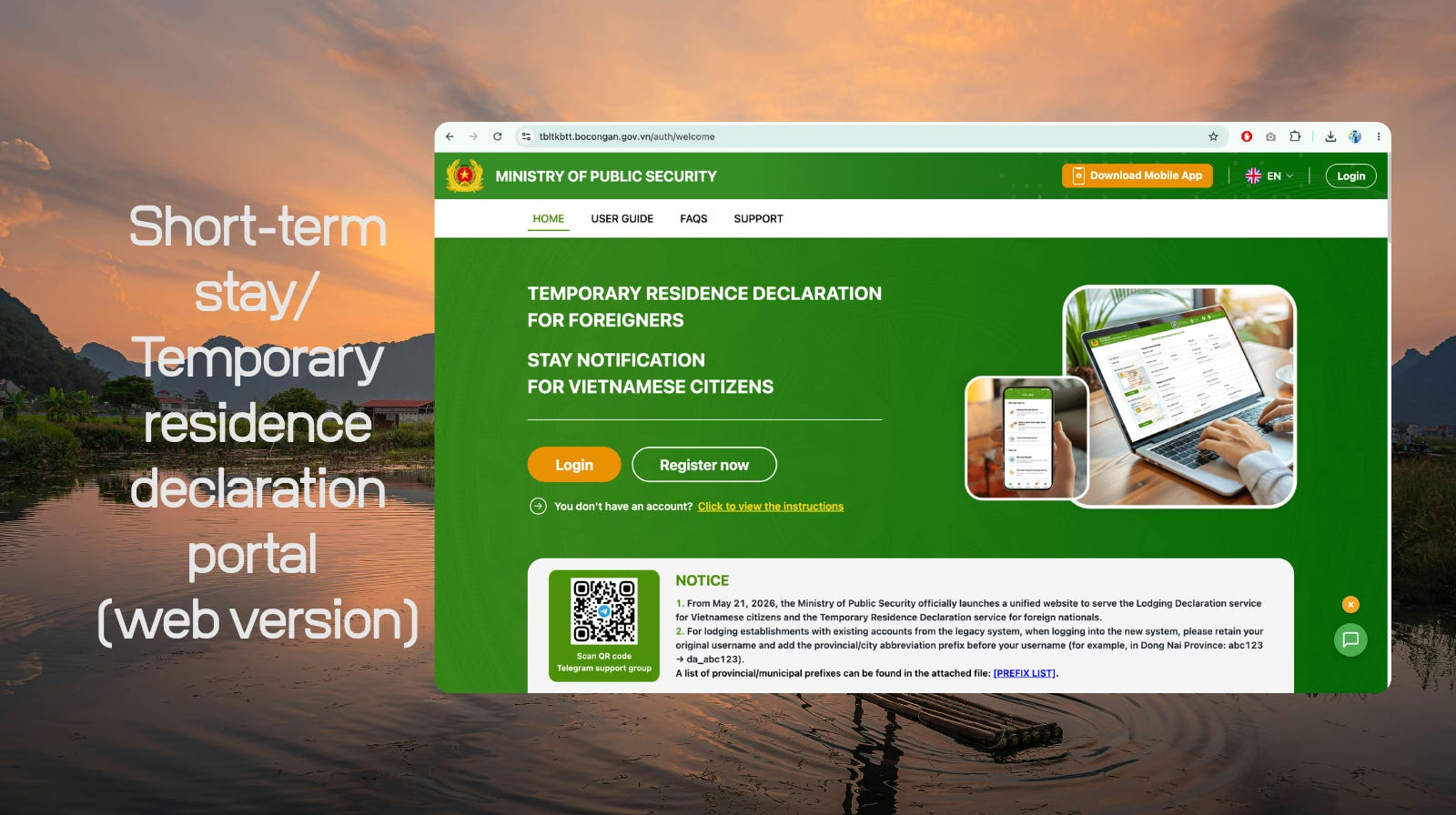
Both systems have moved toward digital infrastructure in 2025 and 2026. For Vietnamese citizens, the VNeID app and the national public service portal (dichvucong.gov.vn) are the main channels for residence procedures. For foreigners’ accommodation declarations, the Ministry of Public Security operates a dedicated platform at tbltkbtt.bocongan.gov.vn, which replaced the previous provincial-level declaration websites.
Three Concepts, Three Situations
Before diving into specifics, it helps to understand how Vietnamese law distinguishes between these three terms, because they refer to different types of stays, not different levels of the same thing.
Short-Term Stay Notification (Lưu Trú)
Think of short-term stay notification as a quick heads-up to the local authorities that someone is sleeping under your roof. It is not a formal registration in the full sense, but in theory, it is a legal obligation.
What it is: Short-term stay (lưu trú) covers a person staying at a location that is neither their registered permanent address nor their registered temporary residence address, for a period of less than 30 days. A relative visiting from another province, a friend passing through before a flight, a colleague in town for a conference: all of these situations fall under lưu trú rules.
Who it applies to: Vietnamese citizens. If a Vietnamese citizen is spending the night at your home or at any private accommodation, the short-term stay notification requirement applies. Foreigners staying overnight are covered by a separate temporary residence declaration, which is due immediately on arrival (see below).
Who is responsible: The host, not the guest. Under Article 30 of the Law on Residence 2020, the responsibility lies with the household member, the manager of the accommodation, or the representative of any facility where the person is staying. The exception is when the host is absent: in that case, the guest is responsible for notifying themselves. If the guest is a foreigner, the host makes the separate temporary residence declaration instead.
Deadline: Notification must be submitted before 23:00 on the day the person arrives. If they arrive after 23:00, the deadline extends to 08:00 the following morning.
How to notify: For households hosting Vietnamese citizens, notification can be submitted through the VNeID app (under “Thủ tục hành chính” then “Thông báo lưu trú”), through the national public service portal at dichvucong.gov.vn, or in person at the local police office (Công an phường, xã).
For households or private accommodations hosting foreign nationals, the separate temporary residence declaration must be submitted immediately on arrival through the Ministry of Public Security’s dedicated platform at tbltkbtt.bocongan.gov.vn. The host registers an account for their accommodation and logs in using two-factor authentication via an Authenticator app. The guest’s details, including passport information, arrival and departure dates, and other required fields, are then submitted through the platform. Hotels, guesthouses, and registered serviced apartments use the same system and are required to declare every foreign guest.
Result: The information is recorded in the local acceptance register and reviewed by the responsible police officer.
Penalties for non-compliance: Under Decree 282/2025/NĐ-CP, failing to comply with the lưu trú notification requirement carries a fine of VND 500,000 to 1,000,000 for individuals. For accommodation businesses (hotels, guesthouses, serviced apartments) with nine or more guests who fail to submit the notification, the fine increases to VND 8,000,000 to 12,000,000 under Article 10, Clause 4 of the same decree. Deliberately false declarations can carry higher administrative penalties, and in cases involving foreign nationals, deportation and re-entry bans are possible outcomes.
Temporary Residence Registration (Tạm Trú)
Temporary residence is where things get a little more layered, particularly for foreigners. The rules differ significantly depending on whether you are a Vietnamese citizen or a foreign national.
What it is: Temporary residence (tạm trú) applies when someone is living at a location outside their registered permanent address for 30 days or more. This is the status most relevant to expats renting apartments, foreigners working in Vietnam, and Vietnamese citizens relocating to another city for work or study. It is time-limited, renewable, and carries a formal registration requirement.
For Vietnamese citizens: Under Article 27 of the Law on Residence 2020, anyone living outside their permanent address for 30 days or more must register temporary residence at the new location. Importantly, this obligation falls on the tenant, not the landlord. The tenant must register themselves at the local police office or through the VNeID app. Temporary residence is registered in increments of up to 2 years, renewable multiple times.
For foreigners: The framework works differently. A foreign national’s lawful stay in Vietnam is primarily tracked through their visa status or Temporary Residence Card (Thẻ Tạm Trú, also called a TRC). However, a separate and mandatory accommodation declaration must also be made. Under Article 33 of Law 47/2014/QH13, this obligation falls on the accommodation provider, meaning the landlord, the employer providing housing, or the host household, not the foreigner themselves. The foreigner must present their passport and relevant travel documents; the accommodation provider submits the declaration to the local police authority.
This is one of the most commonly misunderstood points. A foreign tenant cannot and is not required to register their own temporary residence. That is the landlord’s legal responsibility. The TRC application through the Immigration Department and the landlord’s accommodation declaration are separate obligations, and one does not substitute for the other.
Deadline for accommodation providers: As soon as the foreigner arrives. Since July 24, 2026, under Circular 87/2026/TT-BCA, the declaration is made on the Ministry of Public Security’s electronic system (tbltkbtt.bocongan.gov.vn). Only if the paper form NA17 is used must it reach the commune-level police within 12 hours (24 hours in remote areas).
How to register (for foreigners staying with private hosts or landlords): The accommodation provider submits the declaration through tbltkbtt.bocongan.gov.vn or, only if the paper form NA17 is used, via that form submitted to the commune-level police (Công an xã, phường, đặc khu). The responsible police officer reviews and confirms the declaration, typically within one business day.
For Vietnamese citizens registering tạm trú for themselves: This can be done through the VNeID app (under “Thủ tục hành chính” then “Đăng ký tạm trú”), or in person at the commune-level police office (Công an xã, phường, đặc khu).
Result: For Vietnamese citizens, information is updated in the National Residence Database and reflected in the VNeID app under “Thông tin cư trú.” For foreigners, the declaration is confirmed by the local police authority.
Penalties for non-compliance: Vietnamese tenants who fail to register temporary residence can be fined VND 500,000 to 1,000,000 under Decree 282/2025/NĐ-CP, Article 10, Clause 1. For landlords or accommodation providers who fail to declare foreign nationals, the fine under Article 21 of Decree 282/2025/NĐ-CP depends on how many were not declared: VND 3,000,000 to 5,000,000 for 1 to 3 foreigners, VND 10,000,000 to 15,000,000 for 4 to 8, and VND 15,000,000 to 20,000,000 for 9 or more. Creating an account on the electronic declaration system with false information is fined VND 3,000,000 to 5,000,000 under Article 21, Clause 3(e). The higher band under Article 10, Clause 4 relates to residence rules for Vietnamese citizens, not to foreigners’ temporary residence declarations.
Permanent Residence Registration (Thường Trú)
Permanent residence is the most stable form of residence status in Vietnam. For Vietnamese citizens, it is the digital successor to the old household registration book (hộ khẩu). For foreigners, it is a status that exists but is considerably hard to obtain.
What it is: Permanent residence (thường trú) means registered, long-term, indefinite residence at a specific address. Vietnam formally moved away from the physical household registration book to a fully digital system under the Law on Residence 2020. Today, permanent residence status is reflected in the National Residence Database and displayed in the VNeID app.
For Vietnamese citizens: To register permanent residence, you must have a legal, legitimate place of residence at the new address. This includes owned property, a rented home with the landlord’s written consent, or living with a registered family member. Once conditions are met, registration must be completed within 12 months of establishing the new residence. Registration is done at the local police office (Công an phường, xã) or through the VNeID app and the national public service portal.
For foreigners: The equivalent is the Permanent Residence Card (Thẻ Thường Trú). Only four categories of foreign nationals are eligible to apply under Law 47/2014/QH13:
Foreigners who have received a state-level honor or award recognizing contributions to Vietnam, such as the Labor Medal, Independence Medal, or the “Friend of Vietnam” title. Foreigners who are scientists or experts currently on temporary residence in Vietnam, proposed by the minister or head of the agency managing their field. Foreigners sponsored by a Vietnamese citizen parent, spouse, or child who permanently resides in Vietnam, and who have been on temporary residence in Vietnam continuously for 3 years or more. Stateless persons who have been on temporary residence in Vietnam continuously since 2000 or earlier.
All applicants must also meet baseline conditions: a lawful place of residence in Vietnam and a stable income to support themselves. The application file also includes a criminal record certificate from the applicant’s home country.
For the family-sponsored category, the requirement is continuous temporary residence in Vietnam for 3 years or more.
Applications are submitted to the immigration authority under the Ministry of Public Security. The Minister of Public Security decides within 4 months of receiving a complete file, extendable by up to 2 months if further checks are needed. Once approved, the card is collected at the provincial police immigration office. Government fees are USD 100 per card.
Certain high-value investors, specialists, and scientists at the International Financial Center may also be eligible for an expedited residence pathway under Decree 327/2025/ND-CP, effective December 18, 2025, which established preferential entry and residence conditions for key talent at the IFC locations in Ho Chi Minh City and Da Nang.
Result: The permanent residence card allows indefinite stay in Vietnam and entry and exit without a visa. It does not give property rights similar to Vietnamese citizens: holders remain subject to the foreign ownership limits of the Housing Law (No. 27/2023/QH15). The physical card carries a printed validity (typically 10 years) and must be renewed when it expires, though this is an administrative formality rather than a new eligibility assessment.
Penalties for non-compliance: Failing to register permanent residence within the required 12-month period, or failing to update residence information after a change of address, carries a fine of VND 500,000 to 1,000,000 under Decree 282/2025/NĐ-CP, Article 10, Clause 1.
A Real Experience: Registering a Family Member from Abroad
We recently went through the process of registering an overseas family member who came to stay at our home in Vietnam. It was simpler than it sounds on paper, and the whole thing was wrapped up within a day.
The first step was setting up an account at tbltkbtt.bocongan.gov.vn. This involves registering the accommodation, agreeing to the legal obligations under Vietnamese law on foreign guest declarations, and setting up two-factor authentication via an Authenticator app.
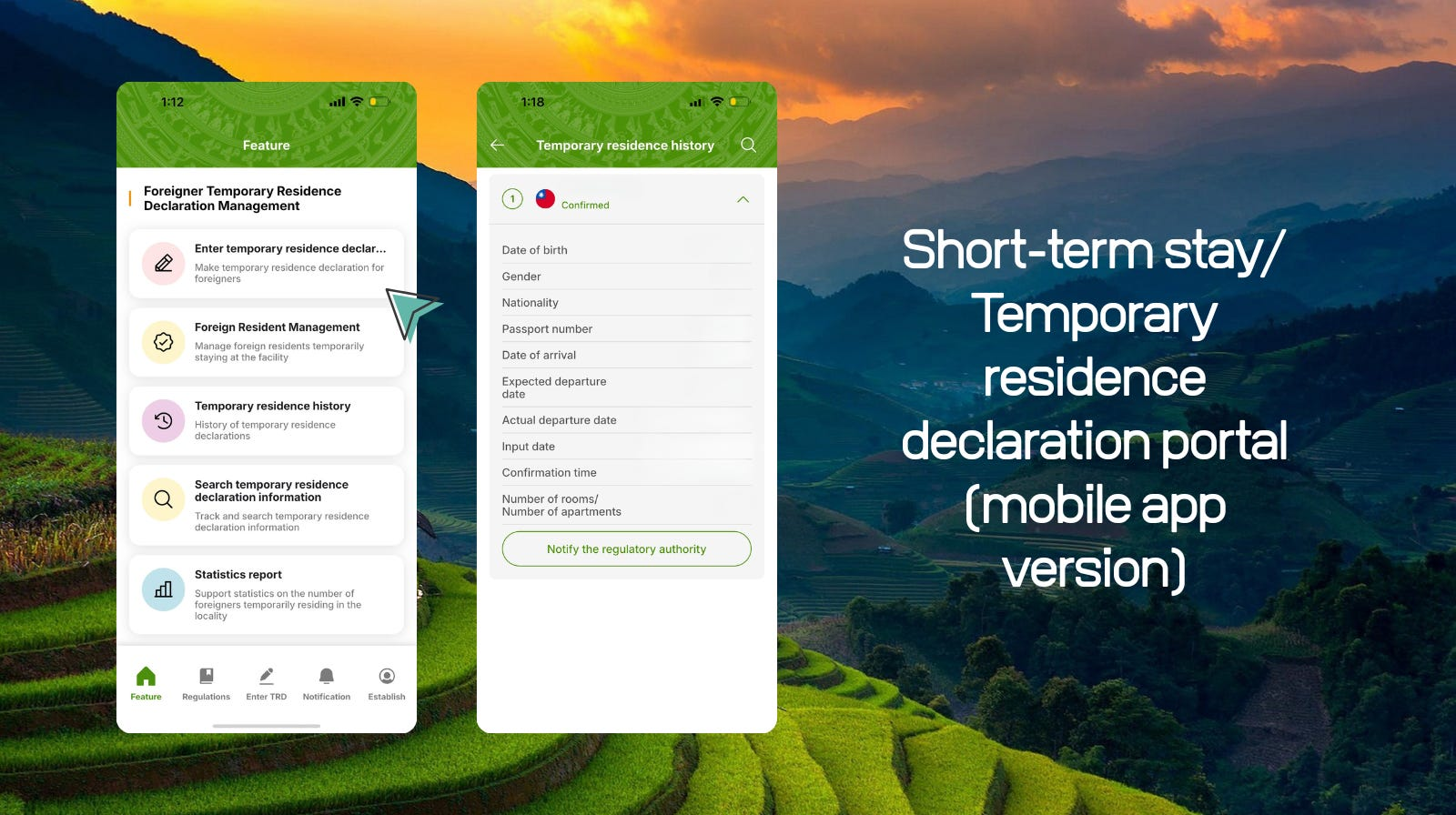
Once logged in, submitting the temporary residence declaration was quick. We entered our family member’s passport details, visa type, arrival date, and expected departure date, and submitted. The status immediately changed to “chờ xác nhận,” meaning pending confirmation. Within one business day, the police officer assigned to our area called us directly, verified the information over the phone, and approved the declaration.
The process from account setup to police approval took less than 24 hours. The key is doing it on time. The declaration itself is quick. The problems come when people skip it entirely and then face an unexpected visit or fine.
What This Means in Practice for Expats and Businesses
A few things are worth keeping in mind whether you are an individual renting an apartment, a business housing foreign employees, or a landlord with foreign tenants.
If you are a foreign employee with a work permit: your employer or HR team typically handles your TRC application, but your landlord also has a separate obligation to declare your residential address through the Ministry of Public Security’s platform. Both processes need to happen, and one does not substitute for the other.
If you are here on an e-visa or visa exemption: your stay is covered by the temporary residence declaration. Whichever accommodation you are staying in, whether a hotel, Airbnb, or a friend’s home, carries the declaration obligation. Hotels handle this automatically. Private stays require the host to act.
If you are a business bringing in foreign staff: make sure your HR or legal team is registered on the lodging declaration platform.
This article is for informational purposes only and does not constitute legal advice. Regulations referenced are based on sources available as of June 2026, updated in September 2026 for rules that took effect in July 2026. Rules are subject to change. For advice specific to your situation, consult a qualified legal or immigration specialist in Vietnam.
Frequently asked questions


Easytiger Match
Find the right professional
- Tell us what you need
- We shortlist professional(s) and introduce them to you