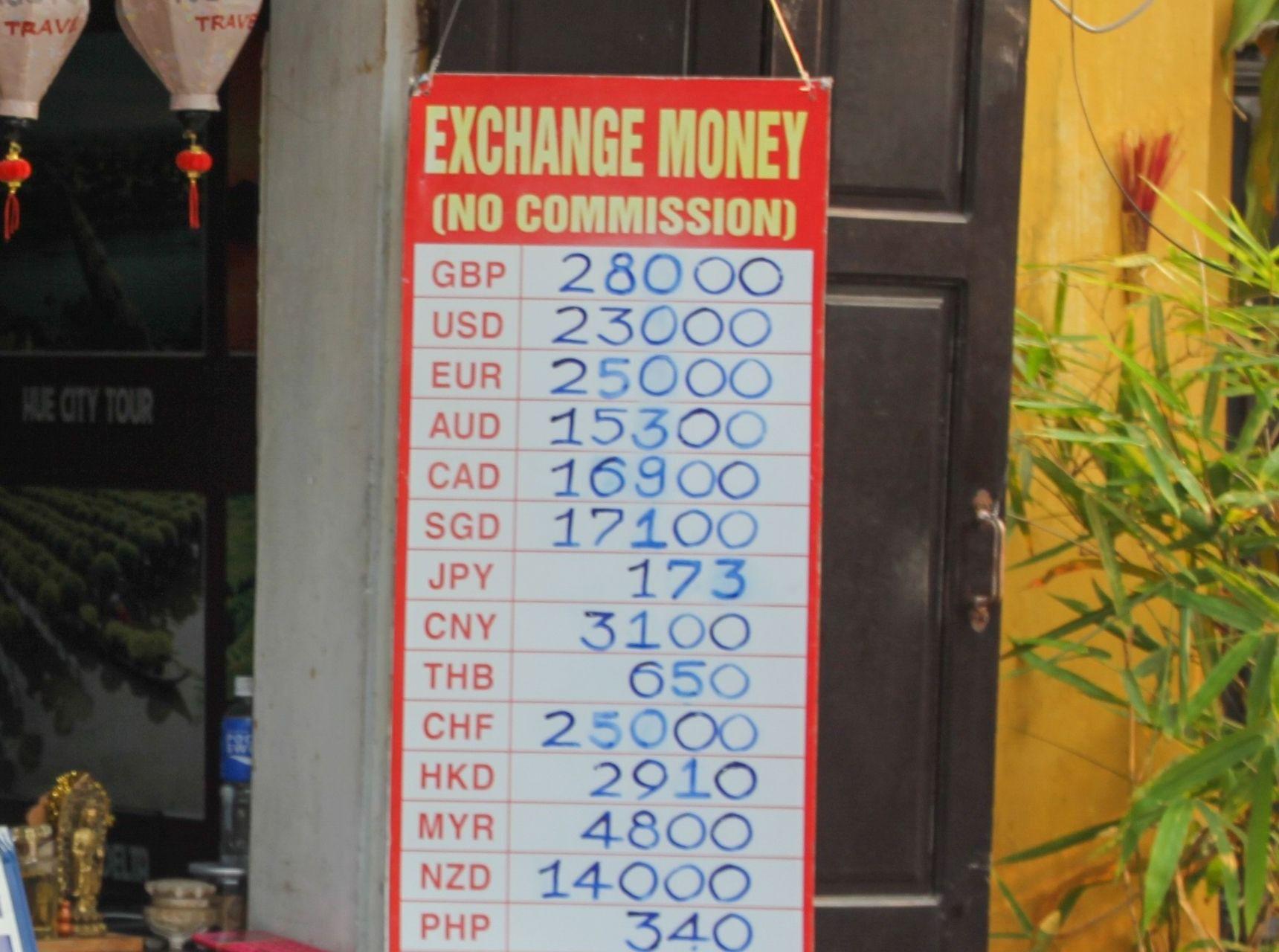
Until recently, changing dollars at a gold shop was the normal thing to do in Vietnam. The rate was better than the bank, nobody asked for a passport, and it took two minutes. In 2026 that door closed. Gold and jewellery shops are now widely reported to be refusing foreign currency, and photographs of queues at ATMs in foreigner-heavy coastal cities have been circulating on social media.
This guide covers what changed, where you can legally change money now, and the rules that catch people out: the counter that can buy your dollars but cannot sell them back, the receipt you need to keep if you want to convert leftover dong before you fly home, and the cash declaration that is widely reported as a limit and is not one.
What changed on 9 February 2026
The Government issued Decree 340/2025/ND-CP on 25 December 2025, covering administrative penalties in the monetary and banking sector. It took effect on 9 February 2026 and replaced Decree 88/2019/ND-CP.
One point matters before anything else: this did not make informal exchange illegal. It already was. The penalty bands in the new decree are the ones that were already in force. What changed is enforcement. The State Bank of Vietnam wrote to the Ministry of Public Security, the Ministry of Industry and Trade and the Government Inspectorate asking them to coordinate against unlawful foreign currency trading, and the effect on the ground was immediate: shops that changed money for years now say no.
So the practical change is not a new rule. It is that the informal option you may have used before has disappeared, and the people still using it are being fined.
What the penalties actually are
Article 27 of the decree covers foreign exchange. Two of the things it penalises will matter to most readers: buying or selling foreign currency between individuals, and doing it at a business that does not hold an exchange licence.
| Amount exchanged | Penalty for an individual | Money confiscated? |
|---|
| Under USD 1,000, first time | Warning | No |
| Under USD 1,000, repeat or multiple offences | VND 10 million to VND 20 million | Yes |
| USD 1,000 to under USD 10,000 | VND 10 million to VND 20 million | Yes |
| USD 10,000 to under USD 100,000 | VND 20 million to VND 30 million | Yes |
| USD 100,000 or more | VND 80 million to VND 100 million | Yes |
Three things are worth reading twice.
Both sides are penalised. The shop and the customer are each liable. In a case in Da Nang reported in January 2026, under the previous decree, which set the same bands, the economic security police fined a private gold business VND 30 million and the customer who came in to exchange money VND 15 million, and confiscated the dong and foreign currency involved, worth an estimated VND 2 billion.
Organisations pay double. The figures in the table are for individuals. A business committing the same violation pays twice the amount.
Confiscation starts above the warning tier. A first exchange under USD 1,000 is a warning and nothing is taken. From the first fine band upwards the currency can be seized, and that is usually worth far more than the fine itself.
Carrying on a foreign exchange business without a licence is a separate and heavier violation, depending on how the conduct is characterised: VND 200 million to VND 250 million for an individual, double that for a company.
Where you can legally change money
Authorised banks. Commercial banks licensed for foreign exchange will buy your cash. Vietcombank, BIDV, VietinBank and Agribank are the usual names, but not every branch offers cash exchange, so call ahead. Bring your passport.
Licensed exchange agents. These are businesses a licensed bank has appointed as its agent, holding a certificate from the State Bank. Under Article 4 of Decree 89/2016/ND-CP, an agent can only sit in one of a short list of places:
- a tourist accommodation rated three stars or above
- an international border gate, by land, air or sea
- a licensed prize-winning entertainment venue for foreigners
- a ticket office of a foreign airline, shipping line or travel company, or an international ticket office of a Vietnamese airline
- a tourist area, trade centre or supermarket visited by foreign customers
The same article requires a separate transaction point: a room or counter that is not part of another business activity and does the exchange work only. That is the condition a gold shop fails. A gold business is not barred from holding a certificate, but the exchange desk cannot be the jewellery counter, and it has to apply for its own certificate. Most have not.
How to recognise a licensed counter. It must display a public rate board and a sign naming both the authorising bank and the agent, its staff must hold a certificate from that bank confirming training in identifying counterfeit notes, and it must issue you a receipt. No bank name, no rate board and no receipt means treat it as unlicensed and walk away.
ATMs. An ATM gives you dong directly from your own account and is the simplest legal option on arrival. Check your own bank's foreign withdrawal fee and the machine's limit per transaction.
The rule almost nobody mentions: agents buy, they do not sell
Under Article 4 of the Regulation on Foreign Exchange Agents, a licensed agent may only use dong to buy cash foreign currency from you. It may not sell you foreign currency.
There is one exception, and it is the useful one. An agent inside the isolated departure area at an international border gate may sell cash foreign currency to someone holding a foreign passport who has completed exit formalities:
- Up to USD 1,000, on presentation of your passport.
- Above USD 1,000, on presentation of your passport and the receipt from the bank or licensed agent where you originally changed the money. The receipt is valid for 90 days from its date.
This is the most practical reason to use a licensed counter: it gives you the receipt that lets you convert leftover dong back on the way out. An informal exchange gives you no receipt, so above USD 1,000 you have no way to change the money back at the airport.
If you live here and need to buy foreign currency
For residents, buying foreign currency is a bank matter, not an agent matter. Banks will sell foreign currency for lawful purposes such as studying abroad, medical treatment, business travel, tourism, visiting family or paying fees overseas, within the foreign currency they have available. According to the State Bank's Regional Branch 2, there is no counter purchase without a stated purpose: bring documents showing what the money is for.
Day to day, hold dong. Pricing, advertising, invoicing or paying for goods and services in Vietnam in foreign currency is restricted, and doing it outside the permitted cases is penalised: VND 30 million to VND 50 million for quoting, listing or pricing in foreign currency, while paying in foreign currency falls on the same bands as unlawful exchange. Leases and clinic price lists written in dollars are common, so if a figure is quoted to you in dollars, agree how it converts and expect to settle in dong.
Bringing cash in and out
This is the part most often reported wrongly. Under Article 2 of Circular 15/2011/TT-NHNN, an individual entering or leaving Vietnam through an international border gate on a passport must declare to customs if carrying more than:
- USD 5,000 or the equivalent in another currency, or
- VND 15 million
That is a declaration threshold, not a cap. You may carry more. You must declare it. Vietnamese media regularly describe it as a maximum, and it is not.
Three details follow from the same circular, and each one saves a trip:
- Leaving with more than you brought in. If you leave carrying more than the thresholds above and more than you declared on your most recent entry, customs will ask for either a confirmation letter from a licensed bank or a written approval from the State Bank. The bank must answer a complete application within three working days, so this is not an airport decision.
- Leaving with what you brought in. If the amount is above the threshold but no more than you declared on arrival, the stamped entry and exit declaration is enough on its own, and it stays valid for 12 months.
- Depositing cash you brought in. If you want to pay imported cash into a foreign currency account at a bank in Vietnam, declare it on arrival even when it is at or below USD 5,000. The stamped declaration is what lets the bank accept the deposit, and it is valid for 60 days.
Cards, traveller's cheques, savings books and securities are outside these thresholds entirely.
Failing to declare, or declaring incorrectly, is dealt with under the customs penalty decree. Carrying currency across the border outside the rules is penalised separately at VND 30 million to VND 50 million.
A short playbook
- On arrival, use an ATM in the terminal, or change a small amount at the airport counter to get moving. Airport and hotel rates are usually worse than a bank.
- For a larger amount, go to a bank branch that offers cash exchange, with your passport.
- Before you hand over cash anywhere, ask whether the counter is licensed, look for the rate board and the sign naming the bank, and confirm the exact amount you will receive.
- Keep every receipt. It is what lets you change dong back above USD 1,000 when you leave, for 90 days.
- Do not take the street rate. The gap between the informal rate and the bank rate is real, and it is also the whole reason the fines and confiscations exist.
- Pay in dong. Cards and bank transfers in dong avoid the problem entirely.



 View full profile of VINA TPT Consulting
 View full profile of UNITED CONSULTING
 View full profile of Nam Thi
