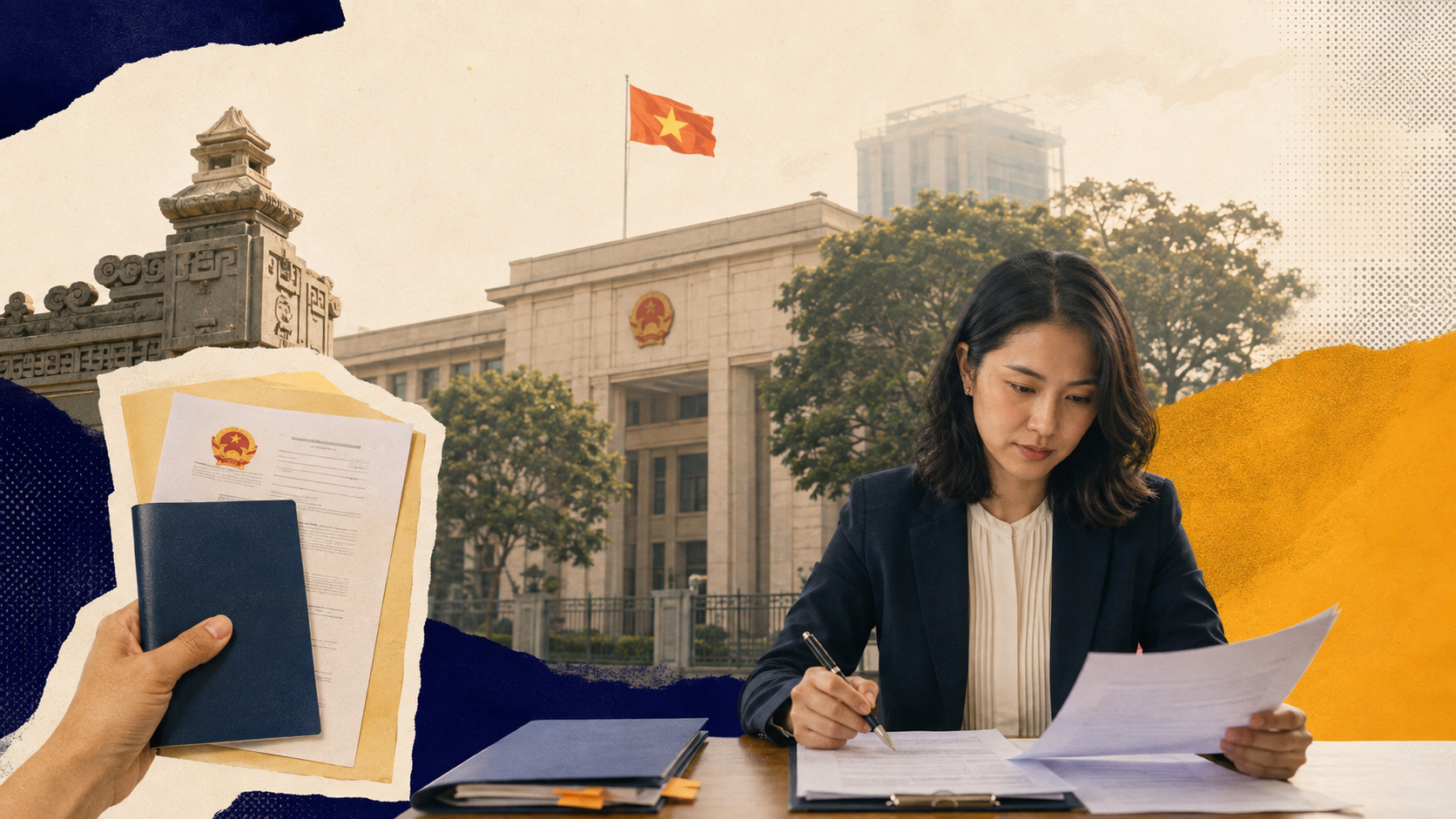
Overseas paperwork becomes expensive when a simple document has to pass through several authorities before anyone in Vietnam will accept it. A Canadian degree, a Singapore police certificate, or a UK company extract could require authentication, Vietnamese consular legalization, translation, and notarization. One missing stamp could send the file back across borders.
From 11 September 2026, Vietnam's accession to the 1961 Hague Apostille Convention shortens that route for many public documents. One Apostille issued in the document's country of origin can replace consular legalization when the Convention applies between Vietnam and the other country. Vietnam deposited its accession on 31 December 2025, and Decree No. 293/2026/ND-CP of 23 July 2026, which implements the Convention in Vietnam, took effect on 11 September 2026.
What an Apostille means
An Apostille is a standardized certificate attached to, or electronically linked with, a public document for international use. It confirms the official signature, the signer's capacity, and the seal or stamp. It does not verify the document's content, legal effect, or suitability for a particular application.
This limit matters. An Apostille on a degree authenticates the relevant official signature or seal. It does not prove that the holder completed the course. The receiving authority still decides whether the document meets its substantive rules.
Why the change matters
The benefit works in both directions. Vietnamese public documents can be Apostilled for use in qualifying Convention countries. Foreign public documents can enter Vietnam with an Apostille from their country of origin and skip Vietnamese consular legalization. Translation, notarization or certification, document-age rules, and sector-specific requirements may still apply.
Who manages Apostilles in Vietnam and who can apply
Vietnam's Ministry of Foreign Affairs is the competent authority. The official directory currently lists the Consular Department at 40 Tran Phu, Ba Dinh Ward, Hanoi, and the Ho Chi Minh City Department of Foreign Affairs at 6 Alexandre de Rhodes, Sai Gon Ward, Ho Chi Minh City. Vietnamese embassies abroad do not issue Apostilles.
An individual or organization may apply for its own public document or another person's or organization's document. Decree 293/2026/ND-CP does not require a power of attorney solely because a third party files the request. The filer remains responsible for lawful use and personal-data protection.
Start with the route, not the paperwork
A country appearing on the HCCH status table is only the first check. Under the Convention, an accession may not operate between two countries if one has objected. You also need to check the effective date and any territorial extension or exclusion. As of 9 September 2026, Austria, Czechia, and Germany have objected to Vietnam's accession. Thailand is a Contracting Party, but the Convention does not enter into force for Thailand until 28 February 2027.
| Situation | Route to consider |
|---|
| Convention relationship is in force and the public document is within scope | Use an Apostille from the competent authority in the document's country of origin. |
| A treaty, destination law, or established practice removes authentication | Use the simpler exemption. An Apostille should not be demanded where authentication has already been abolished. |
| Non-Convention country, an objection applies, or the Convention is not yet in force | Use the traditional consular certification and legalization route unless another treaty provides a simpler route. |
| Private document with no official certification | First ask whether notarization or certification can convert the relevant official act into a public document. The Apostille then authenticates that official act, not the private content. |
| Document is directly connected with commercial or customs operations | Do not assume Apostille applies. Check the exclusion and any Vietnam-specific implementing list before filing. |
The fastest practical question is not simply, Is this country a member? Ask instead: Is the Convention in force between the document's country of origin and the country where I will use it, on the date I need it, for this type of document.
Which Vietnamese documents qualify
Decree 293 organizes eligible Vietnamese public documents into five broad groups. The examples below are practical illustrations, not a promise that every version of a document will be accepted. The issuing authority, format, signature, intended country, and current legal status still matter.
| Group | Typical examples |
|---|
| Judicial and enforcement documents | Court judgments and decisions, documents from courts, procuracies or investigation bodies, civil or criminal enforcement records, and bailiff records. |
| Administrative documents | Birth, marriage, death and other civil status records, nationality or adoption documents, criminal record certificates, diplomas, certificates, transcripts, research confirmations, and medical or health documents issued by a competent public authority or authorized public service provider. |
| Notarial documents | Notarized contracts and transactions, notarized translations, and notarial copies where the notarial act itself is the public document. |
| Authenticated or certified documents | Certified copies, certified signatures, certified translator signatures, and authenticated contracts or transactions. |
| Other qualifying public documents | Other documents lawfully issued by a Vietnamese authority or authorized person, provided they are not excluded by the Convention or Vietnamese law. |
For business files, a corporate registry extract or government-issued certificate may qualify as an administrative public document. A private board resolution, commercial contract, or internal letter does not become a public document simply because it is printed on company letterhead. It may need a recognized notarial or certification step first, subject to the law and the receiving authority's requirements.
What is outside scope or may be refused
Documents outside the Apostille route
- Documents executed by Vietnamese diplomatic or consular agents.
- Administrative documents dealing directly with commercial or customs operations, unless the document could get consular certification before 11 September 2026. The Ministry of Foreign Affairs publishes the list. Foreign commercial or customs documents are not accepted in Vietnam on an Apostille alone.
- Private documents without a qualifying official, notarial, or certification act.
- Foreign documents presented for a Vietnamese Apostille. The country of origin must issue it.
Documents that may be rejected
- A document that has been erased, overwritten, detached, replaced, or altered without authority.
- A forged document or one with signs of falsification.
- A signature, seal, stamp, capacity, or digital signature that cannot be matched to official records.
- A document that is void, revoked, annulled, unlawfully issued, or prohibited from being taken abroad.
- An electronic file without a valid official digital signature or in a format that cannot be authenticated.
- Foreign Apostilled documents may also be refused in Vietnam if the Apostille was issued by the wrong authority, lacks the required title or model information, has been altered or cancelled, or if use of the underlying content would violate Vietnamese law, public order, state interests, or social ethics.
How to Apostille a Vietnamese document
Treat the process as a route check followed by a document check. This sequence avoids paying for translation, copies, and couriers before you know whether an Apostille is the correct authentication method.
- Confirm the receiving authority. Ask exactly which document, version, age, language, and form it accepts. A destination country may have different rules for immigration, court, banking, education, and corporate filings.
- Check the treaty relationship. Use the official HCCH status table and objection notices for the origin and destination countries. Also check whether a bilateral treaty or local rule already removes authentication.
- Prepare the correct Vietnamese public document. For a paper application, the dossier generally includes the Ministry of Foreign Affairs declaration form and the original public document, or an eligible notarized or certified copy or translation. Keep all pages, seals, and bindings intact.
- Choose paper or electronic processing. Paper dossiers may be filed directly or by post. A fully online dossier requires an electronically issued public document carrying a valid official digital signature. A scan of a paper original is not automatically an electronic public document.
- Submit to a designated Ministry of Foreign Affairs office or through the announced official system. At the start of the new regime, confirm which online functions are live before relying on e-Apostille or same-day digital timing.
- Pay the fee and any delivery cost. Translation, notarization, certification, courier, and receiving-agency charges are separate.
- Respond once and completely if the authority asks for supplementation. The applicant generally has seven working days to add missing information. That period does not count toward the processing time.
- Receive and check the result. A paper Apostille must remain attached to the document. An e-Apostille must remain linked to the electronic document. Verify the destination name, signature, capacity, seal, and certificate details before sending the file abroad.
How to use a foreign Apostilled document in Vietnam
A foreign public document must be Apostilled by a competent authority in its country of origin.
- Obtain the correct public document from the foreign issuing body.
- Ask the origin country's competent authority to issue the Apostille. The HCCH country profile lists the designated authorities.
- Confirm that the Convention applies between that country and Vietnam on the relevant date, with no objection or territorial exclusion.
- Translate the document into Vietnamese and have the translation notarized or certified under Vietnamese law, unless the sector-specific procedure expressly allows something different.
- Submit the Apostilled document and certified Vietnamese translation to the Vietnamese receiving authority. It should not require an additional Vietnamese consular legalization step when the Apostille is valid and the Convention relationship applies.
The receiving authority may still review whether the document is current, complete, relevant, and legally usable for the underlying procedure. For a work permit, for example, the labour authority's rules on degree relevance, experience, document age, and translation remain separate from authentication.
Processing time, fee and validity
The processing time starts when the office receives a complete, valid dossier. Time spent verifying the document, or waiting for you to supply missing documents, does not count.
| Documents | Paper dossier | Fully online when operational |
|---|
| 1 to 4 | 1 working day | Same day before the digital cut-off, otherwise next working day |
| 5 to 9 | 2 working days | 1 working day |
| 10 or more | 4 working days | 3 working days |
Decree 293 applies the existing consular fee schedule. The current rate is VND 30,000 per certification, plus postage and any translation, notarization, or service charges. Confirm the payable amount on the official portal when filing.
An Apostille itself does not expire. The underlying public document may have a validity period, and the receiving authority may require a recent issue date. A police certificate might need to be issued within a defined number of months, while a birth certificate may be accepted for longer. Always check the rule for the actual procedure, not only the Apostille date.
The mistakes most likely to waste your time
- Using a private country list without checking the official HCCH status and objection tables. Some commercial lists are outdated or describe only relationships with one particular country.
- Assuming Contracting Party means the Convention automatically operates with Vietnam. Austria, Czechia, and Germany are the clearest 2026 counterexamples.
- Taking a foreign document to a Vietnamese Apostille office. Only the country of origin can Apostille that foreign public document.
- Treating an Apostille as approval of content. It authenticates the official signature, capacity, seal, or stamp. The receiving authority still decides whether the document works for its procedure.
- Forgetting the Vietnamese translation for a foreign document used in Vietnam, or using an uncertified translation when certification is required.
- Detaching the certificate, unstapling pages, laminating over seals, or altering the file after issuance.
- Uploading a scan and expecting an e-Apostille. Fully online processing requires a valid electronic public document and depends on the official system being operational.
- Ordering documents too early. The Apostille may not expire, but the police certificate, corporate extract, medical record, or receiving agency's freshness rule might.
What happens to documents already legalized
Vietnam's transition rules protect work already completed. A foreign document legalized by a Vietnamese embassy or consulate before 11 September 2026 stays valid, and no Vietnamese agency may require an Apostille for it instead. A foreign Apostille issued before that date is also accepted if it is otherwise valid. A dossier for consular certification of a Vietnamese document that the Ministry of Foreign Affairs accepted before 11 September 2026 is still processed under the old procedure. The decree does not say what happens to legalization applications still pending at a Vietnamese embassy abroad, so check with that embassy. A Vietnamese document that already has consular certification can get an Apostille without the underlying document being reissued.
The digital transition is staged. Decree 293 allows paper and electronic Apostilles, a public e-register, QR verification, and fully online filing. In practice, those functions begin according to the Ministry of Foreign Affairs' announcement that its Apostille Information System is ready. Until then, expect paper Apostilles and only the online stages that the official portal confirms are available.
Full Apostille Contracting Party list by region
The official HCCH status table listed 130 Contracting Parties at its 30 June 2026 update. The regional grouping below is for reading convenience, not an HCCH legal classification. It includes Vietnam and Thailand, even though their entry dates require special attention. It also includes Austria, Czechia, and Germany, even though their objections mean the Convention does not operate between each of them and Vietnam as of this article's update date.
Europe
Albania, Andorra, Austria, Belarus, Belgium, Bosnia and Herzegovina, Bulgaria, Croatia, Cyprus, Czechia, Denmark, Estonia, Finland, France, Germany, Greece, Hungary, Iceland, Ireland, Italy, Kosovo, Latvia, Liechtenstein, Lithuania, Luxembourg, Malta, Monaco, Montenegro, Netherlands (Kingdom of the), North Macedonia, Norway, Poland, Portugal, Republic of Moldova, Romania, Russian Federation, San Marino, Serbia, Slovakia, Slovenia, Spain, Sweden, Switzerland, Ukraine, United Kingdom of Great Britain and Northern Ireland.
Americas
Antigua and Barbuda, Argentina, Bahamas, Barbados, Belize, Bolivia (Plurinational State of), Brazil, Canada, Chile, Colombia, Costa Rica, Dominica, Dominican Republic, Ecuador, El Salvador, Grenada, Guatemala, Guyana, Honduras, Jamaica, Mexico, Nicaragua, Panama, Paraguay, Peru, Saint Kitts and Nevis, Saint Lucia, Saint Vincent and the Grenadines, Suriname, Trinidad and Tobago, United States of America, Uruguay, Venezuela (Bolivarian Republic of).
Asia Pacific
Armenia, Australia, Azerbaijan, Bangladesh, Brunei Darussalam, China (People's Republic of), Cook Islands, Fiji, Georgia, India, Indonesia, Japan, Kazakhstan, Kyrgyzstan, Marshall Islands, Mongolia, New Zealand, Niue, Pakistan, Palau, Philippines, Republic of Korea, Samoa, Singapore, Tajikistan, Thailand, Tonga, Uzbekistan, Vanuatu, Viet Nam.
Africa and Middle East
Algeria, Bahrain, Botswana, Burundi, Cabo Verde, Eswatini, Israel, Lesotho, Liberia, Malawi, Mauritius, Morocco, Namibia, Oman, Rwanda, Sao Tome and Principe, Saudi Arabia, Senegal, Seychelles, South Africa, Tunisia, Türkiye.
Exceptions to flag before filing
Austria, Czechia, and Germany objected to Vietnam's accession. The Convention does not apply between Vietnam and each of those countries as of 9 September 2026.
Thailand deposited its accession on 30 June 2026, but the Convention enters into force for Thailand on 28 February 2027. Traditional legalization remains relevant for the Vietnam to Thailand route before that date unless another exemption applies.
Greenland is not covered through Denmark for this Convention, and Tokelau is not covered through New Zealand, according to Vietnam's official implementation notice.
Territorial application, objections, and entry dates can change. Recheck the HCCH status table and the Ministry of Foreign Affairs portal on the day you prepare the file.
A practical closing checklist
- Name the exact receiving authority and procedure.
- Identify the document's country of origin.
- Confirm the Convention relationship and effective date.
- Check whether a treaty or local rule already removes authentication.
- Confirm that the item is a public document within scope.
- Use the correct original, certified copy, or valid electronic document.
- Budget for translation, certification, courier, and processing time.
- Keep the Apostille attached or electronically linked.
- Recheck the underlying document's own validity or freshness rule.
Easytiger takeaway
Vietnam's Apostille regime is a meaningful simplification, especially for founders, HR teams, foreign professionals, families, and investors moving documents across borders. But it is a shortcut with conditions, not a universal stamp. The strongest file starts with one clear question: What will the receiving authority accept for this exact purpose?
Once that answer is clear, the rest becomes a manageable checklist: correct country relationship, correct public document, correct competent authority, correct translation, and a certificate that stays physically or digitally connected to the file. That is the difference between a document that looks official and one that actually moves your application forward.
Easytiger helps foreigners and small businesses in Vietnam understand the process, prepare practical document checklists, and connect with verified legal, notarial, translation, and administrative specialists when professional support is needed.
Sources
Editorial note: This article is general information, not legal advice. The legal framework takes effect on 11 September 2026, and live filing arrangements may be updated by the Ministry of Foreign Affairs.