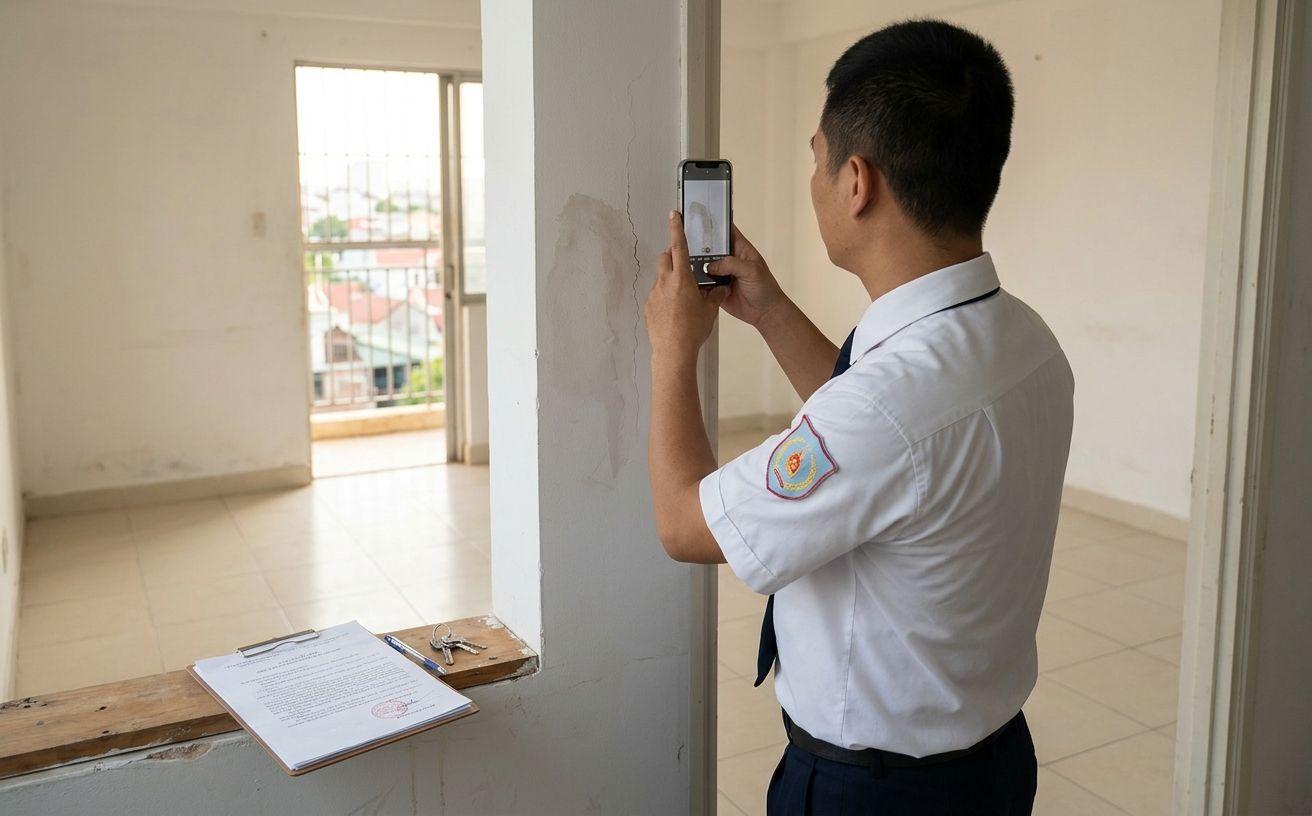
A Vietnamese bailiff is a private, state-appointed officer who can record events as evidence, trace a debtor's assets, deliver court papers and enforce court judgments on request. For most foreign residents, the service that matters is the vi bằng: a written record of something the bailiff saw happen, such as the state of an apartment on the day you hand back the keys. Courts treat it as a source of evidence.
A vi bằng has firm limits. It does not replace a notarized document, and it cannot be used to transfer land or a house that has no ownership papers. Buying property "by vi bằng" proves that money changed hands. It does not make you the owner.
Since 1 July 2026 the system runs under the Law on Civil Judgment Enforcement (106/2025/QH15) and Decree 151/2026/ND-CP, and both the bailiff and the office have new names. The old names are still in common use, and offices have until July 2027 to change theirs.
Two names for the same job
| Before 1 July 2026 | Since 1 July 2026 |
|---|
| The bailiff | Thừa phát lại | Thừa hành viên |
| The office | Bailiff office (văn phòng thừa phát lại) | Civil judgment enforcement office (văn phòng thi hành án dân sự) |
| Legal basis | National Assembly Resolution 107/2015/QH13 and Decree 08/2020/ND-CP | Law on Civil Judgment Enforcement 106/2025/QH15 and Decree 151/2026/ND-CP |
Existing bailiffs carry on without being reappointed, but must swap their card, and existing offices must change their name, both before 1 July 2027 (Law 106/2025, Article 116(5)). Until then you will see both names.
Do not confuse the private civil judgment enforcement office with the state civil judgment enforcement agency (cơ quan thi hành án dân sự). The names are close, but the office is a private business you hire, and the agency is a government body.
What a bailiff does
Article 30 of the Law on Civil Judgment Enforcement lists four jobs:
- Making a vi bằng at the request of an individual, agency or organization
- Verifying a debtor's ability to pay, meaning what they own and where, at the request of a party to a court judgment or someone with a related right or obligation
- Delivering documents for courts, procuracies and enforcement agencies
- Enforcing court judgments and decisions at the request of a party to the judgment
A bailiff must be a Vietnamese citizen with a law degree who has completed the training and practice period and been appointed by the chair of the provincial People's Committee (Article 29). An office is set up as a private enterprise by one bailiff, or as a partnership by two or more, and must carry professional liability insurance for its bailiffs (Articles 26 and 27).
What a vi bằng is
Decree 151/2026, Article 2, defines a vi bằng as a document recording a real event or act that the bailiff witnessed in person, made at someone's request. Article 27 sets out what it is worth:
- It is a source of evidence for courts and other competent authorities.
- It is one of the grounds for carrying out other lawful transactions.
- It does not replace a notarized or certified document, or any other administrative document.
- A court or procuracy can summon the bailiff to confirm what the vi bằng records.
The bailiff records only what they see and hear. A vi bằng does not say that a fact is lawful or that a contract is valid. It says that, on this date at this place, this happened.
The Civil Procedure Code lists a record of events made on the spot by a person with that function among the sources of evidence, and treats it as evidence if it was made following the proper procedure (Articles 94 and 95). The court still weighs it alongside everything else.
What a vi bằng cannot be used for
Article 28 of Decree 151/2026 rules out several uses. The ones a foreign resident is most likely to run into:
- Confirming the content or signing of a contract that the law requires to be notarized or certified, such as a sale of a house or an apartment between individuals. That remains a notary's job.
- Confirming a translation, or certifying a signature or that a copy matches the original.
- Recording events to transfer land, or ownership of a house or other asset, that has no papers proving the right.
- Recording an unlawful transaction.
- Anything that breaches someone's privacy or personal or family secrets.
- Recording officials, soldiers or police while they are on duty.
The bailiff also cannot act where they or a close relative have an interest in the matter.
The third point is the one that costs people money. Houses without a Pink Book are sometimes sold "by vi bằng", with a bailiff recording the buyer handing over the money. The decree forbids this, and even where a vi bằng records a payment, it gives the buyer evidence of the payment, not a registered right to the property.
When a foreign resident might use one
A vi bằng is most useful when you expect a dispute later and want a neutral record made now. For example:
- The condition of a rented apartment when you move in or move out, and the return of the deposit
- Handing over money, goods or keys to someone who may later deny receiving them
- Delivering a notice, such as ending a lease, to a person who may later say it never arrived
- Content on a website or social media page before it is taken down
- Messages or videos on your phone, such as a WhatsApp conversation (see the next section)
- Damage to your home from construction next door
- What was said and agreed at a meeting
Chat messages, videos and other digital evidence
A bailiff cannot certify that a WhatsApp conversation or a video is genuine, but they can record what your phone shows. You open the chat or play the video in front of the bailiff, and the vi bằng records what is displayed: the account names and numbers, the dates and times, the messages themselves, or a description of what the video shows, with screenshots or photographs attached.
That record proves that this content existed on that phone or account on that date. It does not prove that the messages were never edited, who typed them, or when a video was filmed, because the bailiff saw only what you showed them. If the other side says the material is fake, the court can order an expert examination (Civil Procedure Code, Articles 102 and 103).
You do not always need a vi bằng to use this material in a civil case. Electronic data and recordings are sources of evidence in their own right, and a video or audio recording is accepted if you file it with a written statement of where it came from, for example that you recorded it yourself (Articles 94 and 95). A vi bằng is worth paying for when:
- The messages or posts might be deleted, or an account closed, before the case reaches court
- You expect the other side to deny that the conversation took place
- You want a neutral record made now, while the content is still on the device
Two more points:
- Language. Evidence in a foreign language must be filed with a Vietnamese translation that is notarized or certified (Article 96(3)). The bailiff cannot certify a translation, so arrange it separately.
- Privacy. A bailiff must refuse to record anything that breaches someone's privacy or personal secrets (Decree 151/2026, Article 28). A conversation you took part in, on your own phone, is a different matter from another person's private messages that you accessed without permission, which a bailiff can refuse to record.
Keep the original files and the phone itself, and do not crop, edit or forward the material before the bailiff sees it.
How to get a vi bằng
- Contact a civil judgment enforcement office. Under Article 26 of Decree 151/2026, a bailiff can make a vi bằng anywhere in Vietnam, so the office does not have to be in your province.
- Agree in writing with the head of the office on the event to be recorded, the place, the time and the cost (Article 29). An email or other electronic message counts as written.
- Give the office the information and documents it needs. You are responsible for their accuracy.
- The bailiff attends in person, records what happens, and may bring witnesses. They must explain to you the vi bằng's legal value.
- You sign the vi bằng, or put your fingerprint on it if you cannot sign. The bailiff signs every page and the office seals it.
- The vi bằng includes photographs of the bailiff witnessing the event, and can attach other supporting documents (Article 30).
- The office gives you the vi bằng and, within three working days, enters it into the national bailiff database.
The vi bằng is written in Vietnamese, on paper or electronically. It records the requester's name, address and personal identification number, so ask the office in advance how they will record a foreign passport. If you need it in English for use abroad, arrange a certified translation separately.
A bailiff must wear the official uniform and show their bailiff card (Thẻ Thừa hành viên) while working (Decree 151/2026, Article 14). The card can be a physical card or an electronic one held in the bailiff's electronic identity account, and until 1 July 2027 it may still carry the old title, Thừa phát lại. Ask to see it before the bailiff starts, and check the name against the list of practising bailiffs that the Department of Justice of the office's province publishes on its website (Article 13). The vi bằng records the bailiff's name and card number (Article 30), so you can check it again later.
What it costs
There is no government price list. The cost of a vi bằng is agreed between you and the office and can include the bailiff's fee, travel and accommodation, charges for obtaining information, and witnesses (Decree 151/2026, Article 54). Each office must publish its procedures and costs at its premises (Article 17).
Ask for the price in the written agreement before the bailiff attends, including travel if the event is outside the city, and how many original copies you will receive.
Enforcing a court judgment through a private office
If you hold a court judgment and the other side will not pay, you can ask the state enforcement agency to enforce it, or hire a private office. The private route works like this:
- The office takes cases only in its own province (Law on Civil Judgment Enforcement, Article 31(1)), under a service contract that sets its fee and costs.
- The head of the office issues an enforcement decision within five working days of signing (Article 31(4)).
- The bailiff can trace the debtor's assets, and banks, registries and other bodies must answer them as they would a state enforcement officer (Decree 151/2026, Article 38).
- The bailiff cannot seize property or freeze accounts. They ask the state enforcement agency, which must decide within 24 hours (Article 43). In an emergency the bailiff can make a record asking a bank to freeze an account until that decision.
- If the debtor still does not pay or reach an agreement within five working days after those measures, the bailiff ends the private enforcement and passes the file to the state agency to force payment. If you do not agree to that, the bailiff instead asks the agency to lift the measures, so the freeze ends (Decree 151/2026, Article 43(2)).
- You cannot have the same claim enforced by two offices, or by an office and the state agency, at the same time (Article 39).
You can also hire an office only to find out what the debtor owns, which helps you decide whether enforcement is worth pursuing. The information may be used only for enforcing the judgment (Articles 33 to 36).
If you are the one who owes
A court judgment against a foreign national is enforced under the same law (Law on Civil Judgment Enforcement, Article 65). A person who has not paid what a judgment orders can be stopped from leaving Vietnam (Article 70). There is an exception for someone with enough assets who agrees to their sale and appoints another person to handle the enforcement in their absence.
Delivering court papers
Bailiffs deliver documents for courts, procuracies and enforcement agencies under contracts with those bodies, within the office's province (Decree 151/2026, Articles 22 to 25). The court or agency pays a fee of VND 120,000 to 240,000 for each completed delivery (Article 53). You cannot hire a bailiff to serve your own letter in this formal sense, but you can have its delivery recorded in a vi bằng.
What changed on 1 July 2026
| Before 1 July 2026 | Since 1 July 2026 |
|---|
| Name | Thừa phát lại and bailiff office | Thừa hành viên and civil judgment enforcement office |
| Legal basis | A National Assembly resolution and a decree | A law and a decree |
| Form of a vi bằng | A Vietnamese text document | Paper or electronic |
| Photographs | Supporting documents optional | Photographs of the bailiff witnessing the event required |
| Recording | Sent to the provincial Department of Justice, or entered in its vi bằng database, within three working days | Entered in the national database within three working days; sent to the Department of Justice only if that fails |
| Evidence | For courts in civil and administrative cases | For courts and other competent authorities |
Some things did not change. A bailiff could already make a vi bằng anywhere in Vietnam under Decree 08/2020, although some reports presented this as new in 2026. The list of things a vi bằng cannot record is almost the same. And prices were already agreed between the office and the client.
For deposits and handovers when renting, see Renting in Vietnam as a Foreigner in 2026: Lease Terms, Deposits and Red Flags. For what a foreigner can own, see Can Foreigners Buy Property in Vietnam?
Sources
- Law on Civil Judgment Enforcement 106/2025/QH15, Articles 26 to 31, 65, 70, 115 and 116
- Decree 151/2026/ND-CP on civil judgment enforcement offices and thừa hành viên, Articles 2, 13, 14, 17, 22 to 39, 43, 53, 54 and 57
- Decree 08/2020/ND-CP on bailiffs, replaced on 1 July 2026, Articles 32 and 36 to 40
- Circular 05/2020/TT-BTP detailing Decree 08/2020/ND-CP, since replaced by Circular 08/2026/TT-BTP, Article 30
- Civil Procedure Code 92/2015/QH13, Articles 94 to 96, 102 and 103