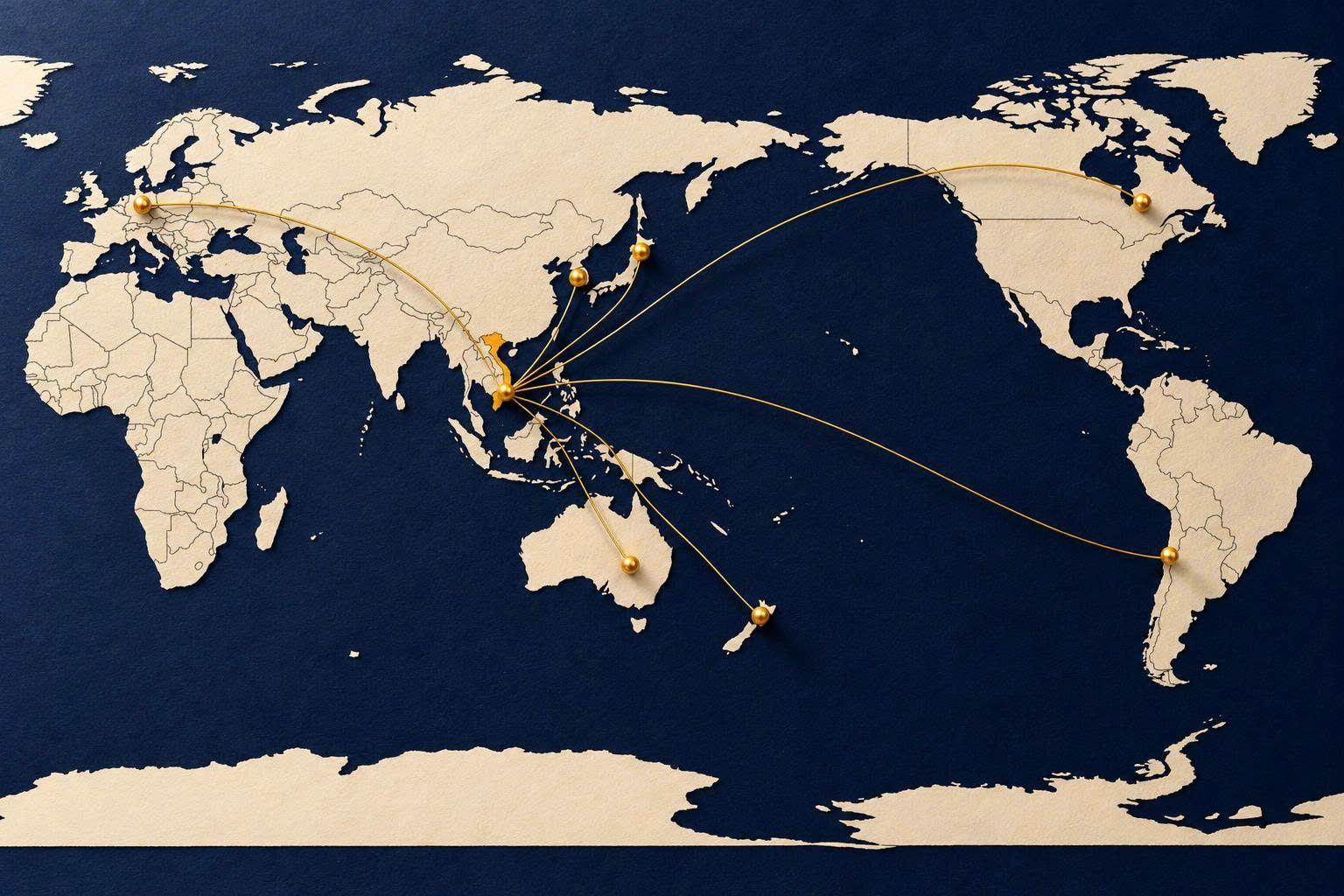
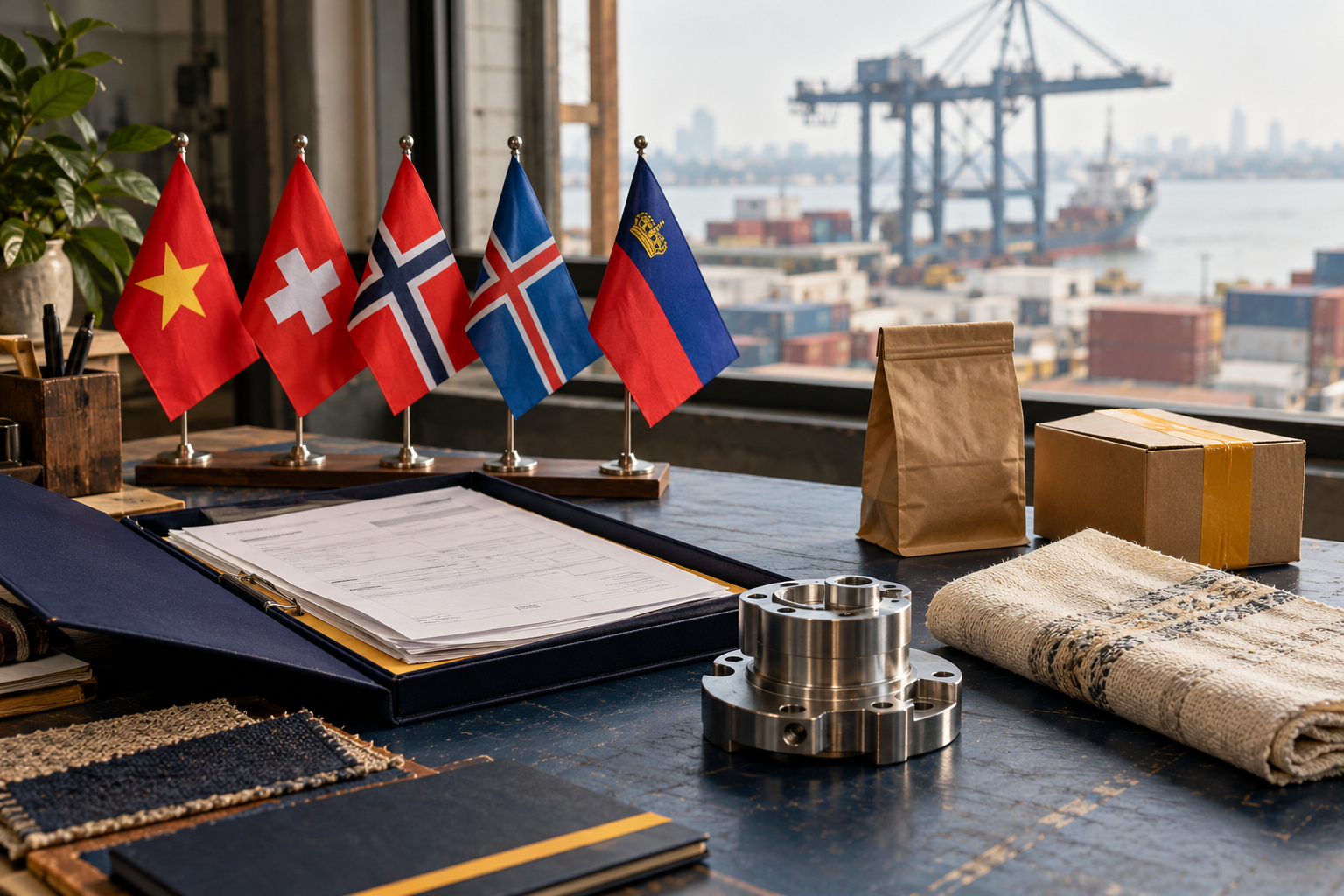
Seventeen trade agreements are in force in Vietnam, from the ASEAN Free Trade Area of 1993 to the economic partnership with the United Arab Emirates that took effect in February. An eighteenth, with Switzerland, Norway, Iceland and Liechtenstein, was signed in Hanoi on 18 October 2026 and awaits ratification. Between them they reach ASEAN, China, Japan, Korea, India, Australia and New Zealand, the European Union, Britain, Canada, Mexico, Chile, Peru, Russia, Israel and the Gulf.
Customs charges the normal rate unless the importer claims a preference and proves it. That claim covers one consignment, on a single tariff line, under one agreement, and firms lose it on origin rules and paperwork.
The network
The WTO and Integration Centre at the Vietnam Chamber of Commerce and Industry keeps the official tally. Its table runs to February 2026; the VEFTA row below reflects the October signing.
| Agreement | In force | Partners |
|---|
| AFTA | 1993 | ASEAN |
| ACFTA | 2003 | ASEAN and China |
| AKFTA | 2007 | ASEAN and Korea |
| AJCEP | 2008 | ASEAN and Japan |
| VJEPA | 2009 | Japan |
| AIFTA | 2010 | ASEAN and India |
| AANZFTA | 2010 | ASEAN, Australia and New Zealand |
| VCFTA | 2014 | Chile |
| VKFTA | 2015 | Korea |
| VN-EAEU | 2016 | Russia, Belarus, Armenia, Kazakhstan and Kyrgyzstan |
| CPTPP | 14 January 2019 for Vietnam; 15 December 2024 for Britain | Australia, Brunei, Canada, Chile, Japan, Malaysia, Mexico, New Zealand, Peru, Singapore and Britain |
| AHKFTA | 11 June 2019 for Vietnam | ASEAN and Hong Kong |
| EVFTA | 1 August 2020 | The 27 European Union states |
| UKVFTA | 1 May 2021, provisionally from 1 January 2021 | Britain |
| RCEP | 1 January 2022 | ASEAN, China, Korea, Japan, Australia and New Zealand |
| VIFTA | 15 October 2024 | Israel |
| Vietnam-UAE CEPA | 3 February 2026 | United Arab Emirates |
| VEFTA | Signed 18 October 2026, not yet in force | Switzerland, Norway, Iceland and Liechtenstein |
Britain appears twice, with a bilateral agreement of its own and a seat in CPTPP, which it took on 15 December 2024 when its accession entered into force between it and Vietnam. The American Country Commercial Guide adds a bilateral agreement with Cuba that the Vietnamese tracker does not count among free trade agreements. Only one negotiation remains open on the official list, between ASEAN and Canada, relaunched in November 2021.
Proving where goods came from
An agreement does not lower the tariff on a country's goods. It lowers the tariff on goods that originate there under that agreement's rules, and only when the importer claims the preference with the prescribed document.
Origin is a legal test with little regard for where the factory stands. Each agreement sets its rules product by product, whether a change of tariff heading, a minimum share of regional value or a particular processing step, so the same goods assembled in Binh Duong may pass under one agreement and fail under another. How an exporter proves origin differs by agreement, as a review of the three main regimes at Hanoi Law University sets out. CPTPP prescribes no form and lets the exporter, producer or importer certify, though Vietnam has kept a transition in which traditional certificates sit alongside self-certification by eligible exporters. Under EVFTA, implemented since 10 May 2026 by Circular 14/2026/TT-BCT, a Vietnamese exporter may self-certify a consignment worth up to EUR 6,000 and needs a certificate above that; the REX system mostly concerns EU exporters sending goods the other way. RCEP takes certificates and declarations by approved exporters, with records kept for at least three years, against five under CPTPP. An importer who cannot produce the right document pays the full rate.
Since 5 May 2025 both preferential and non-preferential certificates come from the Ministry of Industry and Trade, which withdrew the chamber of commerce's authority to issue the non-preferential ones.
None of this is free. Certification, testing and traceability cost money, as does meeting whatever the buyer demands beyond the law, and on thin margins a small preference can cost more to claim than it returns. Ngo Chung Khanh, of the Ministry of Industry and Trade's Department of Foreign Market Development, told Vietnam News Agency in October: zero tariffs bring little benefit if products fail technical, food safety, sustainability or origin requirements.
Take-up is gradual even on a good agreement. Ministry figures put exports leaving Vietnam under a CPTPP certificate of origin at about USD 0.7 billion in 2019 and about USD 5 billion in 2024, the latter around 8.8 per cent of what Vietnam sold to the bloc that year.
Four doors to Japan
Most of Vietnam's larger partners are covered twice over. Japan is covered by four agreements, AJCEP, VJEPA, CPTPP and RCEP; Korea by three; Australia and New Zealand by three; China by two. Exporters choose one per shipment.
An agreement with a higher preferential rate beats a lower one if the exporter can meet its origin rule and document it. Cumulation rules vary too, deciding whether foreign inputs count toward origin. RCEP lets materials originating in any member count as originating in another, which suits manufacturers drawing on Chinese, Korean, Japanese and ASEAN inputs, but it stops short of CPTPP, which also counts processing carried out on non-originating materials in other member states. VEFTA allows certain non-agricultural materials originating in ASEAN or the European Union to count toward Vietnamese origin.
The investor's question
For a trading firm an agreement is a tariff schedule and a rulebook on origin. For an investor it is something else: a set of commitments on services and investment. Those decide whether a foreign company may enter a sector at all, and with how much ownership.
The two meet at nationality. Vietnam's market access conditions can differ according to which treaty covers the investor, since the commitments made in its WTO schedule, in CPTPP and in EVFTA are not identical, and an investor from a country with no relevant treaty may have only domestic law to fall back on. The list and the 62 sectors where conditions apply are set out in Vietnam's 62 Conditional Market Access Sectors.
What the EFTA deal adds
After the agreements with the European Union and Britain, Switzerland and Norway were the two rich European markets Vietnam could not reach on preferential terms. VEFTA covers them, with Iceland and Liechtenstein alongside.
The four states hold about 15 million people between them, so the attraction is spending power. Trade with Vietnam was EUR 4.8 billion in 2025, Vietnam EUR 2.5 billion ahead, concentrated in aquatic products, textiles and garments, footwear, machinery, electronics and components. EFTA will remove duties on covered Vietnamese industrial and aquatic goods the day the agreement takes effect, while Vietnam's own concessions run for as long as eleven years, and sixteen for foods such as cheese, chocolate and baby food. The Ministry of Industry and Trade is aiming to bring it into force at the beginning of 2027.
Checking a tariff line
The ministry runs an FTA portal that looks up tariff and services commitments by product or HS code, direction of trade and partner; the VCCI tracker holds the texts and negotiating histories. Rates change each year under the staging schedules, so the figure that counts is the one on a given line, under a given agreement, in the year the goods ship. Eighteen agreements mean eighteen rulebooks, and the saving goes to whoever reads the right one.
Sources
- VCCI WTO and Integration Centre, current to February 2026, for the agreements in force, their dates and partners, and the open negotiation.
- VGP, for the signing of VEFTA on 18 October 2026 and its scope.
- Ministry of Industry and Trade, for the target of entry into force at the beginning of 2027 and the negotiation history.
- Vietnam News Agency, for the VEFTA tariff schedules, the cumulation provision and the 2025 trade figures.
- FTA portal, run by the Ministry of Industry and Trade, for tariff and services lookups by product and partner.
- United States Country Commercial Guide for Vietnam, last published 23 April 2026, for the bilateral agreement with Cuba that the Vietnamese tracker does not list.
- WTO Regional Trade Agreements database, for the date Britain's CPTPP accession entered into force between Britain and Vietnam.
- Nguyen Quang Anh, , Tap chi Phap ly, 22 August 2026, with Vietnamese law stated to 6 July 2026, for the certification mechanisms, the EUR 6,000 self-certification threshold, record-keeping periods, the limits of RCEP cumulation, and the CPTPP utilisation figures it cites from the Ministry of Industry and Trade.