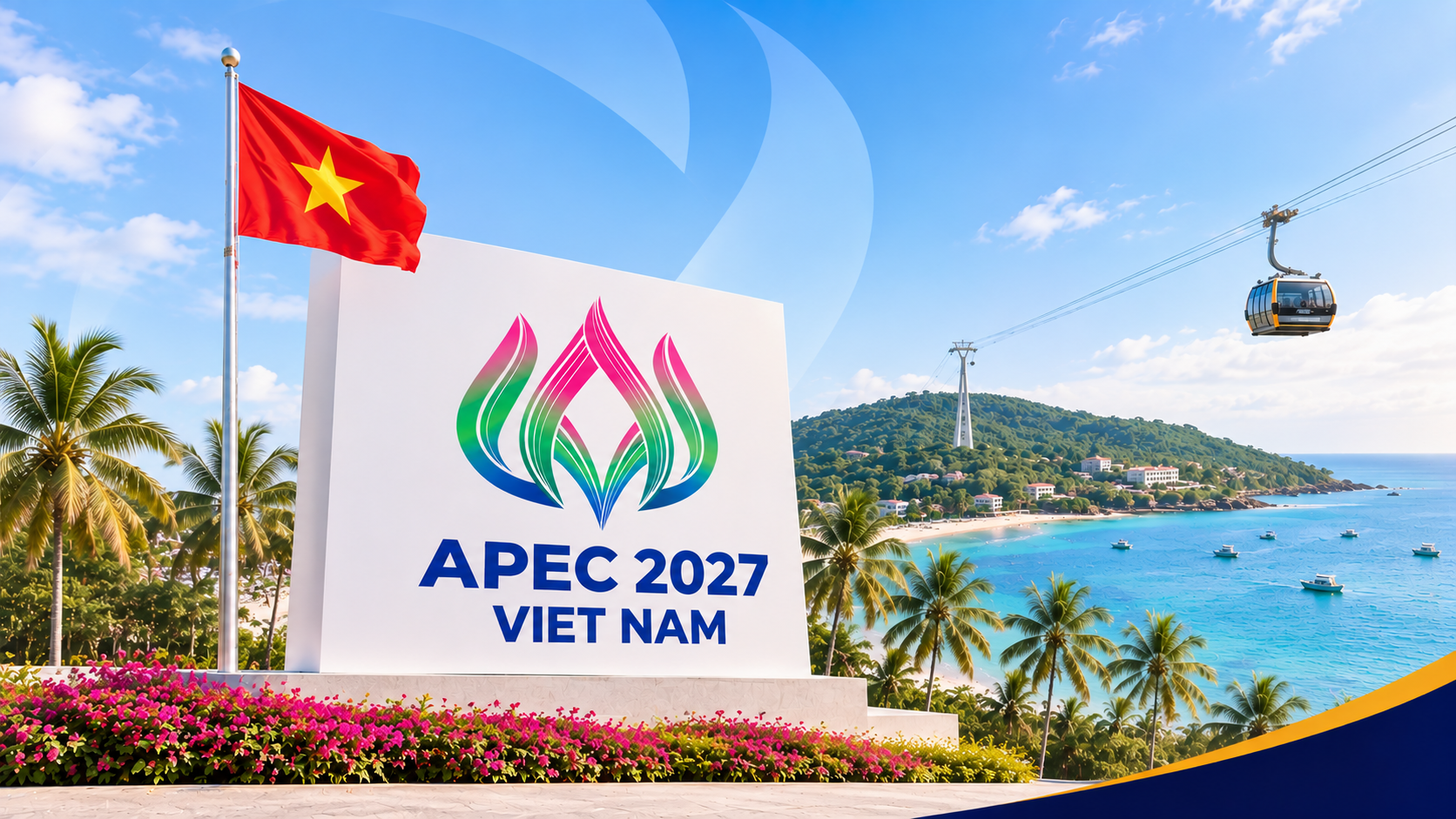
Vietnam officially takes over as host of APEC 2027
November 2026 has been an eventful period for Vietnam. While Ho Chi Minh City is holding a series of cultural activities from November 18 to 24 to celebrate Vietnam Culture Day, the country's attention has also turned towards an important international milestone.
On November 19, 2026, in Shenzhen, China, Vietnam officially received the role of host for the 2027 Asia-Pacific Economic Cooperation (APEC) year from China. The handover took place during the 33rd APEC Economic Leaders' Meeting, which was held in Shenzhen from November 18 to 19.
For Vietnam, this is more than an opportunity to welcome international leaders. It is also a chance to strengthen its position in the regional economy, showcase its development progress and build closer connections with international businesses and investors.
The 2027 APEC Economic Leaders' Week will take place in Phu Quoc, An Giang Province, while related meetings and activities will be organized across different localities in Vietnam throughout the year.
But what exactly is APEC, and why does hosting it matter to someone running a business, investing or living in Vietnam? To understand the potential impact, it helps to look at the forum itself and Vietnam's role within it.
What is APEC and when was it established?
APEC stands for Asia-Pacific Economic Cooperation. Established in 1989, it is a regional economic forum that brings together economies across the Asia-Pacific to promote trade, investment, economic cooperation and regional integration.
The forum began with 12 founding economies, which met in Canberra, Australia, in November 1989. Over the following years, additional members joined. Today, APEC has 21 member economies.
It is worth noting that APEC uses the term "member economies" rather than simply "member countries". This reflects its economic focus and its membership structure, which includes Hong Kong, China and Chinese Taipei alongside sovereign countries.
The 21 members include major regional and global economies such as the United States, China, Japan, South Korea, Australia, Canada, Singapore, Indonesia, Thailand and Vietnam.
For businesses, this membership represents an important network of markets, trading partners, investors and supply chains. Decisions and discussions within APEC can influence the direction of regional economic cooperation, even though the forum itself does not operate as a legally binding trade agreement.
APEC Member Economies by Year Joined
| Year joined | Member economies | Number added | Total members |
|---|
| November 1989 (founders) | Australia, Brunei Darussalam, Canada, Indonesia, Japan, Republic of Korea, Malaysia, New Zealand, The Philippines, Singapore, Thailand, The United States | 12 | 12 |
| November 1991 | People's Republic of China, Hong Kong (China), Chinese Taipei | 3 | 15 |
| November 1993 | Mexico, Papua New Guinea | 2 | 17 |
| November 1994 | Chile | 1 | 18 |
| November 1998 (last intake) | Peru, Russia, Viet Nam | 3 | 21 |
How large is APEC's economic influence?
APEC's importance becomes clearer when looking at the economic scale of its members.
According to the APEC Policy Support Unit's 2026 publication, using 2025 data, APEC economies collectively accounted for:
- 61% of global GDP
- 46% of global trade in goods and commercial services
- 36% of the world's population
Their combined nominal GDP reached approximately US$71.7 trillion in 2025.
These figures demonstrate why APEC is an important platform for international economic cooperation. It brings together economies that play major roles in manufacturing, technology, finance, international trade, logistics and global supply chains.
So, what does APEC actually do?
Its primary purpose is to make it easier for goods, services, investment and people to move across borders. Rather than imposing a single set of rules on all members, APEC encourages cooperation in areas such as customs procedures, trade facilitation, investment conditions, regulatory alignment, digital transformation and economic development.
For example, discussions between members can encourage more efficient customs procedures, better business environments and greater consistency in technical standards. These developments can reduce barriers that businesses face when entering or operating across different markets.
APEC also operates differently from organizations such as the European Union or the World Trade Organization. Its decisions are based on consensus and voluntary cooperation, and its commitments are generally non-binding. This means members work together through dialogue, policy coordination and shared initiatives rather than being required to follow a single set of legally enforceable APEC regulations.
The forum is organized through annual Economic Leaders' Meetings, ministerial meetings, senior officials' meetings and various working groups. It also provides opportunities for the private sector to participate through business dialogues and activities such as the APEC CEO Summit.
When did Vietnam join APEC?
Vietnam became a member of APEC in November 1998, alongside Peru and Russia. Their accession brought the forum's total membership to 21 economies.
Joining APEC was an important step in Vietnam's international economic integration, particularly during a period when the country was expanding its international trade relationships and opening its economy to foreign investment.
Since becoming a member, Vietnam has actively participated in discussions and cooperation initiatives covering trade, investment, tourism, technology, human resources and regional connectivity.
Membership also gives Vietnam opportunities to engage with major economic partners, understand regional policy developments and promote its own economic priorities within a broader international forum.
How many times has Vietnam hosted APEC?
APEC 2027 will be the third time Vietnam has hosted the APEC year, following two previous events:
2006: Hanoi
Vietnam first hosted APEC in 2006, with Hanoi serving as the main location for the Economic Leaders' Meeting. The event marked an important milestone in Vietnam's international integration and helped strengthen its diplomatic and economic relationships with member economies.
2017: Da Nang
Vietnam hosted APEC for the second time in 2017, with Da Nang welcoming regional leaders and international business representatives.
The 2017 event included nearly 250 activities throughout the year, with the Economic Leaders' Week becoming its highlight. According to figures reported by the Vietnamese Ministry of Foreign Affairs, Vietnam signed 121 cooperation agreements and contracts worth nearly US$20 billion during the 2017 APEC period.
2027: Phu Quoc
Hosting APEC for a third time reflects Vietnam's growing experience in international cooperation and its increasingly active role in regional economic affairs.
However, the significance of 2027 extends beyond the diplomatic event itself. This time, the preparations are also expected to accelerate infrastructure investment and expand Phu Quoc's position as an international tourism and conference destination.
Where will APEC 2027 take place?
The main destination for APEC 2027's Economic Leaders' Week will be Phu Quoc Special Zone, An Giang Province, in southern Vietnam.
Known for its beaches, resorts, natural landscapes and growing tourism industry, Phu Quoc has already developed into one of Vietnam's best-known international holiday destinations.
However, hosting an event of this scale requires more than hotels and beautiful scenery. The island needs the infrastructure to accommodate international delegations, business representatives, media organizations and supporting operations.
That is why infrastructure development has become one of the major priorities in preparation for APEC 2027.
Vietnam will also organize APEC-related meetings and activities in other localities throughout the year. Therefore, the economic and business impact should not be viewed as something limited exclusively to Phu Quoc.
What infrastructure developments are expected in Phu Quoc?
One of the most significant aspects of APEC 2027 is the scale of infrastructure preparation underway in Phu Quoc.
According to the approved project list under Decision 948/QD-TTg, the island has 21 projects associated with preparations for APEC 2027, with a preliminary total investment of approximately VND137,138 billion.
The project portfolio includes 10 public investment projects and 11 projects implemented through public-private partnerships (PPP) and business investment.
Major areas of development include:
1. Expansion of Phu Quoc International Airport
The airport is undergoing major expansion to increase passenger capacity and improve international connectivity. The expanded airport is intended to accommodate higher passenger volumes, including the expected increase in international visitors and official delegations.
2. New conference and exhibition facilities
A major APEC Conference and Exhibition Centre, together with a multi-purpose performance venue, is being developed to accommodate large-scale international meetings, conferences and events.
3. Transport and road infrastructure
Road expansion and new transport connections are underway to improve travel between the airport, conference facilities and other key areas of the island. A light rail transit (LRT) project is also part of the infrastructure plan.
4. Utilities and urban development
Preparations also cover essential infrastructure such as water supply, electricity, urban facilities, technical systems and supporting services. These improvements are important for both the event and the island's longer-term development.
The objective is not simply to build temporary facilities for a major international meeting. Ideally, these projects should leave Phu Quoc with better transport, utilities and public infrastructure that can support its growth beyond 2027.
Nevertheless, the VND137,138 billion figure represents the preliminary investment value of the project portfolio, including both public and private investment. It should not be interpreted as government spending alone or as a guarantee that every project has already been completed.
How has APEC benefited Vietnam so far?
For Vietnam, APEC has provided a platform to strengthen international relationships, participate in regional economic discussions and promote the country as an increasingly important destination for trade and investment.
There are several areas where this participation has been particularly meaningful.
Stronger international economic connections
APEC creates opportunities for Vietnamese authorities and businesses to engage with partners from major economies. These connections can support trade relationships, investment cooperation and access to international markets.
Greater visibility for Vietnam
Hosting APEC puts Vietnam in the international spotlight. It provides opportunities to showcase the country's economic development, business environment, infrastructure, tourism potential and cultural identity.
Support for economic integration
Through regional discussions and voluntary cooperation initiatives, APEC encourages improvements in trade facilitation, business conditions, connectivity and regulatory cooperation. These are relevant to Vietnam's continued integration into international supply chains.
More opportunities for Vietnamese businesses
APEC events bring together international business leaders, investors, policymakers and organizations. These interactions can create opportunities for partnerships, market expansion and business development.
It is important, however, to understand that APEC alone does not create all of these benefits. Vietnam's economic growth and international integration also depend on domestic reforms, trade agreements, infrastructure investment and the competitiveness of individual businesses.
What can Vietnam and other member economies expect from APEC 2027?
Vietnam has introduced the theme for APEC 2027: "Co-creating a New Era of Resilience, Innovation and Shared Prosperity."
Alongside the theme, Vietnam has proposed three main priorities:
- Enhancing economic productivity, with greater attention to innovation and the factors that support sustainable economic growth.
- Promoting regional trade and investment, strengthening connections between member economies and creating opportunities for businesses.
- Strengthening economic resilience and dynamism while improving people's quality of life, addressing economic uncertainty and supporting more inclusive development.
These priorities reflect some of the key challenges facing the Asia-Pacific region, including changes in global supply chains, technological developments, digital transformation and the need for more resilient economies.
For Vietnam, APEC 2027 is an opportunity to attract greater international attention, encourage higher-quality investment and strengthen relationships with key economic partners.
For other member economies, it provides another platform to discuss shared challenges, identify areas for cooperation and explore opportunities for trade, investment and innovation.
For local businesses, the potential benefits may be more practical. Better infrastructure, increased tourism, international exposure and new business connections could create opportunities across multiple industries.
What should foreigners, investors and businesses in Vietnam pay attention to?
For foreigners and international businesses already operating in Vietnam, APEC 2027 is worth following beyond the headlines.
Businesses in tourism, hospitality, transportation, construction, logistics, technology, event management and supporting services may find opportunities as infrastructure and business activities expand.
For foreign investors, Phu Quoc and the wider An Giang region deserve attention as infrastructure development progresses. However, investment decisions should be based on commercial fundamentals, project feasibility, licensing requirements and long-term demand, rather than expectations surrounding a single international event.
Small businesses and service providers can also prepare by reviewing their business profiles, strengthening their service capabilities, improving communication with international clients and building relationships with potential partners.
Foreign companies considering new projects or partnerships should also pay attention to local investment regulations, company establishment, tax obligations, employment requirements, permits and contractual arrangements. Hosting APEC does not automatically provide special investment approvals, tax exemptions or changes to Vietnam's domestic business and immigration rules.
Ultimately, APEC 2027 should be viewed as part of Vietnam's longer-term economic development rather than simply a week of international meetings.
For anyone considering doing business, investing or building a life in Vietnam, understanding the changes taking place now can help identify opportunities and prepare for what comes next.
At Easytiger, we help foreigners and international businesses connect with suitable professionals in Vietnam, including legal advisors, business consultants, accountants and tax specialists. Whether you are exploring an investment opportunity, establishing a company or looking for professional support in a new market, finding the right local expertise can make the process easier to navigate.
Explore Easytiger.vn to learn more about doing business in Vietnam and connect with professionals who understand the local market.







 View full profile of Crown Worldwide Group
 View full profile of Nam Thi

