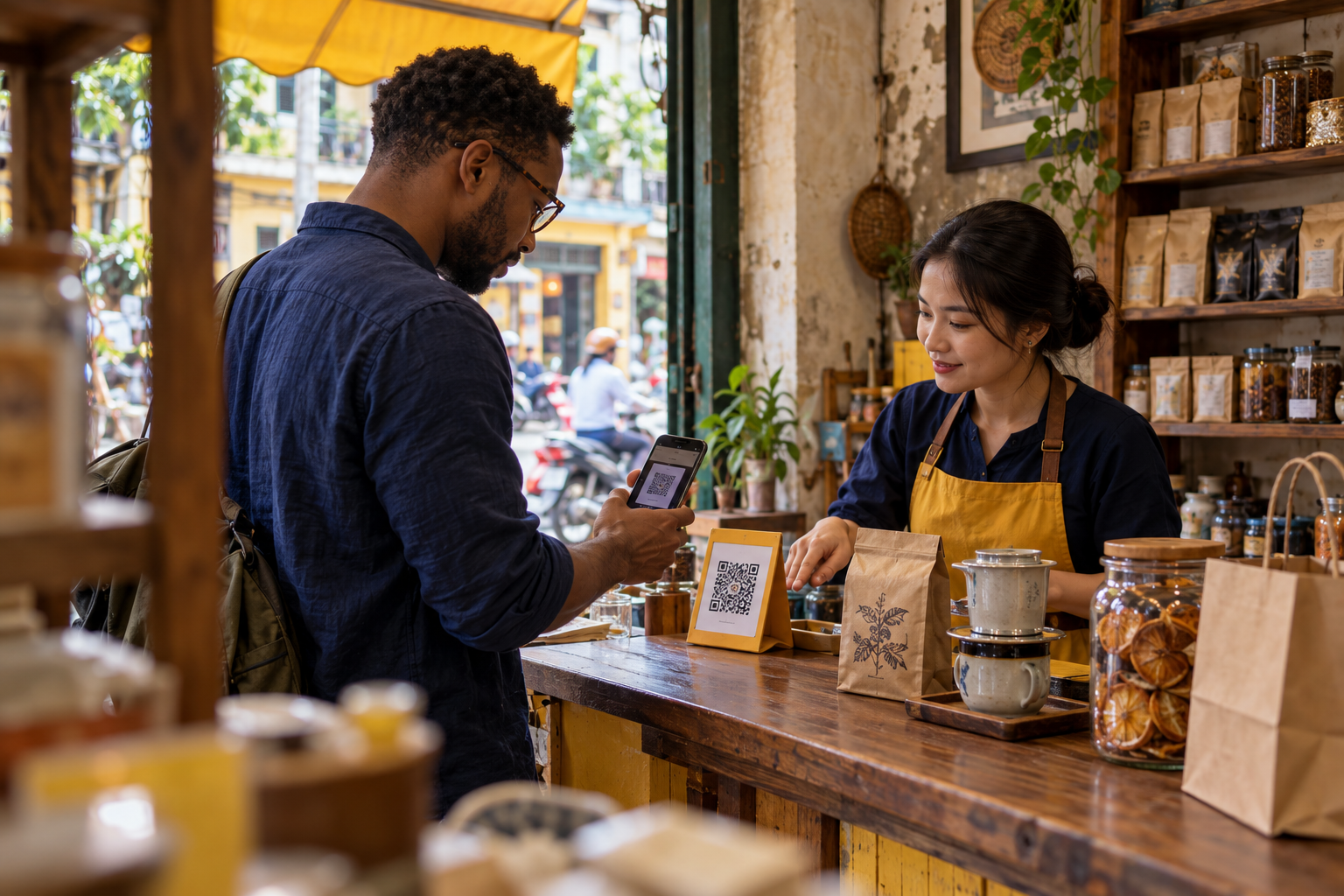
Imagine a customer finishing lunch at your café in Hoi An. They ask whether they can pay with the app they use at home. You point to the QR code beside the till, but their phone cannot complete the payment.
The customer sees a familiar way to pay. You see a QR code that works perfectly well for local customers. Yet the two systems may not connect.
Cross-border QR payments are helping close that gap. For visitors, they can mean less time finding an ATM. For small businesses, they can make it easier to complete a sale. The practical question is whether the customer's app and the merchant's payment service work together.
How cross border QR payments work
A cross-border QR payment lets someone use a participating bank or wallet app to pay a merchant in another country. The connected providers process the payment and currency conversion. Vietnam's NAPAS infrastructure uses the VietQRGlobal identity for its cross-border QR service.
This differs from an ordinary domestic transfer. An expat paying a Vietnamese shop from a Vietnamese VND bank account is generally making a domestic payment. Their nationality does not turn the transaction into a cross-border one.
Likewise, displaying a VietQR bank-transfer code does not automatically make a shop ready for foreign apps. International acceptance must be supported by the customer's app and the merchant's provider. That distinction explains many unsuccessful scans.
Which countries and payment providers are connected
There is no single country list for every app. As of October 2026, NAPAS identifies six connected markets: Thailand, Laos, Cambodia, China, Singapore and South Korea. Its connections with the first five operate in both directions. Korean customers can pay at participating Vietnamese merchants, while the reverse NAPAS direction remains under development.
Wallet providers can reach additional destinations through separate partnerships. Consequently, a wallet may support spending in a country that is not yet available through a particular bank's NAPAS connection.
Payment intermediaries cover different parts of this journey. Wallet services help customers spend overseas, while merchant services help businesses accept foreign payments. These examples show the routes available:
| Provider | Practical use | Published coverage |
|---|
| MoMo | Eligible wallet users paying overseas | Reports more than 60 countries and territories. Named examples include China, Thailand, South Korea, Japan, Singapore and Malaysia. |
| Zalopay | Eligible wallet users paying overseas | Its current publisher descriptions list 11 countries and territories: Thailand, Singapore, Japan, South Korea, Malaysia, China, Hong Kong, the Philippines, Laos, Cambodia and the United States. |
| Payoo | Wallet payments abroad and acceptance through Payoo merchants in Vietnam | Its June 2026 outbound guide confirms Thailand, Laos and Cambodia. Its inbound list covers all six NAPAS markets above. |
| VNPAY | Foreign customers paying participating VNPAY-QR merchants in Vietnam | Supports apps and networks from China, South Korea, Singapore, Thailand, Laos and Cambodia. |
| 9Pay | Vietnamese businesses accepting foreign payments through its gateway and Payment Link | Its published VietQRGlobal coverage includes China, South Korea, Singapore, Thailand, Laos and Cambodia. |
Zalopay's stated expansion to 60 markets by the end of 2026 is a target, rather than its current published coverage. More broadly, these lists describe participating networks, not universal acceptance at every shop in a country.
Banks offer further options. ACB ONE and MSB Digital Bank publish outbound support for China, Singapore, Thailand, Laos and Cambodia. VCB Digibank also offers cross-border QR payments and a destination lookup. Start with your existing provider, then check its current list against your actual itinerary.
What the transaction figures tell us
The growing number of connections is generating transactions, although the published figures need careful interpretation.
An 18 August 2026 Nam A Bank update, citing NAPAS, reported these cross-border QR figures to date:
| Payment direction | Transactions | Transaction value |
|---|
| From Vietnam to overseas merchants | More than 810,000 | More than VND 760 billion |
| From overseas users to Vietnamese merchants | More than 111,000 | More than VND 232 billion |
Together, those figures exceed 921,000 transactions worth VND 992 billion. The release does not specify the measurement's starting date. They should therefore be described as reported-to-date NAPAS figures, rather than a January-to-August total or an all-provider national total.
Separately, State Bank of Vietnam figures presented in September put national QR payments at 311 million transactions worth VND 274.2 trillion in the first eight months of 2026. That wider QR category must not be presented as cross-border QR alone.
Growth on established corridors is clearer. NAPAS reported that payments in Vietnam by visitors from Thailand, Laos and Cambodia rose eightfold in number and sixfold in value in January to August 2026 compared with the same period in 2025.
Who benefits and what it costs
For restaurants, shops, hotels and tourism businesses, the commercial opportunity is straightforward. Customers who can use a familiar app have one fewer obstacle between choosing something and paying for it. Visitors can reduce cash handling and see the converted payment amount on their phones.
There is no universal cross-border QR fee. Separate the customer's charge from the merchant's acceptance fee:
- MSB's published outbound tariff lists 0.2% of the transaction, with a VND 1,000 minimum, excluding VAT.
- TPBank's July 2026 announcement quotes a 0.33% merchant discount rate, meaning the fee charged to the business accepting payment.
Those prices cover different sides of a transaction and are not directly comparable. Request your own written quotation. Check the exchange rate and final amount as well, because a zero transaction fee does not establish that a payment is cheapest overall.
How a small business can start accepting payments
Start with the bank or payment provider handling your merchant account. Explain where your customers come from and ask which foreign apps it can actually accept.
Before displaying an international QR sign, work through five practical steps:
- Confirm the supported apps. Ask for the current list by country and payment direction. A connection announcement alone does not confirm that your merchant account is enabled.
- Complete merchant registration. Ask what business documents, account verification and contractual updates your provider requires. Agree the fees, settlement currency and timing, refund process and support contact.
- Check how the QR is generated. Some providers support existing merchant QR arrangements; others generate a code on a POS terminal or payment page. Follow your provider's instructions.
- Test the complete process. Run a small payment and a refund. Train staff to verify payment in the merchant system, rather than relying only on a customer's screenshot. Ask how to handle a pending transaction before requesting another payment.
- Connect it to your bookkeeping. Keep the sale, payment reference, provider fees and settlement record traceable. Ask your accountant how to match these with the relevant invoice. The payment confirmation and the sales invoice serve different purposes.
For example, if a VND 1 million sale reaches your account after a provider deducts its fee, retain records explaining the difference. Simply matching the bank deposit to the customer's bill can leave your accounts out of balance.
Easytiger's guide to issuing VAT invoices in Vietnam explains the invoice side of that process.
How foreign visitors can pay in Vietnam
Start with your existing home app. Payoo's supported-app list includes Alipay and WeChat Pay for China; Purple GLN, Toss and Hana Money for South Korea; and ChangiPay and LiquidPay for Singapore. These examples apply at participating Payoo merchants, not every Vietnamese QR code.
At checkout:
- Confirm that the shop accepts your specific app through its cross-border payment service.
- Ask the cashier to generate the appropriate payment QR. At Payoo POS merchants, the cashier enters the bill and displays the code.
- Scan using your supported app. Check the merchant, bill, converted amount and any charges before confirming.
- Authenticate, retain the transaction reference and let the merchant verify successful payment in its own system.
A supported home app avoids the need to open a Vietnamese bank account for that purchase. If your app is unsupported, use another payment method.
How locals and eligible foreign residents can pay overseas
Before departure, update your Vietnamese bank or wallet app, complete required verification, check the destination and spending limits, and ensure payment authentication works abroad. Confirm the eligible funding source and available balance.
On MoMo, open the QR scanner, scan the merchant code, select the country when prompted, review the funding source and converted VND amount, then confirm. Payoo likewise lets you scan the merchant QR, review the displayed conversion and confirm.
For bank users, ACB ONE supports payments from the customer's VND account at participating merchants in its five listed outbound markets. VCB Digibank's published instructions also require an internet connection and location permission. Follow your own bank's instructions.
Foreign residents should ask whether the feature supports their account and identification documents. Domestic transfer access does not establish eligibility for every outbound service. Keep cash or a card available, and check pending transactions before paying again.
Questions to ask before relying on QR
Can foreigners pay by QR without a Vietnamese bank account?
Yes, through a supported home app at an enabled merchant. An ordinary QR sticker does not guarantee compatibility.
Which countries support cross-border QR payments with Vietnam?
NAPAS has six connected markets, with different payment directions. Wallet partnerships can cover more destinations. Check the provider table and your app before travelling.
Are cross-border QR payments free?
Some services waive customer fees; others charge. Check the final converted amount. Merchant acceptance fees are separate.
How can a Vietnamese business accept foreign QR payments?
Register with a participating merchant bank or payment provider, confirm supported foreign apps, and agree fees, settlement and refund procedures.
What if a QR payment fails or is charged twice?
Check the status before retrying. Keep the reference and contact your app provider and merchant for investigation or a refund through the original payment channel.
Make the payment experience work for your customers
Choose acceptance based on your actual customer mix, then test the counter experience, refunds and accounting records. These services support merchant purchases. For supplier transfers, investment capital or profit repatriation, ask your bank which payment channel and documents are appropriate.
If you need help organising the accounting or business processes around international customer payments, Easytiger.vn can connect you with relevant accountants and business advisers in Vietnam.





 View full profile of Crown Worldwide Group
 View full profile of Nam Thi

