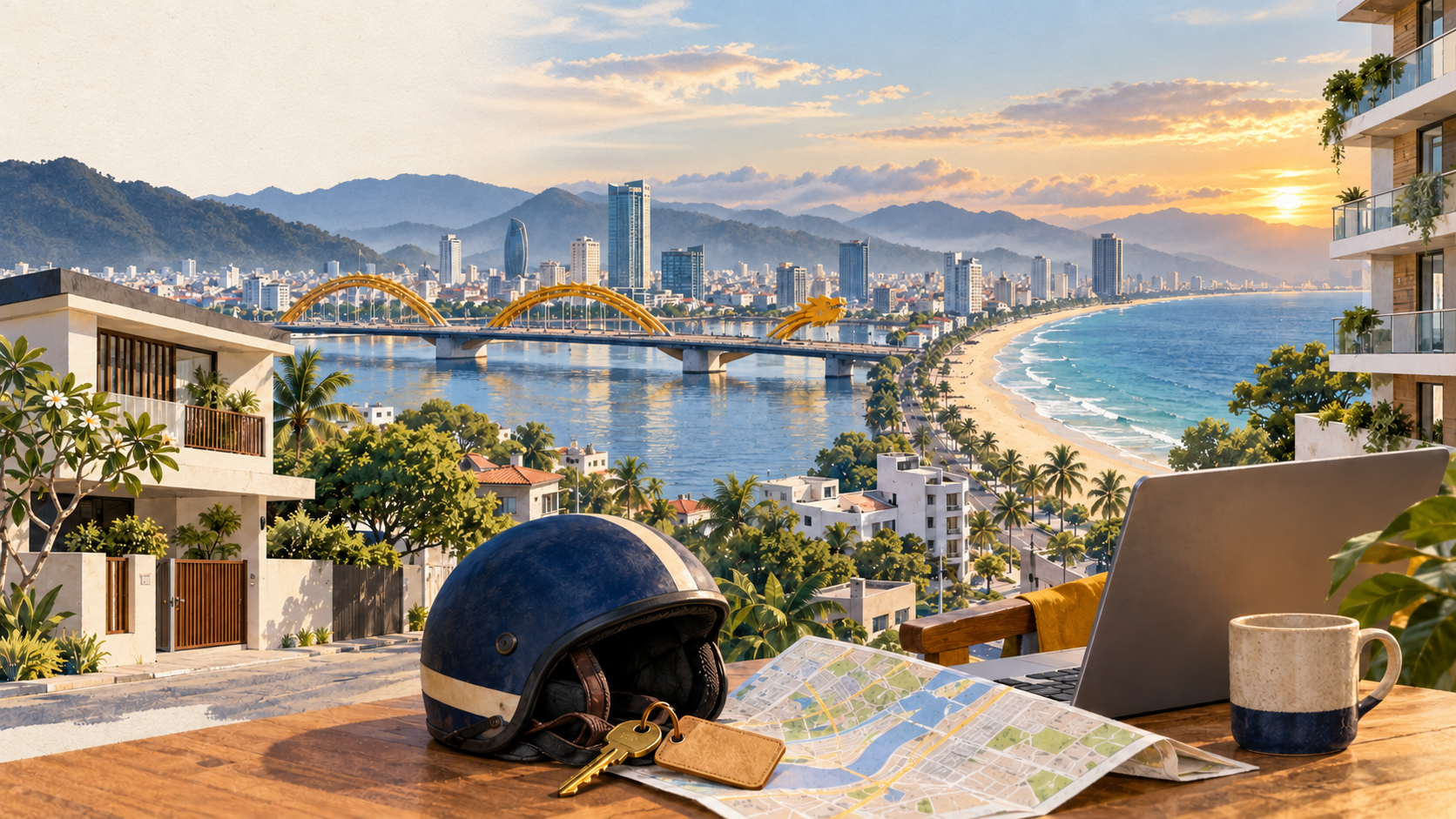
A weekday in Da Nang can begin with a swim at My Khe, continue beside the Han River and still have you at your desk early. For a founder, remote worker or family, that compactness returns something a megacity often takes away: time.
Still, the useful question is not simply, "Is Da Nang livable?" It is, "Which neighborhood will make life easier?"
First, understand the new Da Nang map
Da Nang changed significantly in 2025. National Assembly Resolution 202/2025/QH15 combined the former Da Nang municipality and Quang Nam Province. The enlarged municipality covers 11,859.59 square kilometers, has 3,065,628 residents, and borders Hue to the north, Quang Ngai to the south, Laos to the west and the East Sea to the east, as the official overview of Da Nang.
Names such as Hai Chau, Son Tra, Cam Le and Ngu Hanh Son remain useful location labels. Resolution 1659/NQ-UBTVQH15 reorganized Da Nang into 23 wards, 70 communes and the Hoang Sa Special Zone under a two-tier local government. Leases and official applications should use the current ward-level address.
Da Nang grew from the port historically known as Cua Han. The official history of Da Nang records that Emperor Minh Mang designated it for Western maritime trade in 1835. French forces attacked in 1858 and later called it Tourane. It became a centrally governed city in 1997 and entered its enlarged form in 2025, retaining its role as a gateway between the sea, central Vietnam and Laos.
Why move to Da Nang?
Da Nang's appeal is balance rather than scale. The airport sits inside the urban area, many trips are short, and traffic generally feels more manageable than in Hanoi or Ho Chi Minh City. Busy periods still happen, so test your actual commute.
Nature shapes the routine: My Khe and Non Nuoc beaches, the Han River and Son Tra Peninsula are all close. Still, traffic, construction and weather affect local air quality.
Climate should influence both neighborhood and building choice. The official weather guidance gives an annual average of about 25 to 26 degrees Celsius. January to August is generally drier, while September to December is wetter, with the heaviest rain commonly from October to December. Summer can reach about 33 to 36 degrees Celsius. High humidity and late-year storms make drainage, ventilation, mold and coastal corrosion important inspection points.
The Da Nang City Portal estimated gross regional domestic product grew 9.52% year on year in the first half of 2026 to more than VND 171.267 trillion, led mainly by services. Priorities include tourism, logistics, high-tech manufacturing, semiconductors, artificial intelligence and digital services. The Da Nang Free Trade Zone, established in 2025, designates areas for production, logistics, trade, services and digital innovation.
For small businesses, the tradeoff is a smaller client, supplier and specialist talent pool than in Hanoi or Ho Chi Minh City. Da Nang fits firms serving national or international clients, working digitally, or operating in tourism, technology, education or logistics.
The official Da Nang International Airport route page lists links including Seoul, Bangkok, Singapore, Kuala Lumpur, Taipei and Hong Kong, subject to schedule changes. By road, Hoi An is roughly 30 kilometers from the urban core, My Son about 60 to 70 kilometers, and central Hue about 95 to 105 kilometers. Hoi An and My Son now sit within enlarged Da Nang, while Hue remains separate.
Mì Quảng, bún chả cá, bánh tráng cuốn thịt heo and seafood feature in the city's official local food guide. Hospitals, universities and technology campuses support long stays, but families should confirm international schooling and specialized medical care before moving.
Planning your housing budget
Da Nang's 2025 official spatial cost-of-living index was 97.89% of Hanoi's, but no official neighborhood rent index exists. The ranges below are EasyTiger estimates for September 2026, informed by listings and official price indicators. Totals cover rent, utilities, internet, building fees, food, local transport and personal spending. Deposits, visas, insurance, school fees, travel and business costs are excluded. Condition, furnishing and lease length affect prices.
1. Hai Chau District (Urban Core)
Best for central convenience
Hai Chau feels most like Da Nang's working center. Banks, hospitals, offices, the airport, Han Market, the riverfront and local restaurants are close enough to keep errands from consuming the day.
- Known for: The administrative and commercial core, Han River access, established services, markets and proximity to the airport.
- Advantages: Short trips to offices and major hospitals, extensive food and retail, and an easy first base for newcomers.
- Disadvantages: Denser traffic, event noise, higher prices in newer river-view buildings, less space, and street-specific flooding during intense rain.
- Planning cost: Budget VND 18 million to VND 29 million monthly for one adult, including VND 6 million to VND 15 million for a furnished studio or one-bedroom apartment. Premium serviced or river-view units cost more.
Hai Chau suits frequent meetings and administrative work. Check the block because noise, parking and drainage vary by street.
2. Son Tra District & My Khe Area (Beachside)
Best for beach life
Across Han River, work and leisure sit unusually close together. My Khe is a popular first stop for foreigners, while Son Tra becomes more residential toward the peninsula.
- Known for: My Khe Beach, an international community, tourism services, cafes, restaurants and a modern coastal lifestyle.
- Advantages: Walkable beachside pockets, coworking and social options, newcomer-friendly services and convenient access to central Da Nang.
- Disadvantages: Tourist-oriented prices, construction and nightlife noise on some blocks, and faster wear on buildings, vehicles and electronics from salt air.
- Planning cost: Budget VND 20 million to VND 32 million monthly for one adult, including VND 8 million to VND 17 million for a furnished studio or one-bedroom apartment. Serviced units and direct sea views cost more.
This fits remote workers and regular beach users. Visit morning and evening before committing.
3. Hoa Xuan Eco-Urban Area (Cam Le District)
Best for families who want space
Hoa Xuan, formerly associated with Cam Le District, is a newer, mainly low-rise residential area south of the established center. It makes sense when an extra bedroom, home office, pet space or parking matters more than tourist convenience.
- Known for: Planned residential streets, newer houses, riverside sections and a quieter family setting.
- Advantages: More space, wider roads, easier parking and better whole-house value than central or beachfront locations.
- Disadvantages: Limited walkable retail in some pockets, longer trips to the beach and central hospitals, and flood exposure that requires street-level checks.
- Planning cost: Two adults should budget VND 32 million to VND 48 million monthly, including VND 12 million to VND 20 million for a typical furnished three- or four-bedroom house. Premium riverside homes can exceed VND 30 million in rent alone.
Hoa Xuan works best for households with a motorbike or car. Without personal transport, longer school and work journeys can offset the extra space.
4. Ngu Hanh Son District & South Da Nang Area
Best for FPT and Hoi An access
This corridor connects Non Nuoc, university areas, FPT City and the road toward Hoi An. For someone working or studying in the south, living nearby can remove a surprising amount of travel.
- Known for: Non Nuoc Beach, Marble Mountains, university communities, FPT City and access toward Hoi An.
- Advantages: Newer housing, growing technology and education infrastructure, open space and convenient access to southern workplaces.
- Disadvantages: Quiet evenings in some developments, ongoing construction, heavy traffic on certain arterial roads and a longer journey to central meetings.
- Planning cost: Budget VND 23 million to VND 34 million monthly for one adult, including VND 11 million to VND 16 million for a furnished two-bedroom apartment around FPT City. Villas and premium coastal homes cost more.
Choose this area when work or school is nearby. If most meetings are in Hai Chau, test the trip at your normal travel time.
Before signing a Da Nang lease
Start with a flexible stay and test two areas. Repeat your routes to work, school, groceries and healthcare. Visit after dark and, if possible, after heavy rain. Da Nang's official urban flooding information map can help, but cannot replace inspecting the building and asking nearby residents.
Check water pressure, internet, ventilation, mold, lift backup and coastal corrosion. Put electricity, water, management, parking, cleaning and maintenance terms in writing. Verify the landlord's authority to lease, use a bilingual agreement you understand, record the inventory, and make deposit, notice and refund terms clear.
Foreign residents should confirm that the host will complete temporary residence registration at the current address. We also wrote a detailed article about Vietnam Visa Guide for Foreigners and Expats in 2026. A home lease does not automatically permit use as a company office, so founders should confirm permitted use and required documents before signing.
So, where should you live?
Choose Hai Chau when work and services come first. Choose My Khe or Son Tra when the beach and an international network shape daily life. Choose Hoa Xuan when your family needs a house, parking and quiet. Choose Ngu Hanh Son or the southern corridor when work, university or regular Hoi An travel pulls you south.
Da Nang will not be cheaper, cleaner or calmer on every street. Its real advantage is that a balanced routine can be more achievable. Rent flexibly first, experience an ordinary workweek and some heavy rain, then choose the neighborhood that supports your actual life.
Information reviewed in September 2026. Rental figures are editorial planning estimates because no official neighborhood-level private rent index was identified.