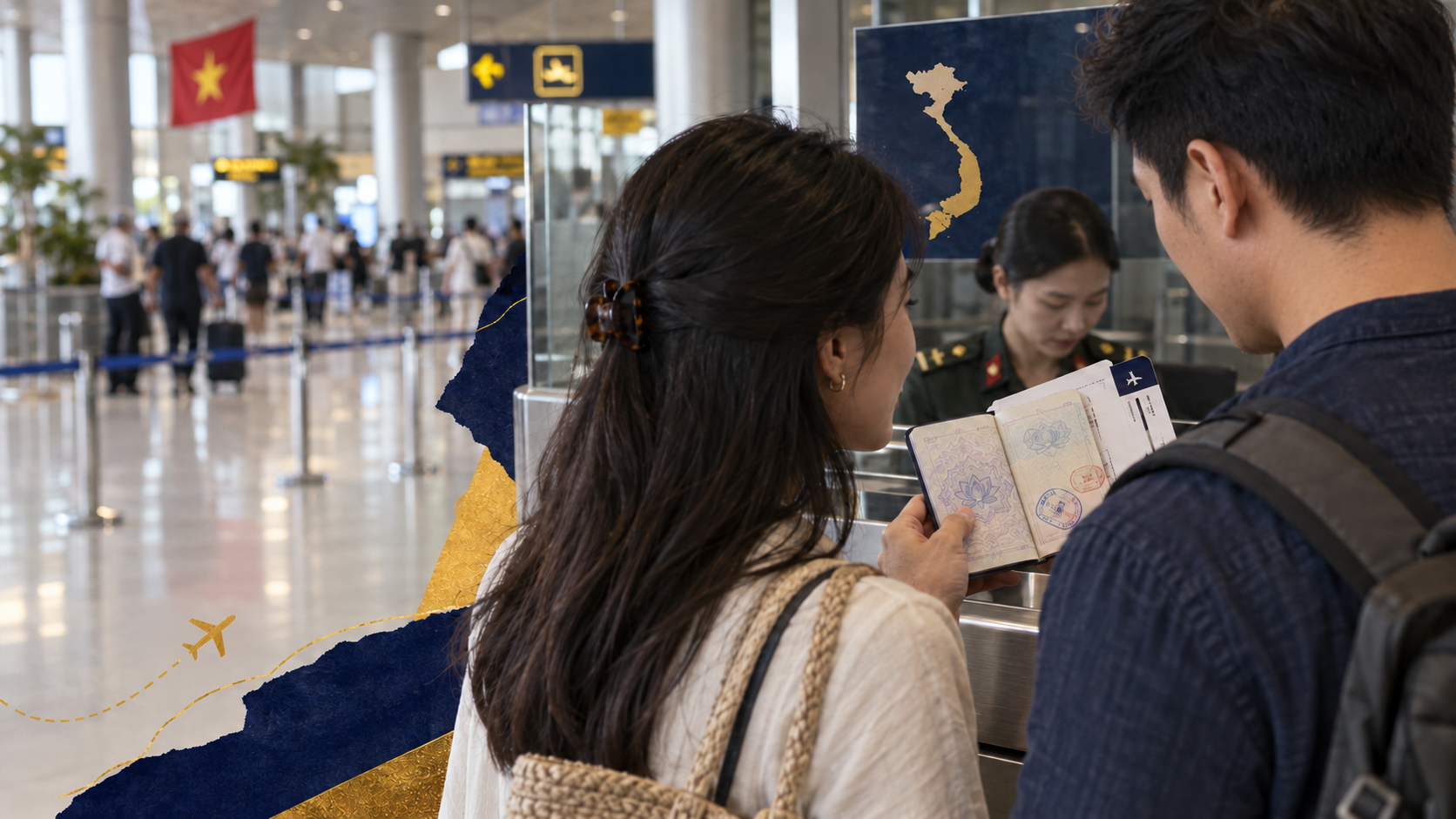
Often called a “five-year visa,” Vietnam’s Visa Exemption Certificate can simplify repeat family visits for overseas Vietnamese and eligible foreign relatives. This practical guide explains who qualifies, how long each stay can last, where to apply, what the official process costs, and when an extension or new certificate is required.
In this article9
A foreign business owner married to a Vietnamese citizen may hear “five-year visa” and assume it permits five continuous years in Vietnam. Then, at the airport, immigration grants a stay of only six months. Neither part is necessarily a mistake. The document can remain valid for up to five years, while each entry normally permits no more than six months. Missing that distinction can lead to an overstay or the wrong long-term immigration plan.
Officially, this document is a Visa Exemption Certificate, or Giấy miễn thị thực. “Five-year visa” is only the name commonly used by families and service providers. Under Decree 82/2015/ND-CP, it is intended for overseas Vietnamese and certain foreign family members entering Vietnam to visit relatives or handle private matters.
What is a Vietnam 5-year Visa Exemption Certificate?
A Visa Exemption Certificate allows repeat entry without a new visa for every trip. It is usually placed in a foreign passport, although a separate booklet may be issued in limited cases. For eligible families, this makes regular visits and personal matters much easier to manage.
However, the certificate is not:
- permission to remain in Vietnam continuously for five years;
- a temporary or permanent residence card;
- a work permit or confirmation of a work permit exemption;
- an investor or business visa; or
- proof of Vietnamese nationality.
Owning a Vietnamese company, investing in a project or serving as a company director does not, by itself, create eligibility. Immigration status, permission to work and corporate roles are separate legal questions.
Who is eligible for the 5-year visa exemption?
The certificate is available to two main groups:
- Vietnamese people residing overseas who use a foreign passport, an international travel document or, in qualifying cases, a foreign permanent residence document.
- Foreign nationals who are the spouse or child of a Vietnamese citizen or an overseas Vietnamese person.
For foreign family members, the list is specific. A marriage certificate may support a spouse’s application, while a birth certificate, parent-child confirmation or adoption decision may support a child’s application. Being a parent, sibling, fiancé, unmarried partner or other relative of a Vietnamese citizen does not automatically fall within this particular exemption category.
The Ministry of Public Security procedure states three core conditions:
- the applicant holds a passport or international travel document valid for at least one year, or an eligible overseas Vietnamese applicant without one holds a foreign permanent residence document with at least one year remaining;
- the applicant can prove that they belong to an eligible category; and
- the applicant is not subject to a prohibition on entry or a temporary suspension of exit under Vietnam’s immigration law.
The one-year rule is important. Some older guidance and commercial websites still mention six months, but the current domestic public-service procedure and the Vietnamese Embassy in the United States specify at least one year. If the goal is a certificate valid for the full five years, the passport should have at least five years and six months remaining.
How long is the certificate valid, and how long can you stay?
The certificate can be valid for up to five years, but it must expire at least six months before the passport or relevant travel or foreign residence document expires.
If a passport has three years remaining, certificate validity would generally be capped at about two years and six months. Renewing the passport first may produce a more useful result.
During the certificate’s validity, the holder may make multiple entries. For each entry:
- if the certificate has at least six months remaining, the permitted temporary stay is no more than six months;
- if it has less than six months remaining, the stay is limited to its remaining validity; and
- the immigration stamp or recorded admission period controls the actual departure deadline.
Always check the admission stamp after entering Vietnam. “Up to six months” should not be treated as an automatic right to stay until an estimated date calculated from a flight ticket.
The certificate does not remove other compliance obligations. Accommodation providers must still register the holder’s temporary residence, while work, business and tax requirements remain separate.
Documents required for the application
The exact presentation can vary between an overseas consular post and the Immigration Department in Vietnam, but a standard application normally includes:
- One application form. Form NA9 is used for the domestic procedure. An embassy or consulate may direct applicants to its own consular form or the Ministry of Foreign Affairs online declaration portal.
- Two recent colour photographs, 4 x 6 cm. They should have a white background, show the applicant facing forward and bare-headed, without tinted glasses. One photo is attached to the form and one is submitted separately.
- The original foreign passport or eligible travel document, together with the copy required by the receiving authority.
- Evidence of eligibility. The correct evidence depends on the applicant’s category. Use a certified copy or present the original for comparison, as instructed.
An overseas Vietnamese applicant may use a Vietnamese birth certificate, an old Vietnamese passport or identity document, nationality records, or an eligible foreign document recording Vietnamese origin. The Ministry of Foreign Affairs guidance also describes guarantee documents for certain cases where standard origin records are unavailable.
A foreign spouse or child should provide a marriage certificate, birth certificate, parent-child confirmation, adoption decision or another legally valid record proving the relationship. The authority may also request identity or nationality evidence for the Vietnamese citizen or overseas Vietnamese family member.
Documents issued outside Vietnam may need consular legalisation, Vietnamese translation and certification unless an applicable treaty, reciprocal arrangement or Vietnamese rule provides an exemption. Confirm this before sending originals. Names, dates of birth and passport details should be consistent across every document. A spelling difference after marriage or transliteration can delay a file even when the relationship itself is genuine.
Where and how to apply
The correct route depends mainly on where the applicant is currently residing.
Applying outside Vietnam
Submit one dossier to a Vietnamese embassy, consulate or other Vietnamese overseas authority competent to issue visas. Many missions allow the declaration to be completed online, but applicants may still need to print and sign it, provide originals, attend an appointment or send the dossier by post.
Check the mission’s appointment, payment and return-mail instructions before filing, particularly if originals will be mailed.
Applying inside Vietnam
An applicant who is lawfully present in Vietnam may apply through the Immigration Department of the Ministry of Public Security. The current public-service listing identifies its offices at:
- 44-46 Tran Phu Street, Hanoi; and
- 333-335-337 Nguyen Trai Street, Ho Chi Minh City.
The application may be initiated directly, through the National Public Service Portal or through the Ministry of Public Security portal. The service is classified as partially online. For an online application, the original passport or travel document may still have to be sent through the public postal service, while documents that are not electronically certified may also need physical submission.
Official fee and processing time
The Ministry of Public Security portal currently lists an official fee of USD 10 and a processing time of five working days for a complete, valid domestic application, whether initiated directly, online or with required postal supplements.
Overseas processing varies. The Vietnamese Embassy in the United States publishes an estimate of five to seven working days after receiving a valid dossier. Mailing, holidays and requests for more evidence add time.
The fee excludes photographs, translation, certification, legalisation, postage and professional help. Confirm the accepted currency and payment method. For time-sensitive travel, apply two or three weeks ahead rather than relying on the minimum period.
Can the stay or certificate be extended?
Two different issues are often described as “renewing the five-year visa.” They require different procedures.
Extending the temporary stay in Vietnam
A person who entered with a valid Visa Exemption Certificate may be considered for a temporary stay extension of up to six months when an agency, organisation or individual in Vietnam provides a guarantee and there is a legitimate reason.
The extension dossier includes the original passport or eligible travel document, the certificate and Form NA5. The Ministry of Public Security procedure lists five working days, a USD 10 fee and an extension of no more than six months. Approval is not automatic. Official consular guidance states that this route is unavailable when the certificate has less than six months remaining. File before the current stay expires.
Renewing or reissuing the certificate itself
The certificate’s five-year validity is not extended by adding more time to the old document. When it expires, the holder applies for a new or reissued certificate. Reissuance is also relevant if the certificate is lost or damaged, the passport is renewed, its pages are exhausted, or personal details need correction.
The original issuing authority may allow a simplified dossier, while a different authority may require a full first-time file. A lost certificate requires a loss report. A certificate attached to an expired passport should be dealt with before the next trip.
A practical pre-filing checklist
Before submitting, confirm that:
- you qualify through Vietnamese origin or as an eligible foreign spouse or child;
- your passport has at least one year remaining, and ideally five years and six months for maximum certificate validity;
- your relationship or origin documents are legally usable in Vietnam;
- all names, dates and passport numbers match;
- you are using the correct form for the filing location;
- you have allowed time for legalisation, translation and corrections; and
- you have planned around the stay per entry, not only the certificate’s expiry date.
For frequent family visits, the Visa Exemption Certificate can be simpler and more economical than arranging a new visa for every trip. For someone planning to settle, work or manage a long-term assignment in Vietnam, it may be only one part of the solution. Compare it with the EasyTiger Vietnam visa guide and the guide to Vietnam Temporary Residence Cards before choosing a route.
Every family file is slightly different. A foreign marriage certificate, an old Vietnamese birth record, a new passport or inconsistent names can change what must be prepared. If you are unsure about eligibility, document legalisation, the correct filing authority or your longer-term immigration plan, contact EasyTiger. We can match you with an appropriate immigration or legal professional who can review your circumstances and help you organise the process correctly.
Information checked against official sources on 22 September 2026. Immigration procedures, office instructions and fees may change, so confirm the current requirements with the receiving authority before filing.
Frequently asked questions


Easytiger Match
Find the right professional
- Tell us what you need
- We shortlist professional(s) and introduce them to you