
From getting your tax code to completing your annual PIT finalization, here is a practical guide to the eTax system for employees, freelancers, and expats in Vietnam. (This article was originally published on 24 April 2026 on our Substack)
In this article13
If you earn income in Vietnam, whether from a salary, freelance work, or a side business, you have tax obligations, and you are expected to manage most of them through the eTax system. The eTax platform, run by the Tax Department (formerly the General Department of Taxation) under the Ministry of Finance, is the government’s central digital infrastructure for tax compliance. The mobile version, eTax Mobile, has crossed 13 million downloads since launching in 2022, which tells you how widely it has been adopted by individual taxpayers across the country.
That said, navigating eTax still has its learning curve, especially if you are new to Vietnam or dealing with it for the first time. This guide covers what you need to know: your tax code, what you owe, how to register, how to use eTax Mobile and the web portal, dependent deductions, finalization, and what happens if you miss a deadline.
The eTax System: What It Is and How Individuals Use It
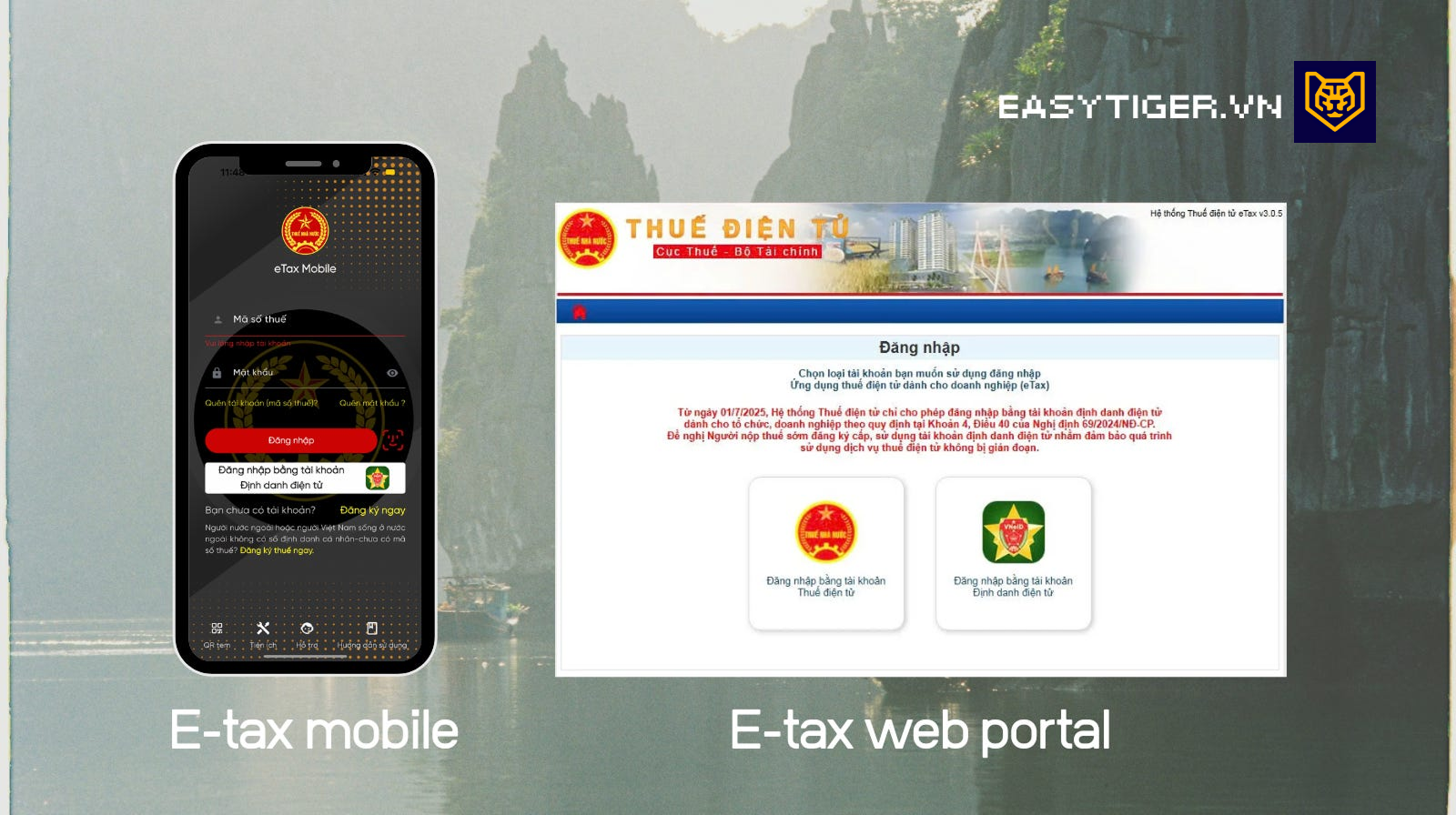
eTax, or thuế điện tử, is Vietnam’s national platform for handling tax obligations digitally. For individuals, there are two main entry points.
The personal tax web portal at canhan.gdt.gov.vn is the browser-based option. From this portal, you can file your annual PIT finalization, register dependents, check withholding tax records, look up outstanding obligations, and submit supplementary declarations. It does everything you would expect a personal tax account to do, and it works on any desktop browser.
eTax Mobile is the app version, and for most individuals this is where day-to-day interactions happen. It is built around the same functions as the web portal but optimized for mobile. One practical difference from the web portal: eTax Mobile can pre-fill your finalization form by pulling income data directly from employer records already submitted to the Tax Department, which saves significant time during finalization season.
If you are also the legal representative of a registered company, and your business VNeID account is properly linked, your company’s tax filings and submission records will appear alongside your personal tax information within the same session. This means you can monitor both personal PIT obligations and your company’s pending filings without switching accounts.
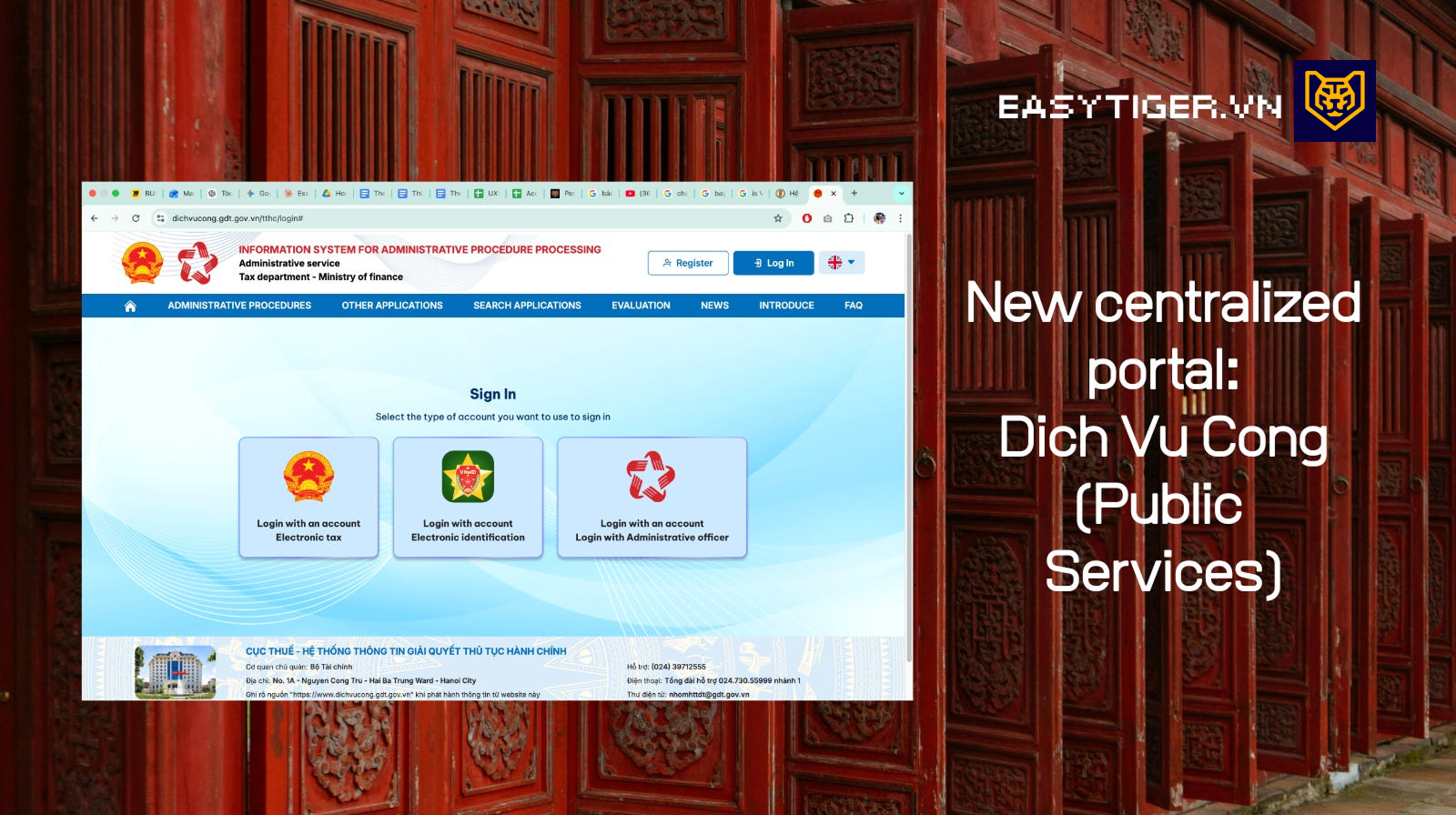
There is also a newer centralized portal the Tax Department has been rolling out at dichvucong.gdt.gov.vn. This platform sits within a broader government push to consolidate administrative procedures, covering not just tax but a range of public service tasks. What makes it noticeably different from the older portals is the transparency: it shows real-time processing status for submitted documents, sends OTP confirmations to your phone, and notifies you by email at each step. In practice, this level of responsiveness makes a real difference, it is possible to receive confirmation and processing within couple working days, compared to far longer waits in the past.
VNeID single sign-on now applies to both the web portal and the mobile app. If you have a VNeID Level 2 account, the biometric-verified national electronic identity issued by the Ministry of Public Security, you can use it to authenticate across eTax, the social insurance app (VssID), and the National Public Service Portal (Dich Vu Cong) with a single credential. If you are not yet familiar with how VNeID works or how to get your Level 2 account set up, we put together a full practical guide to VNeID that walks through the registration process, what Level 2 verification requires, and what you can actually do with it once it is active.
Your Tax Code: Where Everything Starts
Before you can do anything on eTax, you need a tax code. In Vietnam, the tax code (mã số thuế or MST) is the unique identifier that links you to the Tax Department. Every filing, every payment, every withholding certificate is tied to this number.
As of July 1, 2025, Vietnamese citizens use their 12-digit national citizen ID number (CCCD) directly as their tax code. This rule is now set out in the Law on Tax Administration 108/2025/QH15, and the registration procedures are in Circular 90/2026/TT-BTC, effective July 1, 2026. If you have an older 10-digit code from a previous employer registration, that record remains valid, but you may be asked to link it to your current citizen ID through the eTax portal.
Foreign nationals working in Vietnam continue to use a separate 10-digit TIN issued by the Tax Department. If you are unsure of your tax code, look it up at tracuunnt.gdt.gov.vn using your name or ID number.
When Does an Individual Have to Pay Tax in Vietnam?
If you earn income in Vietnam, including salary, freelance fees, rental income, or investment returns, you are potentially subject to Personal Income Tax (PIT). There is no minimum salary threshold that exempts you entirely from the obligation to register and declare. Instead, PIT is calculated progressively after applying your deductions, and many lower-income earners end up owing nothing after those deductions are applied. But the obligation to register your tax code and, in many cases, complete an annual finalization still applies.
Personal Income Tax: Rates and How They Work
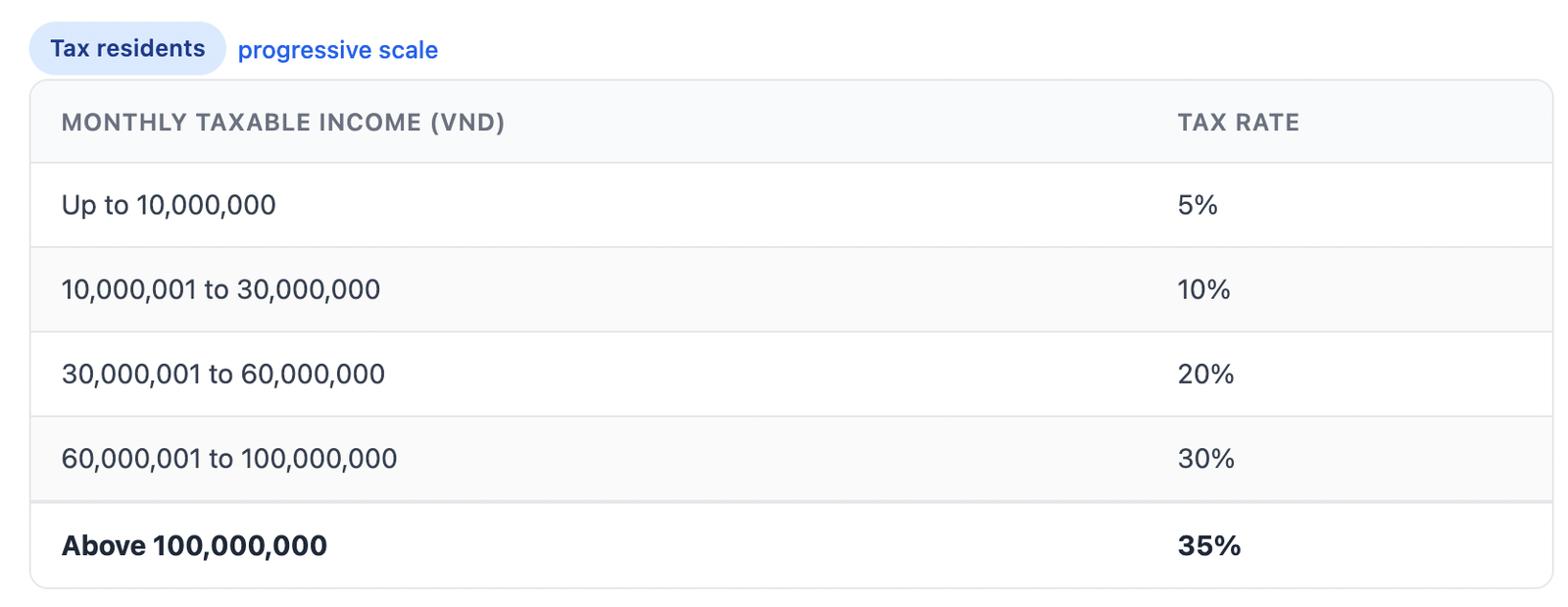
Applies to salary income from the 2026 tax year under PIT Law 109/2025/QH15, which took effect on July 1, 2026. A tax resident is any individual present in Vietnam for 183 days or more in a calendar year or in the 12 consecutive months from their first arrival, or who has a habitual residence here: the address on a permanent residence card, the address declared for a temporary residence card, or rental contracts totaling 183 days or more in the tax year. Tax residents pay progressive rates on worldwide income.
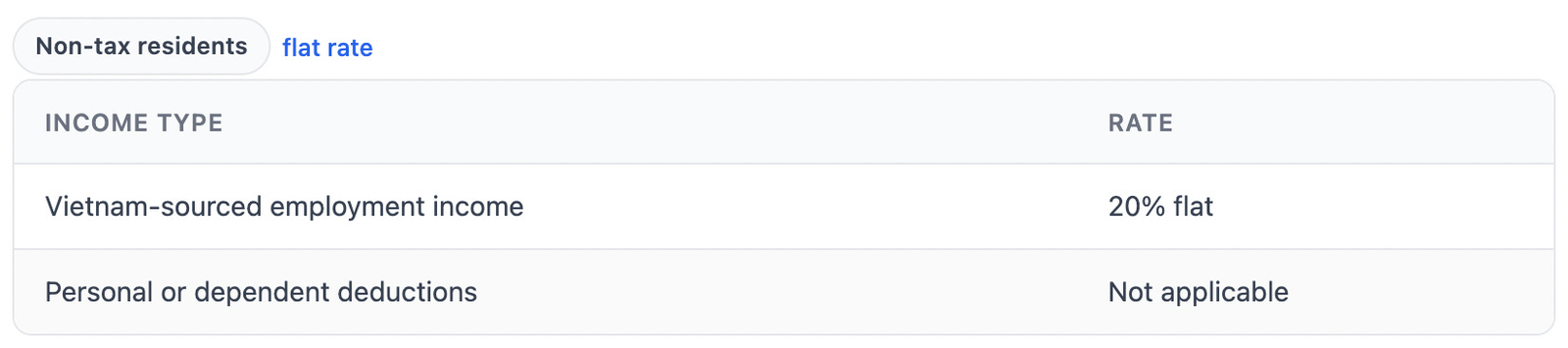
Non-tax residents are those who meet neither the 183-day test nor the habitual residence test. They pay a flat 20% on Vietnam-sourced salary only, with no deduction entitlements.
How companies calculate PIT, withhold monthly, and finalize at year-end
In practice, PIT for employees is calculated on a monthly provisional basis and then reconciled during annual finalization. Each month, the company calculates:
Gross salary
- Minus mandatory insurance (local employee portion)
- Minus personal deduction (15.5M/month in 2026)
- Minus dependent deductions (if registered)
This results in monthly taxable income, which is then taxed using the progressive PIT brackets. This monthly withholding is not final tax. It is only a temporary estimate. At year-end, the company performs PIT finalization (quyết toán thuế):
- Recalculate total annual income
- Apply deductions based on actual working months
- Apply progressive tax on annual taxable income
- Compare with total PIT already withheld
Result:
- If withheld > actual → employee gets refund
- If withheld < actual → employee must pay additional tax
Important nuance: Monthly withholding assumes stable income across the year, but real situations (resignation, unpaid leave, partial months) break that assumption. That’s why refunds often happen.
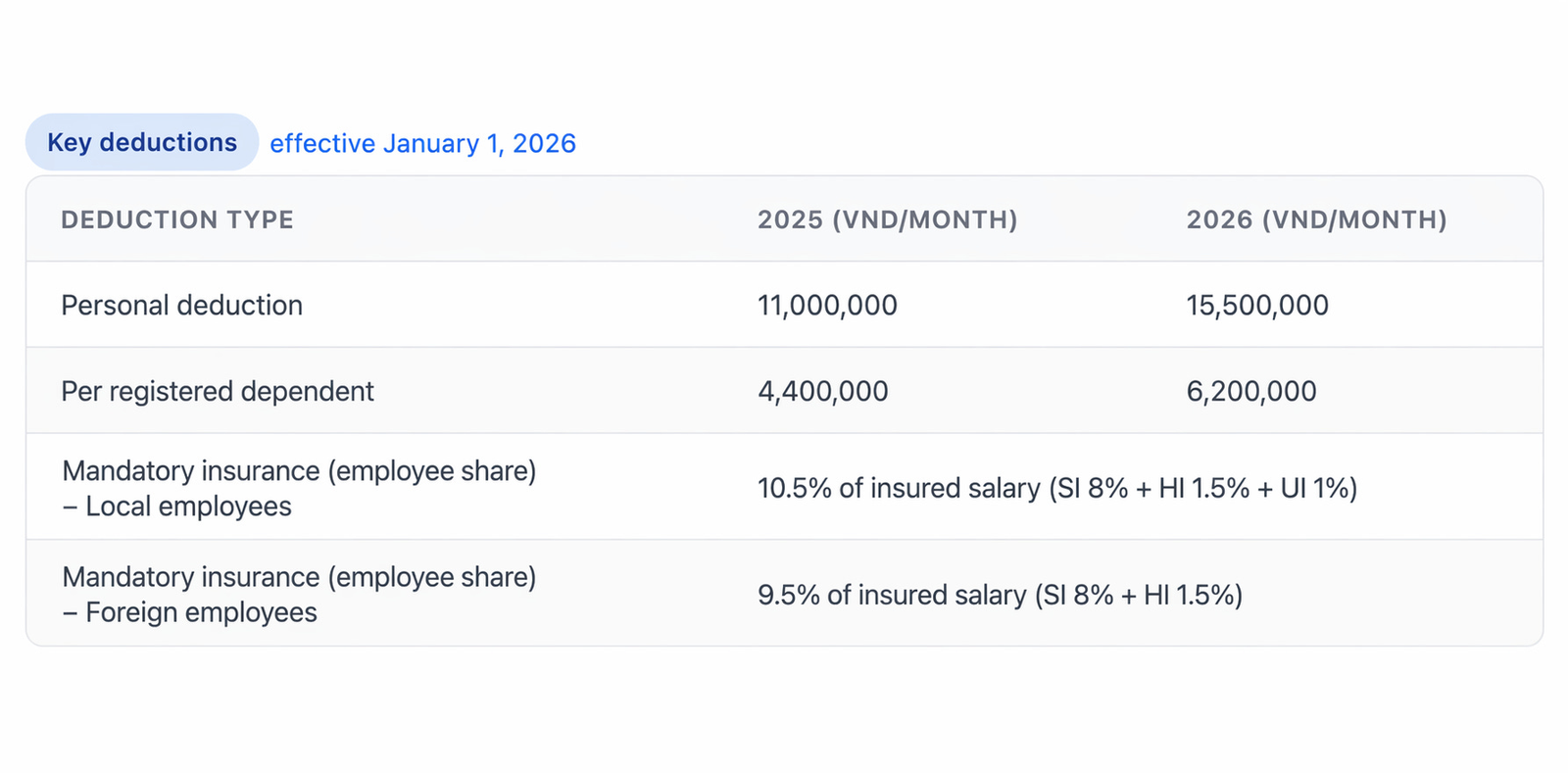
Source: Resolution 110/2025/UBTVQH15 and PIT Law 109/2025/QH15. The mandatory insurance deduction is capped at a salary of VND 46,800,000/month for SI and HI.
Dependent Deductions: Who Qualifies, and How to Register
Under Vietnam’s family circumstance deduction rules (giảm trừ gia cảnh), each registered dependent reduces your monthly taxable income by VND 6.2 million as of January 2026. Over a full year, that is VND 74.4 million in income shielded from tax, which at the 10% bracket translates to roughly VND 7.4 million saved annually.
Qualifying dependents include children under 18; children above 18 who are disabled and unable to work; adult children in full-time university or college study, with no age limit; and parents, siblings, or other direct relatives who cannot support themselves due to age or disability. Students and other relatives qualify only if their average monthly income is no more than VND 3 million, the threshold set by the Minister of Finance in Circular 87/2026/TT-BTC.
To register a dependent, log in to your eTax account or open eTax Mobile, navigate to the dependent registration section, and upload the required documents. For a child, a birth certificate is typically sufficient. For other relatives, you will also need income declarations and proof of relationship. The registration must be completed before you can apply the deduction, and you cannot claim the same dependent at more than one employer simultaneously.
If you are currently employed, flag this to your HR team as early in the year as possible. The sooner the dependent is registered with your employer, the sooner the deduction reduces your monthly withholding. If you change jobs, your dependent registration does not carry over automatically. You will need to re-register with the new employer.
For foreigners, the deduction is available under Vietnamese law to any tax resident who can document qualifying dependents. Children living abroad can qualify, but you will likely need legalized and translated versions of birth certificates or other relationship proof in a format acceptable to Vietnamese tax authorities.
How to Register Your Tax Code
If you are starting a new job in Vietnam, your employer typically handles tax registration on your behalf. The company files a declaration to the Tax Department, and your tax code is issued within three working days. Vietnamese nationals: your CCCD number now serves directly as your tax code.
If you need to register independently, for example as a freelancer, a foreign national, or someone setting up without a full employer’s support: you can complete the process through the eTax web portal. Simply navigate to the 'First-Time Registration' section and follow the administrative steps. It typically takes a few days to receive your tax code
How to Set Up Your eTax Account
- Via the web portal (canhan.gdt.gov.vn): Visit the site, select account registration, and enter your tax code or citizen ID, full name, date of birth, phone number, and email. The system sends an OTP to verify your number. Once verified, set a password and your account is active. This gives you full browser access to PIT finalization, dependent registration, and tax status checks.
- Via VNeID on eTax Mobile (recommended): Download eTax Mobile from the App Store or Google Play. Select Đăng nhập bằng VNeID. The app links to your VNeID profile and automatically pulls prior year withholding records, filing history, and outstanding obligations. This is the faster and more secure route.
Paying tax online: Once your account is active, tax payments can be made directly through eTax Mobile or canhan.gdt.gov.vn via your bank’s internet banking. The system generates a unique payment reference code. Major banks including Vietcombank, Techcombank, BIDV, and Shinhan all support eTax payment integration.
Tax Finalization: Deadlines and Who Must File Directly
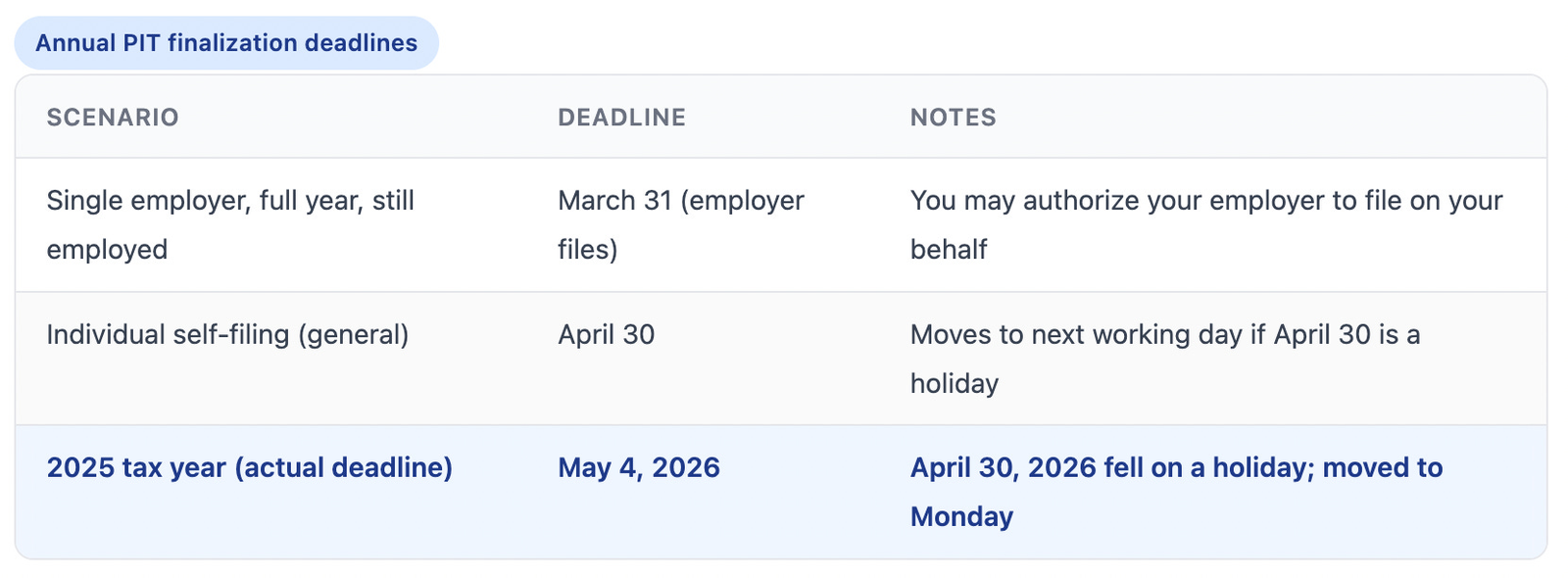
You must file your own finalization if you had income from two or more sources in the tax year, left your employer before finalization season, or had side income that averaged more than VND 15 million per month or was not withheld at 10% (the 2026 tax year rule in Article 51 of Decree 253/2026/ND-CP). You must also finalize yourself if you claim a tax reduction for disaster, fire, accident or serious illness, or deductions under Article 49 of that decree. For a detailed walkthrough of the self-filing process, see our guide on Personal Income Tax Finalization in Vietnam.
If you are a foreign tax resident and your labor contract in Vietnam ends, you must file your PIT finalization before leaving Vietnam, and no later than 45 days after the contract ends (Article 10 of Decree 252/2026/ND-CP).
Penalties for Late Filing: What They Actually Cost
Vietnam’s penalty framework sits under Decree 125/2020/ND-CP, as amended by Decree 310/2025/ND-CP effective January 16, 2026, and by Decree 291/2026/ND-CP effective July 21, 2026. One important note: if your late finalization produces a refund rather than additional tax owed, you will not face an administrative fine. The penalties below apply only when there is an outstanding tax balance.
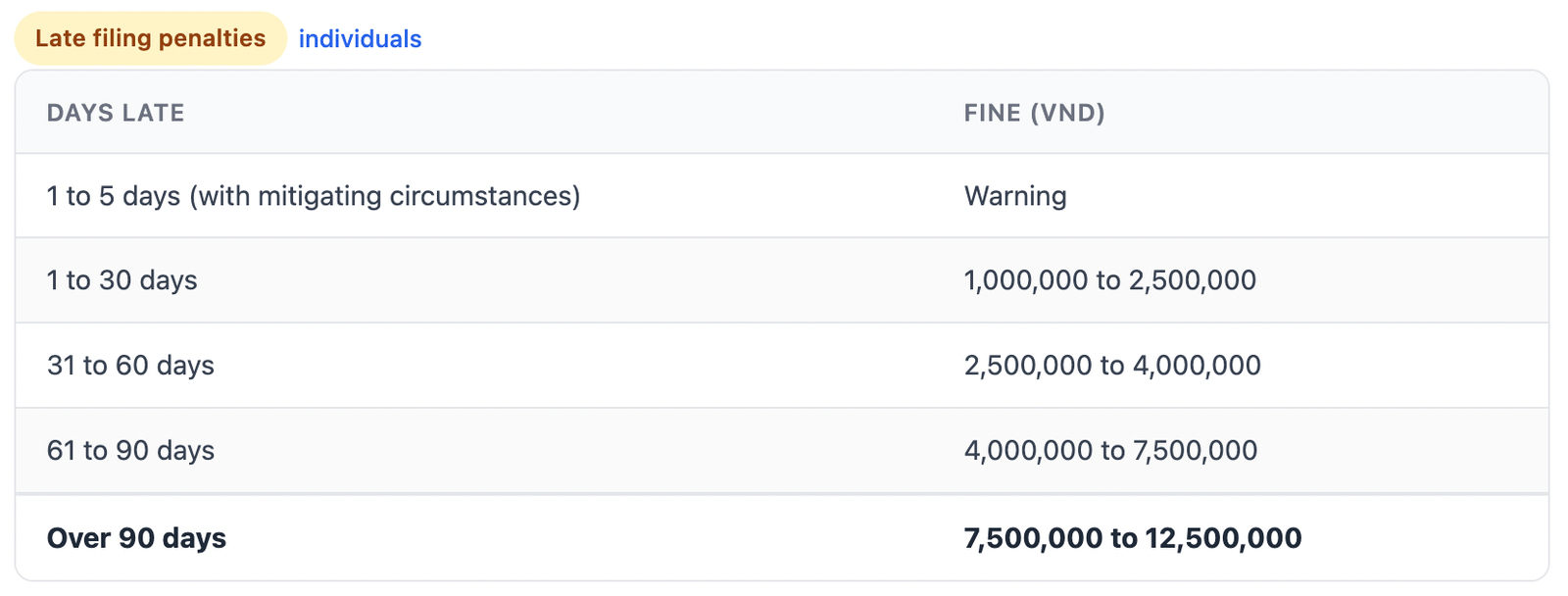
Source: Article 13, Decree 125/2020 as amended by Decree 310/2025. In addition to the filing fine, late payment interest accrues at 0.03% per day on any outstanding tax, counted continuously including weekends and public holidays. If the delay exceeds 90 days with tax unpaid, authorities may reclassify as tax evasion, carrying a penalty of 1 to 3 times the evaded amount.
Under Decree 252/2026/ND-CP, in force since July 1, 2026, a foreigner with overdue tax debt that has not been paid can also be stopped from leaving Vietnam, with no minimum amount.
What Is New in 2025 and 2026
PIT Law 109/2025/QH15 passed December 10, 2025. Key changes for individuals: five simplified tax brackets (down from seven), personal deduction raised to VND 15.5 million per month, dependent deduction raised to VND 6.2 million per month. A five-year PIT exemption also applies to qualified professionals in digital technology, R&D, semiconductor, and AI sectors. The law took effect on July 1, 2026, and its rules on salary income for residents apply from the 2026 tax year.
Exit bans: Decree 252/2026/ND-CP replaced Decree 126/2020/ND-CP on July 1, 2026. A foreigner with overdue tax debt that has not been paid can now be stopped from leaving Vietnam, with no minimum amount. The VND 50 million threshold for debts overdue by more than 120 days applies only to business individuals and heads of household businesses under enforcement.
eTax Chatbot: Launched in December 2025, the Tax Department added an AI chatbot to eTax Mobile to guide users through common procedures and surface relevant regulations. Useful for quick lookups, though still being refined.
Closing Note
Vietnam’s eTax system has become genuinely usable for most everyday tax tasks. The VNeID login removed the most frustrating friction point. The mobile app pre-fills finalization data. The new Dich Vu Cong portal adds real-time tracking that did not exist before.
What still requires attention is the volume and pace of regulatory change. The personal income tax framework was overhauled at the end of 2025, with the full effect rolling into 2026. If you are a salaried employee, staying connected to your payroll team, managing your tax code and your eTax account is enough for most situations. If you have income from multiple sources, freelance work, or you changed jobs mid-year, getting early advice on your finalization is worth the time.
If you have questions about your specific situation, or need support with tax registration, dependent registration, or PIT finalization, reach out to Easytiger and we will connect you with a verified specialist.
Easytiger.vn connects individuals, expats, and businesses across Vietnam with trusted legal and compliance professionals for tax, accounting, company registration, and more.
This article is for informational purposes only and does not constitute formal tax or legal advice. Tax regulations in Vietnam are subject to ongoing changes. All rates, thresholds, and deadlines referenced are based on information available as of April 2026, updated in September 2026 for the rules that took effect on July 1, 2026. Consult a qualified tax professional for guidance specific to your situation.
Frequently asked questions


Easytiger Match
Find the right professional
- Tell us what you need
- We shortlist professional(s) and introduce them to you