From 28 September 2026, Decree 320 lets any foreigner who entered Vietnam lawfully get a VNeID account, with no residence card. What that changes for company directors, what it does not, and the deadlines that follow.
In this article8
Until now, a foreigner could only get a VNeID account with a temporary or permanent residence card. That left a specific group stuck: the foreign director who flies in for a week at a time on a DN business visa, whose company is expected to file everything online through accounts that only a VNeID login can open.
From 28 September 2026 that condition is gone. Decree 320/2026/ND-CP, signed on 13 August 2026, amends Decree 69/2024/ND-CP on electronic identification and authentication. Under the new Article 7, any foreigner "who has lawfully entered Vietnam or is lawfully residing in Vietnam" can be issued an electronic identification account on request. The decree names no visa type at all, so a business visa, a tourist visa or a lawful entry under a visa exemption all meet the same wording.
This guide covers what changes for you personally, what does not change for your company, and the deadlines that follow.
What changes on 28 September
- No residence card. Lawful entry or lawful residence is the test. The old rule required a temporary or permanent residence card and shut out anyone on a short visa.
- No account levels for foreigners. Where foreigners previously had Level 1 and Level 2 accounts, there is now a single account. Levels 1 and 2 remain for Vietnamese citizens.
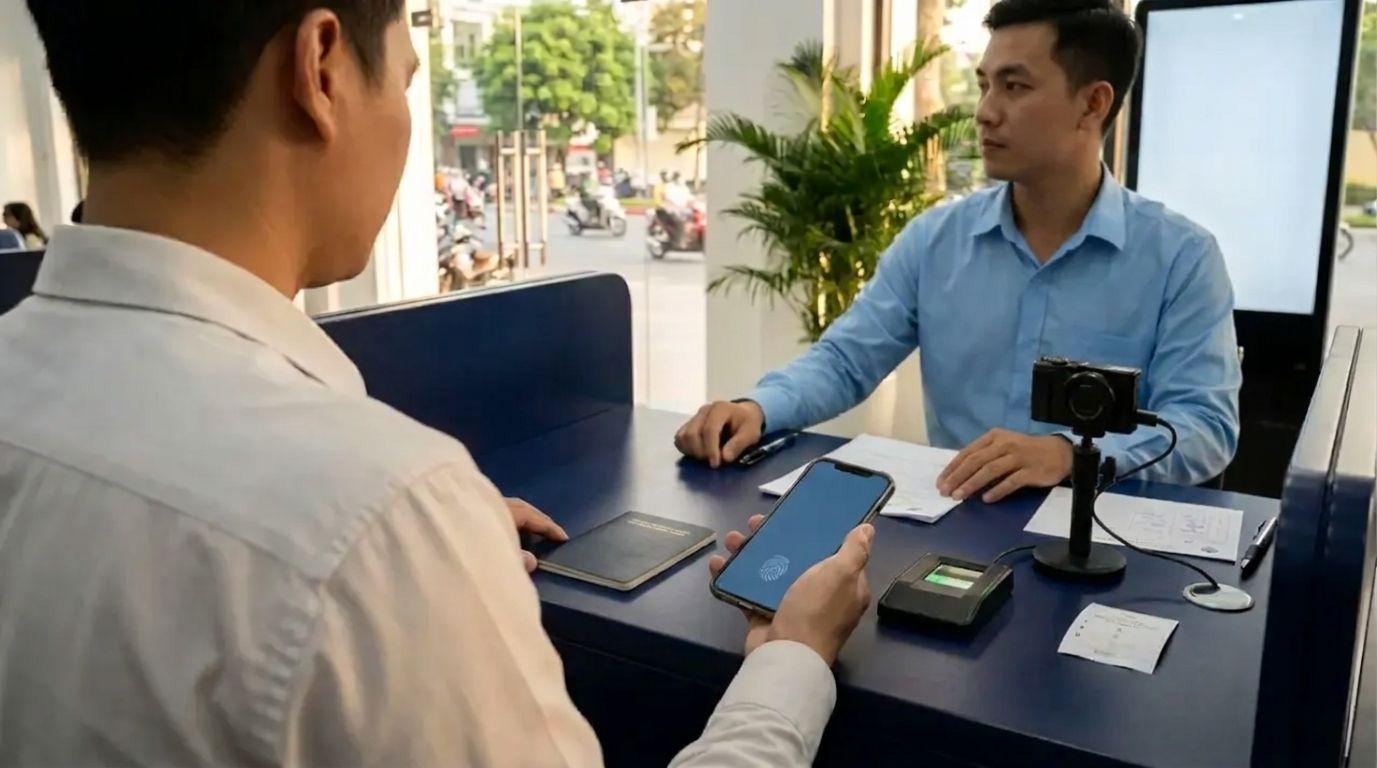
- Registration is in person. You go to the immigration office of the provincial police with your passport or other international travel document and complete form TK01. Staff take your photograph and fingerprints and check them against the immigration database. The option of applying at the Immigration Department of the Ministry of Public Security is gone.
- What to bring and provide: your passport, a Vietnamese mobile number registered in your own name, and an email address if you have one. You can also list other documents you want integrated into the app.
- Two or five working days. Two if your face photo and fingerprints are already in the national immigration database, five if they are not, counted from a complete application. Neither decree sets a fee, and the published record of the procedure lists none.
- Foreigners under 14 and people with a guardian attend with their representative, who uses their own registered mobile number to apply on their behalf.
Two smaller changes in the same decree are worth knowing. An account now gives foreigners and organizations access to the full range of features of the identification system, not a reduced set. And foreigners holding an account can use the automated border gates on entry and exit, which until now was open to Vietnamese citizens and a narrower group.
Why this matters more than it sounds
The residence card rule was not just an inconvenience. Vietnam moved its company-facing portals onto VNeID over two years, while foreigners without a residence card could not obtain the account those portals require.
| Date | What happened |
|---|---|
| 1 July 2024 | VNeID becomes the only login for individuals on the National Public Service Portal, and the only login on the National Business Registration Portal |
| 1 July 2025 | Portal accounts issued to organizations stop working, so companies must use an organization e-ID account. The same day, the Ministry of Public Security starts issuing accounts to foreigners, but only to residence card holders |
| 31 December 2025 | The legacy business registration account can no longer be used to sign online filings |
| 1 July 2026 | A new tax circular makes the electronic identification account the tax transaction account, keeping tax-issued accounts only for those not required or not eligible to hold one |
| 21 July 2026 | Electronic authentication becomes a condition of being granted registration of a new company |
| 28 September 2026 | The residence card condition for foreigners disappears |
Tax and immigration guidance bridged the gap by hand. When the tax system announced in June 2025 that it would accept only electronic identification logins, follow-up guidance days later let taxpayers who had not been issued an account, naming foreigners specifically, keep using their existing tax account. The 2026 rules on biometric authentication for electronic invoices carry a similar exception for foreigners who cannot yet meet the Level 2 requirement. From 28 September those exceptions sit oddly: a foreigner can be issued an account, and cannot be issued a Level 2 one, because levels no longer apply to them.
Your account, your company's account: two different things
This is where the headline going around, that company identification now needs only a business visa, runs ahead of the text.
A company's electronic identification account is governed by Article 12 of Decree 69/2024, and Decree 320 does not amend it. It still says the legal representative, or a person they authorize, registers the company account by signing in to the app with "their own Level 2 account". From 28 September no foreigner can be issued a Level 2 account, so that condition cannot be met literally by a foreigner registered after that date. Foreigners who obtained a Level 2 account before then still hold one.
That is almost certainly a drafting oversight rather than a policy. Decree 69 elsewhere expressly contemplates a foreign legal representative, identified by a foreigner identification number, and the amended Article 9 gives a foreigner's account the full feature set. The Ministry of Public Security has also stated the intended sequence: register the foreigner's personal account first, then the company account under Article 12. No guidance published so far reconciles the wording, and no implementing announcement for 28 September had appeared at the time of writing.
In practice there are three routes, in order of how well the text supports them:
- Filing at the counter. Article 12 allows the company account to be applied for in person on form TK02. Read closely, the Level 2 phrase describes how you log in online, not a status the person must hold, and the second sentence attaches no account condition. The published procedure records list no requirements or conditions.
- Authorizing someone who holds an account. A Vietnamese colleague with a Level 2 account can file. Online, the representative still has to confirm the request inside their own account and a signed authorization is uploaded, so this helps most on the counter route.
- Trying the app once you have your own account. Reasonable, and the likely intended path, but nobody has reported doing it under the new rules.
For company registration filings specifically, the law already provides a workaround that does not depend on any of this. Since July 2026 the filer and the person authorizing them must pass electronic authentication, but where the authorizing person has no electronic identification account, the file may instead include a copy of their passport. So a foreign representative can sign the documents and have a Vietnamese colleague file them. Note also that the registration portal's own 2026 login guide documents the citizen flow, keyed to a Vietnamese identification number. Whether a foreigner's account signs in there has not been confirmed anywhere official.
An account obtained on a short stay locks when the stay ends
This is the part the announcements leave out. Article 15 of Decree 69/2024, which Decree 320 does not touch, locks a foreigner's account automatically when the passport expires, when the permitted period of residence ends, or on the holder's death. It unlocks when the reason disappears.
For a residence card holder that is a distant event. For a director on a three-month business visa it is the normal state of affairs: the account works while the stay is valid, locks when it expires, and comes back when you next enter lawfully. Plan filings around that, and do not assume an account registered in March is usable in June.
Two deadlines to put in the diary
- 31 December 2026. National digital platforms must support electronic identification for login, authentication and transactions. Separately, electronic transaction accounts that already exist in a list of named sectors must be linked and authenticated with an electronic identification account. The list includes electronic invoices, securities, telecommunications, e-commerce sellers, transport, tourism, pharmacy, healthcare, education and social networks.
- 30 June 2027. The same linking obligation for accounts in the banking sector.
Ministers can add further lists of online transactions that require linkage, so the scope will keep growing without a new decree. Note that the obligation applies to accounts in those sectors, not to every account a company holds.
What to do now
- If your legal representative is a foreigner without a residence card, book the trip to the provincial immigration office. Two working days is realistic if they have entered Vietnam recently and their biometrics are on file.
- Check whether your company already has an organization account, and who controls it.
- If it does not, decide now which route you will use, and get the authorization document ready if a Vietnamese colleague will file.
- Check your electronic invoice provider and bank against the 31 December 2026 and 30 June 2027 linking dates.
- Keep the passport in the account current. A renewed passport means the account details need updating, and an expired one locks it.
If you would like help with any of this, tell us what you need and our team will match you with suitable professionals. For background on the app itself, see our guide to VNeID and Vietnam's digital ID, and for the filing portals, eTax, the MPS portal and business registration.
Research checked on 23 September 2026 against the signed text of Decree 320/2026/ND-CP. This article is general information, not legal or tax advice. Implementing guidance for 28 September had not been published when this was written, so confirm the company account procedure before you rely on it.
Sources
- Decree 320/2026/ND-CP, signed text (Government of Vietnam, Vietnamese)
- Decree 320/2026/ND-CP, summary and full text (Government of Vietnam, Vietnamese)
- Decree 69/2024/ND-CP on electronic identification and authentication (Vietnamese)
- Decree 168/2025/ND-CP on enterprise registration and Decree 296/2026/ND-CP amending it (Vietnamese)
- Circular 89/2026/TT-BTC on tax administration (Vietnamese)
- National Business Registration Portal: VNeID as the only login from 1 July 2024 (Vietnamese)
- National Business Registration Portal: electronic authentication required from 21 July 2026 (Vietnamese)
- Ministry of Public Security answer on companies with a foreign legal representative (Vietnamese)
Frequently asked questions


Easytiger Match
Find the right professional
- Tell us what you need
- We shortlist professional(s) and introduce them to you