
Already living or operating in Vietnam? These three platforms are where your taxes get filed, your police clearance gets issued, and your company stays legally registered. Here is what you need to know about each one.
In this article5
In Part 1 of this guide, we covered the four platforms that form the identity and personal compliance layer in Vietnam: VNeID, Cong Dich Vu Cong, the Immigration Portal, and VssID. If you missed it, that is a good place to start. This second part picks up where those leave off, covering the platforms that touch your money, your police record, and your business registration.
Whether you are a solo expat earning a salary, a freelancer managing your own tax obligations, or a foreign investor running an FDI company, these three portals belong in your toolkit.
5. eTax: Managing Your Tax Obligations in Vietnam
What it is and who runs it
The eTax system is managed by the Tax Department (formerly the General Department of Taxation) under the Ministry of Finance. It is Vietnam's centralized electronic tax platform, and since the government's push toward full digital tax administration, every tax obligation in Vietnam is expected to flow through it.
There is not one portal but several, and which one you use depends on who you are.
For individuals earning income in Vietnam, the core tools are the eTax Mobile app (iOS and Android) and the personal tax web portal at canhan.gdt.gov.vn. Both cover tax declaration, annual PIT finalization, dependent registration, and payments through linked bank accounts. The mobile app has a practical edge: it pre-fills your finalization form by pulling income data already submitted by your employer to the tax authority, which makes the year-end process significantly faster.
For businesses registered in Vietnam, the main dedicated portal is thuedientu.gdt.gov.vn, where your accountant or tax agent handles monthly and quarterly filings, CIT declarations, VAT returns, e-invoice management, and annual finalization.
Both individuals and businesses can now also use the newer centralized portal at dichvucong.gdt.gov.vn as an alternative to the older dedicated portals above. This platform sits within a broader government push to consolidate administrative procedures under a single interface. Login is via your existing eTax credentials from canhan.gdt.gov.vn or thuedientu.gdt.gov.vn, or directly via VNeID. What makes it noticeably different is the transparency: it shows real-time processing status for submitted documents, sends OTP confirmations to your phone, and notifies you by email at each step. For straightforward filings and administrative submissions, dichvucong.gdt.gov.vn is increasingly the recommended entry point for both individual and business users.
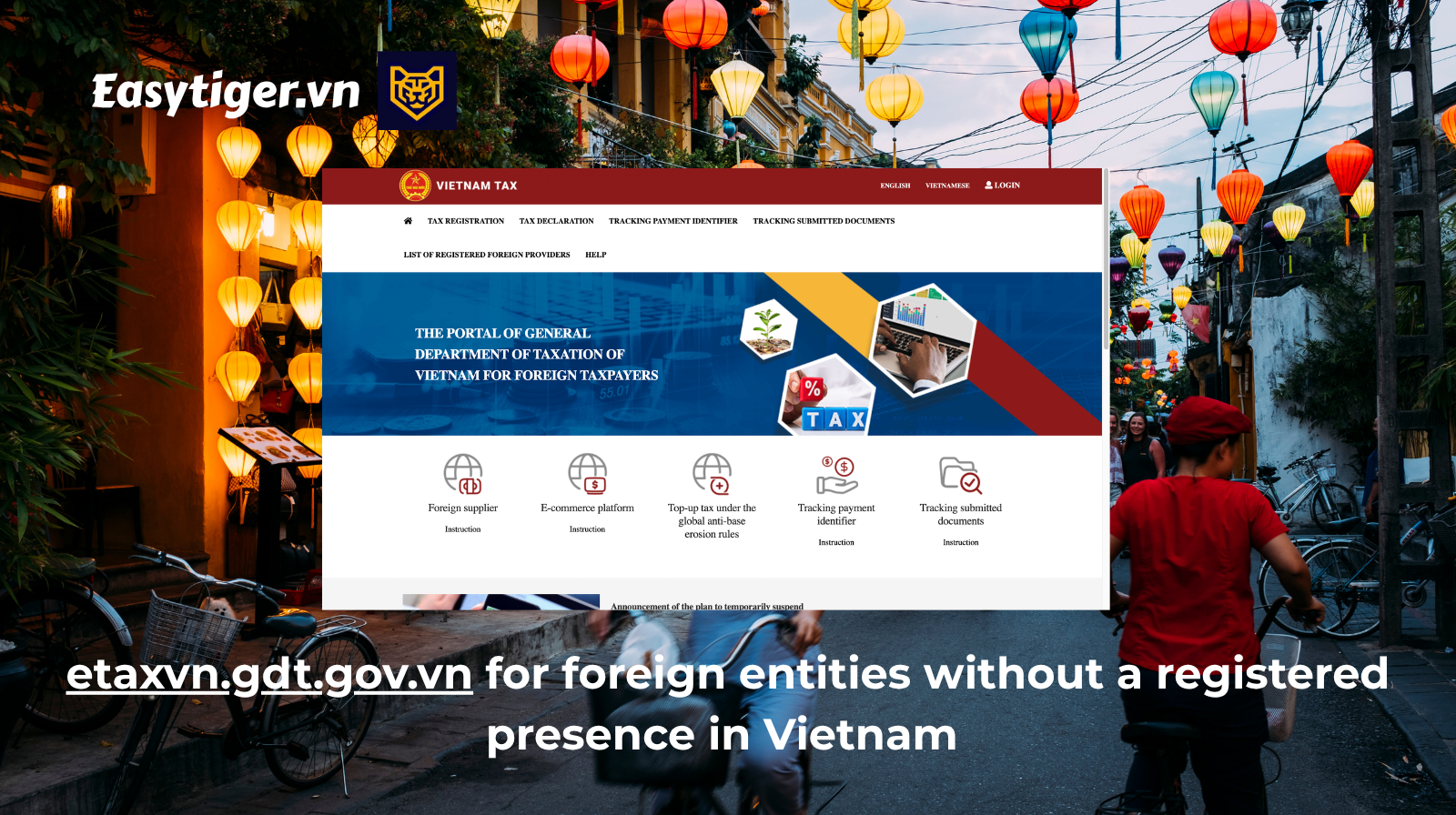
For foreign companies and digital service providers without a registered presence in Vietnam, the dedicated channel is etaxvn.gdt.gov.vn. This is where foreign entities selling goods or services to Vietnamese customers, such as streaming platforms, SaaS providers, and cross-border e-commerce operators, register for a Vietnamese tax code, declare, and pay taxes remotely.
Who needs it, and when
The short answer: anyone with a tax obligation in Vietnam.
For salaried expats, your employer handles monthly PIT withholding and submits it on your behalf. But the annual PIT finalization is your personal responsibility if you earned income from more than one source, received income from outside Vietnam, or want to claim deductions. The finalization deadline for individuals is April 30 of the year following the tax period. If you are a foreigner leaving Vietnam before the calendar year ends, you should complete your PIT finalization before your departure date.
If you are a tax resident in Vietnam, meaning you spent 183 days or more in the country within a calendar year, you are taxable on worldwide income at progressive rates. If you are a non-resident, you pay a flat 20% on Vietnam-sourced income only. Under Resolution 110/2025/UBTVQH15, from the 2026 tax year the personal deduction allowance was raised to VND 15,500,000 per month and the dependent deduction to VND 6,200,000 per dependent per month. The new PIT Law 109/2025/QH15 took effect on July 1, 2026, and its salary tax rules apply from the 2026 tax year. These deductions are applied through your annual PIT finalization on the eTax system. For a full breakdown of how PIT works in Vietnam, including the bracket tables, deductions, and finalization process, see our Vietnam eTax for Individuals guide.
For businesses, eTax is where you register for corporate income tax (CIT), file VAT returns, manage electronic invoice compliance, and pay quarterly CIT installments. Late or incorrect filings attract administrative fines and daily interest of 0.03% on unpaid amounts. For a detailed look at how business tax filings work, including CIT rates, VAT obligations, e-invoice setup, and filing calendars, see our Vietnam eTax for Businesses guide.
For foreign e-commerce platforms and digital service providers selling into Vietnam, tax obligations exist regardless of whether your company has a physical presence here. Registration and filing are done through etaxvn.gdt.gov.vn.
Eligibility and how to access
For individuals: download eTax Mobile from the App Store or Google Play and log in using your VNeID account. If you have a Level 2 VNeID, the biometric-linked authentication connects your tax profile automatically. You can also access canhan.gdt.gov.vn on any browser and register using your tax code or citizen ID number, verified via OTP. Foreign nationals use their existing 10-digit tax code issued by the tax authority rather than a citizen ID. As an alternative to both of these, the newer centralized portal at dichvucong.gdt.gov.vn accepts login via your existing canhan.gdt.gov.vn credentials or directly via VNeID, and is increasingly the cleaner option for first-time users thanks to its real-time status tracking and guided interface.
For businesses: access thuedientu.gdt.gov.vn using your company's eTax credentials, or via your linked VNeID organizational account. To file electronically, your company needs a valid digital signature, either a USB token from a licensed CA provider or an approved cloud-based digital signature, registered with the tax authority. Without this, your company cannot submit declarations or make electronic tax payments. Alternatively, dichvucong.gdt.gov.vn accepts login via your existing thuedientu.gdt.gov.vn business eTax credentials or a VNeID organizational account, and supports the same core filing and payment functions with added transparency features.
6. Cong Dich Vu Cong Bo Cong An: The Ministry of Public Security Services Portal
What it is and who runs it
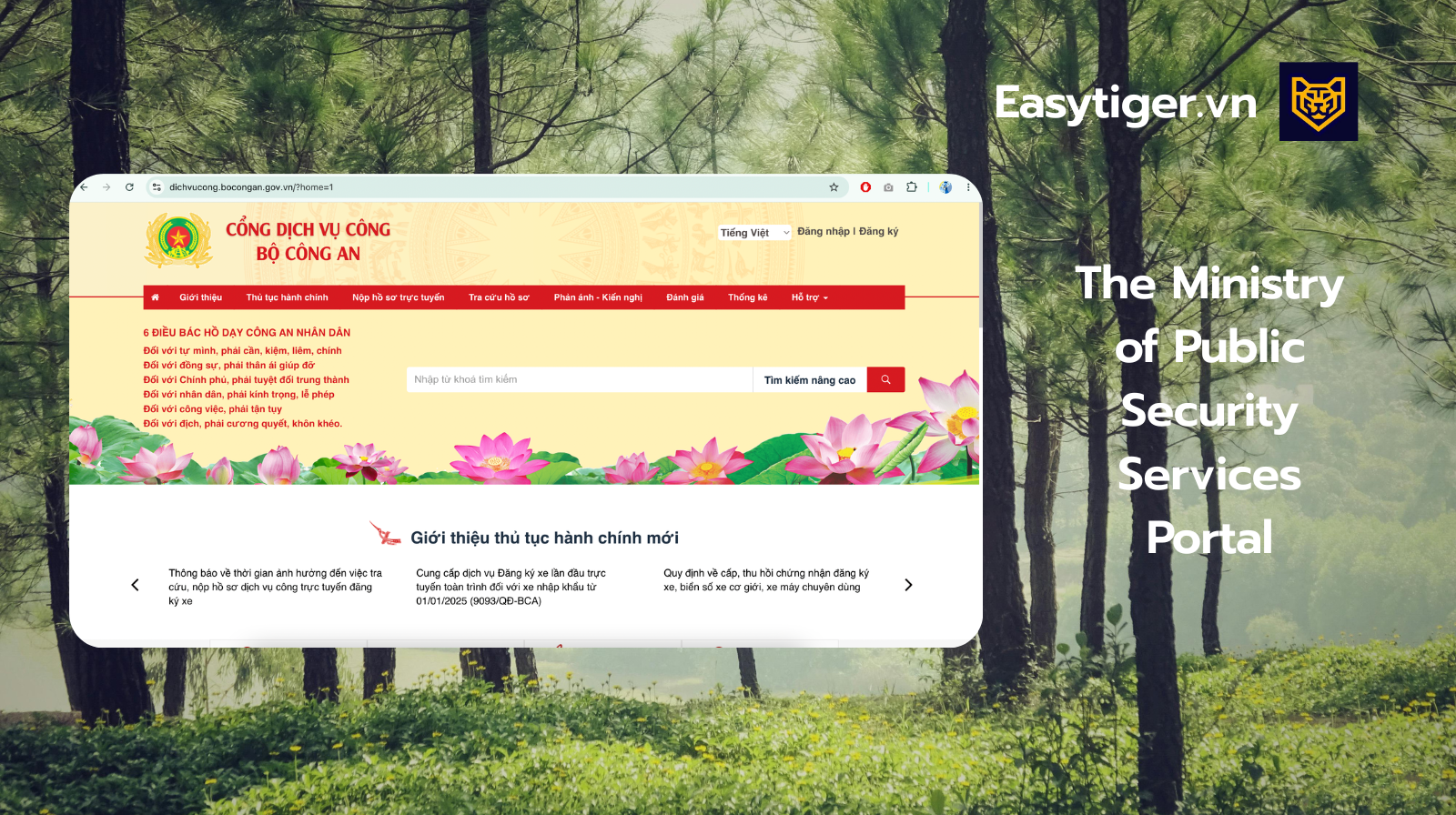
The Ministry of Public Security (Bo Cong An) operates its own dedicated public services portal at dichvucong.bocongan.gov.vn, separate from the national Public Service Portal at dichvucong.gov.vn. While the national portal handles administrative procedures across all ministries and provinces, the MPS portal is specialized: it covers only procedures under police jurisdiction, with some of the key service categories below.
ID and Citizen Cards (Cap, Quan Ly Can Cuoc): Covers the issuance, renewal, and replacement of the Can Cuoc citizen identity card for Vietnamese nationals aged 14 and above. Applications and status tracking are fully available online.
Criminal Records (Ly Lich Tu Phap): The dedicated channel for criminal record certificates, also known as Police Clearance Certificates, which are required for work permit applications and certain other administrative procedures. From March 2025, authority over these certificates was transferred from the Ministry of Justice to the Ministry of Public Security, making this portal the correct and current source.
Residence Registration (Dang Ky, Quan Ly Cu Tru): Manages permanent and temporary residence registrations and accommodation declarations for Vietnamese citizens and foreign nationals. For foreigners, since July 24, 2026 (Circular 87/2026/TT-BCA), the accommodation establishment must declare the foreigner's temporary residence on the Ministry of Public Security's electronic residence declaration system as soon as the foreigner arrives. If the paper form is used instead, it must reach the commune police within 12 hours (24 hours in remote areas).
Immigration Administration (Quan Ly Xuat Nhap Canh): Covers passport issuance for Vietnamese citizens, exit and entry permit processing, and certain immigration-related filings for foreign nationals and their sponsoring organizations.
The MPS portal offers a wide range of online public services across these categories. Most services require VNeID login, and the portal is fully integrated with the national digital identity layer. While many procedures can now also be initiated through the National Public Service Portal (dichvucong.gov.vn) or directly via the VNeID app, the MPS portal remains the authoritative source for police-administered procedures.
Who needs it, and when
For expats and foreign employees, the most common use case is the criminal record certificate for work permit applications. This is required for nearly every initial work permit and for renewals in many cases. HR teams managing multiple foreign hires should build this into their work permit preparation timeline early. For a work permit application, the certificate must have been issued no more than six months before the application is submitted, so time your request accordingly.
For businesses and organizations that accommodate foreign staff or clients in private accommodation, the residence declaration function is relevant. Hotels and other accommodation establishments must actively declare each foreign guest, and if you are managing apartments or serviced offices for foreign employees, someone in your team needs to be registered on the Ministry of Public Security's residence declaration system to submit accommodation declarations.
For Vietnamese citizens, this portal is the first stop for ID card applications, residence changes, and passport applications.
How to access
Visit dichvucong.bocongan.gov.vn. For most services, login via VNeID is now required. If you are a foreign national applying for a criminal record certificate, online filing requires a Level 2 electronic identification account. Without one, you can apply in person or by post to the relevant provincial police authority.
7. National Business Registration Portal: Your Starting Point for Company Setup
What it is and who runs it
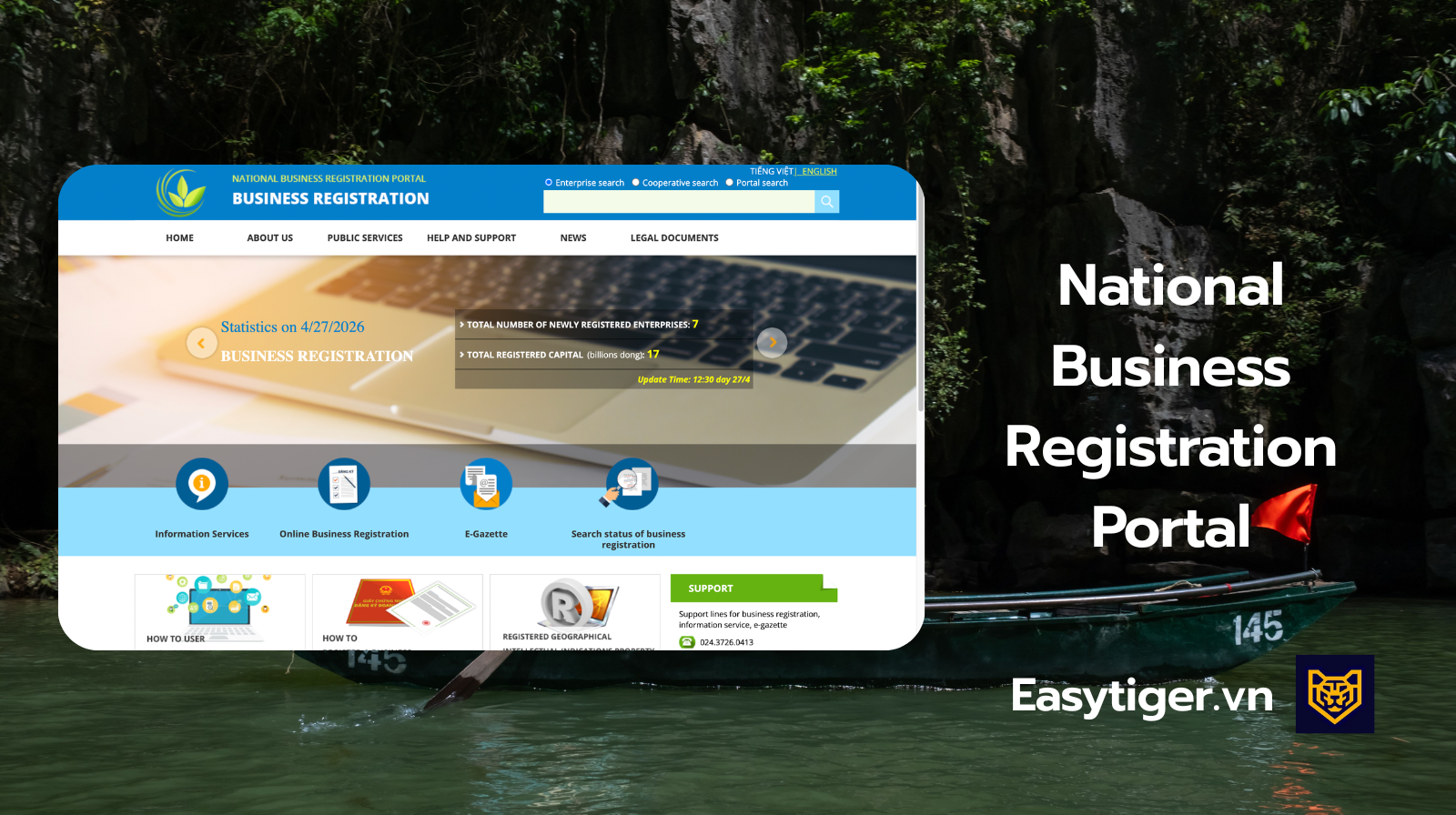
The National Business Registration Portal, known as the NBRP and accessible at dangkykinhdoanh.gov.vn, is run by the Ministry of Finance. It is the official platform for registering companies, updating business information, filing structural changes, and looking up the registration status of any enterprise operating in Vietnam.
The portal is also a useful due diligence resource. A company's name, business registration number, registered address, business lines, name of the legal representative, legal status, and branch information are all publicly accessible and free to search. Before signing a significant contract or entering a joint venture with a Vietnamese or foreign-invested entity, a quick search here is a sensible first step.
Who needs it, and when
If you are setting up a business in Vietnam, this is where your company comes into legal existence. If you are changing your business scope, adding a branch, replacing your legal representative, or increasing charter capital, the updates go through here. If you are checking whether a supplier's company is active and legitimate, this is where you verify.
For foreign investors, the NBRP is where the Enterprise Registration Certificate (ERC) is issued. Foreign-invested companies have typically also needed an Investment Registration Certificate (IRC) before the ERC, but the sequence depends on the current investment law (Law 143/2025/QH15, in force since March 1, 2026), so check what applies to your project before you start. The ERC serves as the company's primary business license. Without it, the company cannot legally operate, open bank accounts, hire employees, or register for tax.
Eligibility and how to access
Under Decree 168/2025/ND-CP, online business registration through this portal requires an electronic identification account. Since July 23, 2026 (Decree 296/2026/ND-CP), login goes through the National Public Service Portal or the VNeID app.
Putting It Together
Between Part 1 and Part 2, you now have a working map of Vietnam's digital government landscape. VNeID is the identity backbone. Cong Dich Vu Cong is the central service window. The immigration portal manages your legal status here. VssID tracks your social insurance. eTax handles your financial obligations. The MPS portal covers police-administered procedures and clearance. The NBRP is where your business begins and stays on record.
None of these portals operate in isolation anymore. They share data, they authenticate through the same VNeID layer, and a gap in one can create a problem in another. The system is more connected than most people realize, which works in your favor when everything is in order, and against you when something is not.
Setting up VNeID correctly and early is the single most efficient thing you can do to get ahead of the compliance requirements that follow. Everything else can be handled methodically from there.
If you need support navigating any of these platforms or the compliance requirements behind them, Easytiger connects you with verified legal and compliance specialists who work in this system every day.
This article is for informational purposes only and does not constitute legal, tax, or compliance advice. Regulations and platform requirements in Vietnam are subject to change. Always verify current requirements with a qualified specialist for your specific situation.
Frequently asked questions
Need Expert Advice?
Connect with verified legal, tax, and business specialists in Vietnam.
Find a Professional