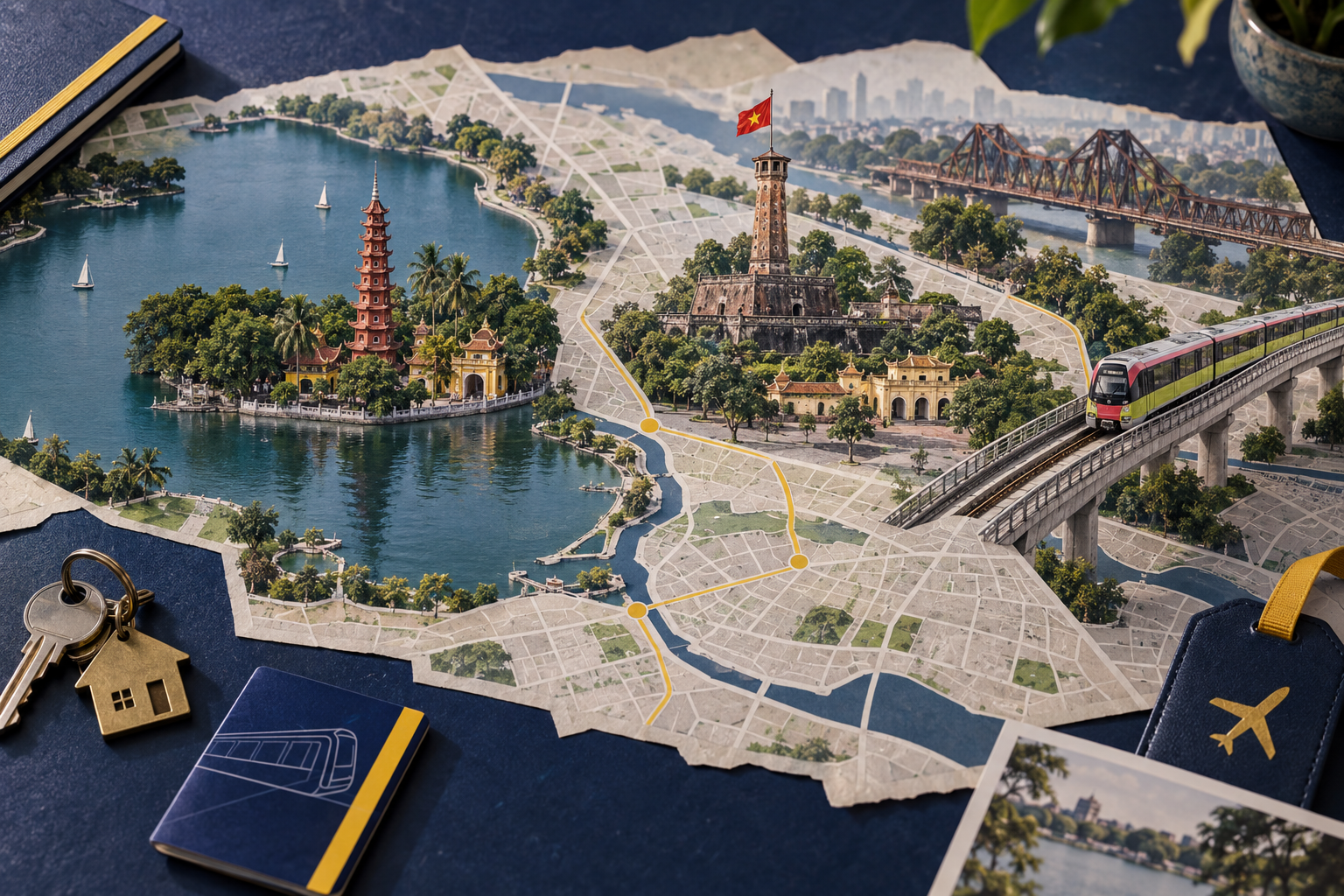
Why Vietnam's capital appeals to foreign professionals, families and small business owners, plus where to live and what to budget
In this article10
Hanoi does not usually sell itself in one dramatic moment. It happens slowly: breakfast pho before work, a meeting in a narrow coffee shop, an evening beside West Lake, or the first cool autumn day after a long summer.
For foreigners moving to Vietnam, the capital offers a different proposition from Ho Chi Minh City's commercial speed or Da Nang's coastal ease. You can compare neighborhoods and rental costs in our Ho Chi Minh City guide and Da Nang guide. In fact, Hanoi is the country's political centre, a major northern business hub and a city where history still shapes daily life. The real question is which part of the city will support your work, family and routine.
Why move to Hanoi?
A capital whose history is still visible
In 1010, Emperor Ly Thai To moved the imperial capital to Dai La and renamed it Thang Long. The city's political importance continued through successive dynasties and into the modern era. Hanoi's official portal describes the Imperial Citadel as a heritage complex containing cultural layers built over more than a thousand years, alongside later revolutionary sites. You can see that continuity in the Thang Long Imperial Citadel, the Temple of Literature, old communal houses, pagodas, French-era villas and the street pattern of the Old Quarter.
History is part of ordinary life. Pho, bun cha, cha ca, banh cuon and egg coffee remain everyday food, not just visitor attractions. Small businesses operate from old shophouses, modern towers and family homes, often within a few kilometres of one another.
Hanoi also has real seasons. Spring is mild but humid, summer is hot and wet, autumn is often the most comfortable period, and winter can feel colder than the temperature suggests because homes are not always well insulated. Air quality can worsen during parts of the cooler season, while intense rain can expose drainage problems. When viewing an apartment, check ventilation, heating or reverse-cycle air-conditioning, window seals and any history of water ingress.
Geography and a northern economic base
Hanoi lies in the Red River Delta, at approximately 20°34' to 21°18' north and 105°17' to 106°02' east, with an area of about 3,360 square kilometres. Following the 2025 provincial consolidation, the capital borders Phu Tho to the west and northwest, Thai Nguyen to the north, Bac Ninh to the east, Hung Yen to the southeast and Ninh Binh to the south.
That position matters to a founder or consultant. Ministries, embassies, universities, banks and major Vietnamese groups are concentrated in the capital, while nearby industrial centres are reachable for meetings and supplier visits.
The latest full-year figures on Hanoi's official economic dashboard show GRDP growth of 8.16% in 2025, with services accounting for 66.44% of the economy. Those numbers do not make every business easy, but they explain why Hanoi remains important for professional services, technology, education, trade and public-sector work.
A better-connected city, but commute still comes first
Hanoi has two urban railway services in operation. Line 2A runs between Cat Linh and Yen Nghia through Dong Da, Thanh Xuan and Ha Dong. The operating part of Line 3 runs from Nhon to Cau Giay. Hanoi's People's Council confirmed in September 2026 that these are the city's two operational rail lines; the underground section from Cau Giay toward Hanoi Station is still a project, not a commuting option you should count on. See the official urban-rail oversight update.
Noi Bai International Airport is the northern international gateway, with nonstop services to major regional hubs such as Bangkok, Singapore, Kuala Lumpur, Seoul, Tokyo, Taipei and Hong Kong. Schedules change, but the underlying connectivity is substantial. The Government reported that Noi Bai handled more than 30 million passengers in 2024 and continued adding international connections in early 2025. Government information on Noi Bai.
For weekends, Hanoi is a practical base for Hai Phong, Ha Long, Cat Ba and the northern mountains. Sa Pa, Cao Bang and the Ha Giang highlands need more time than a casual day trip, but they are realistic long-weekend destinations. Road conditions and travel times vary sharply by season. If you ride a motorbike, confirm that your licence and vehicle category are valid in Vietnam before leaving the city.
Where to live in Hanoi in 2026
Since July 2025, Hanoi has operated with 51 wards and 75 communes under the two-tier local-government model. Names such as Tay Ho, Ba Dinh and Dong Da are used below as familiar residential areas, not as a claim that the former districts still operate administratively. The change is recorded in Hanoi's summary of Resolution No. 1656/NQ-UBTVQH15.
The figures below are planning ranges for a furnished, modern one-bedroom apartment, checked against active listings across several major property platforms in September 2026. Total budgets assume one adult, utilities, mixed local and international food, ordinary transport and moderate leisure. Deposits, private insurance, international-school fees and premium serviced apartments are excluded.
1. Tay Ho and West Lake: the easiest international landing
Known for: International services, lakeside living, restaurants, cafes, gyms and family-oriented amenities.
Tay Ho is often the smoothest first base for remote workers, couples and families who want English-friendly services close at hand. Quang An and the Xuan Dieu corridor are highly international, while other streets around the lake can feel more residential.
Advantages: Easy social entry, broad dining choices and housing designed for foreign tenants.
Disadvantages: Higher rents, peak-hour congestion, uneven walkability and flood risk on some low-lying streets. It can also become an expat bubble if you do not make an effort to engage with the wider city.
Planning cost: Around VND 13 to 24 million monthly for a modern one-bedroom, or VND 30 to 50 million for a comfortable single-person lifestyle.
2. Ba Dinh and Truc Bach: central, established and diplomatic
Known for: Government institutions, embassies, mature streets, historic sites and a quieter central atmosphere.
Ba Dinh suits diplomats, NGO staff, executives and families who need central access without living inside the Old Quarter. Truc Bach adds a compact lakeside area with local restaurants and cafes.
Advantages: Central position, a strong mix of local and international life, and convenient access to Tay Ho and Hoan Kiem.
Disadvantages: Housing quality varies, nightlife is limited, and traffic controls near official sites can occasionally affect routes.
Planning cost: About VND 12 to 21 million for a modern one-bedroom, with VND 27 to 43 million as a practical total monthly budget.
3. Cau Giay and My Dinh: newer housing and western workplaces
Known for: Apartment towers, offices, universities, shopping centres and access to Hanoi's western business areas.
This side of Hanoi works especially well if your office, school or clients are in the west. Selected addresses also benefit from the operating Nhon to Cau Giay metro section. My Dinh has a visible Korean business and residential presence.
Advantages: Newer buildings, more choice at mid-range prices and better access to western employment centres.
Disadvantages: Construction, wide roads and rush-hour traffic can make the area feel functional rather than intimate. Amenities are dispersed, so compare the exact building location, not only the area name.
Planning cost: Roughly VND 10 to 18 million for a one-bedroom and VND 24 to 39 million in total each month.
4. Dong Da: central convenience with a local rhythm
Known for: Universities, dense local food, established residential streets and access to Line 2A.
Dong Da is a useful middle ground for academics, students and professionals who want everyday Hanoi while remaining near the centre. It usually offers better value than West Lake.
Advantages: Excellent food, central access and a lived-in neighbourhood atmosphere.
Disadvantages: Noise, motorbike traffic, limited parking and inconsistent building quality. Always inspect the specific lane after dark and after heavy rain.
Planning cost: Around VND 9 to 17 million for a modern one-bedroom and VND 23 to 37 million for total monthly spending.
5. Long Bien: more space for family life
Known for: Planned compounds, larger homes and quieter residential areas east of the Red River.
Long Bien can suit families who value pools, playgrounds, security and space more than a central address. Large developments offer a self-contained lifestyle, and the area is practical for some schools and workplaces east of the centre.
Advantages: More space and newer family housing for the money.
Disadvantages: Bridge traffic can turn a short map distance into a long commute, and life outside planned developments is less walkable.
Planning cost: Around VND 9 to 18 million for a one-bedroom and VND 23 to 39 million overall. Villas and larger compound homes are a separate, much higher market.
6. Hoan Kiem and the French Quarter: culture at your door
Known for: Hoan Kiem Lake, heritage architecture, street food and Hanoi's most walkable cultural core.
This area rewards people who actively want the city's historic energy. The French Quarter generally feels calmer than the Old Quarter and can work for hospitality professionals or a shorter first stay.
Advantages: Exceptional centrality, culture and food within walking distance.
Disadvantages: Limited modern inventory, noise, tourism, small floor plans and difficult parking. The Old Quarter is rarely the easiest long-term choice for a family or home-based professional.
Planning cost: Approximately VND 13 to 26 million for a good one-bedroom and VND 29 to 50 million for total monthly costs.
Choose the commute before the postcode
Ha Dong and Duong Noi can offer newer homes and lower rents, and Line 2A makes selected locations practical. They are less compelling if your work, school and social life are around West Lake or Hoan Kiem. The same rule applies everywhere: a cheaper apartment becomes expensive when every day starts with a long cross-city journey.
Hanoi is a strong fit if you value history, northern food, seasonal change, professional access and weekend routes into northern Vietnam. Think more carefully if air quality, damp winters, traffic or a highly international environment are decisive concerns.
Before signing a long lease, stay in the target area for at least a week. Test the commute at rush hour, check mobile coverage and internet options, inspect the building after rain, ask which costs are included, and confirm that the landlord can support the residence-registration process required for foreign tenants. The best Hanoi neighbourhood is not the one with the loudest reputation. It is the one that makes your ordinary Tuesday work.
Editorial note: Rental and living-cost figures are non-official planning estimates compiled from a cross-check of current market listings in September 2026. They are intentionally presented as ranges because building age, furnishing, services, lease length and negotiation can materially change the final price.
Frequently asked questions


Easytiger Match
Find the right professional
- Tell us what you need
- We shortlist professional(s) and introduce them to you